Well before the latest wave of protests in Iran, Saeed, a tech entrepreneur in Tehran, was ready for them.
For months, it felt as if he and his country were in free-fall. He had spent many sleepless nights since Israeli forces battered Iran’s nuclear facilities in June agonizing over his family’s future and whether more war was inevitable. A deepening economic crisis forced him to lay off his employees. All the while, Iran’s plummeting currency was evaporating his savings.
“I made my decision to join before these protests even took place,” said Saeed, who asked to withhold his full name, fearing retribution from the authorities.
“I am tired and exhausted by the fools and idiots that get to govern us,” he said. “I am tired of their theft, corruption and injustice.”
On Dec. 28, the Iranian rial plunged to an all-time low against the U.S. dollar, and unleashed the wave of anger Saeed had been expecting.
Within hours, shopkeepers in Tehran’s bazaars — the historic heart of Iran’s economy — organized a strike and took to the streets.
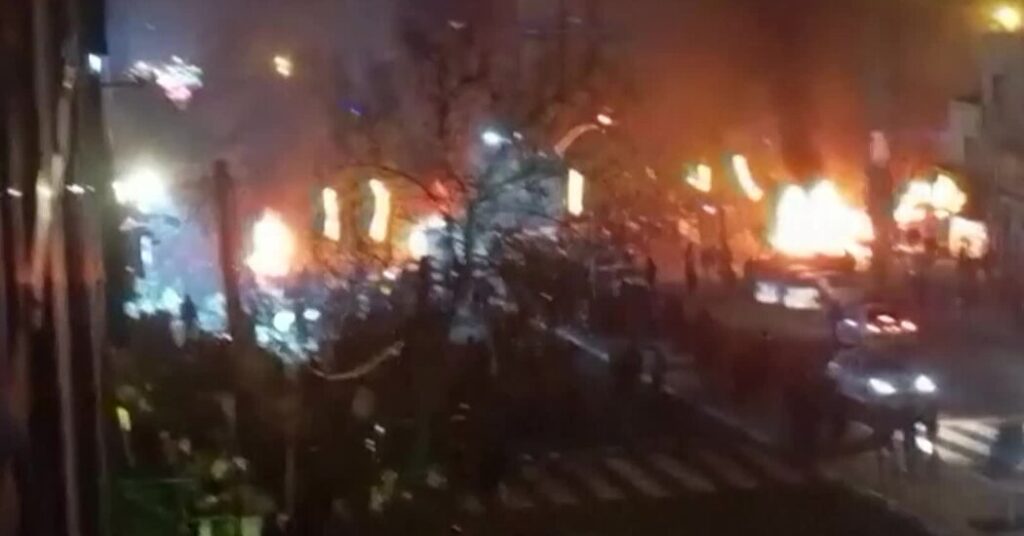
Over nearly two weeks, protests have spread from the markets and universities of major cities to the impoverished towns in Iran’s hinterland, killing dozens, according to rights groups.
The protests come at a precarious moment for Iran’s authoritarian government. Already weakened by its international foes, it now faces domestic unrest drawing an ever broader spectrum of the population.
Over more than a decade — in 2009, 2019, 2021 and 2022 — Iranians have taken to the streets against their theocratic rulers. In all those movements, security forces prevailed with brutal crackdowns.
Yet each of the 10 protesters interviewed by The New York Times by phone — all of whom requested to withhold surnames for their safety — said these protests felt far more dangerous to the Islamic Republic.
“We can see from the news and from some government reactions that this regime is terrified to its bones,” said Sahar, 33, a protester in Tehran.
Domestically, the widespread demonstrations of 2022, known as the “Women, Life, Freedom” movement, rebelled against social repression, like the mandatory hijab, but they barely mobilized poorer, conservative Iranians. Today’s protests, spurred by economic pain, brought the poor and middle class alike to the streets.
Beyond its borders, Iran — once the linchpin of a powerful network of anti-Western forces — has seen its regional power rapidly diminish over the past two years, as Israel decimated its regional allies, Hezbollah and Hamas.
In late 2024, rebels toppled President Bashar al-Assad of Syria, one of Iran’s most important partners. And last June, Israel launched a 12-day war, briefly joined by U.S. warplanes, that killed top security officials, battered nuclear facilities and degraded military infrastructure.
With nuclear negotiations at an impasse, sanctions reimposed by both the United States and Europe have sunk Iran’s economy to new lows.
The pressure was compounded by decades of financial mismanagement and the rise of a corrupt elite, economists say, fueling a growing wealth disparity.
Iranian authorities have struggled to find a cohesive response, oscillating between expressions of sympathy for economic grievances with vows to deal harshly with “rioters” they accuse of aligning with “foreign enemies.”
Despite heavy losses during the June war, Iranian authorities still have an enormous, largely intact security apparatus. But they must choose how to respond, knowing that Israel and the United States, which have expressed support for the protests, could try to intervene.
“Everyone should know that the Islamic Republic came to power through the blood of several hundred thousand honorable people,” the supreme leader, Ayatollah Ali Khamenei, said in a speech on Friday. “In the face of those who engage in destruction, the Islamic Republic will not back down.”
A Weakening Economy
The Dec. 28 currency crash enraged shopkeepers, who were already reeling from months of currency depreciations that kept prices changing daily.
Over the past decade, inflation has lingered above 40 percent.
“People’s income is a third to a fourth of what it was,” said Mahdi Ghodsi, an economist with the Center for Middle East and Global Order.
That the protests started with bazaar merchants added momentum symbolically — they initiated the protests that led to Iran’s 1979 revolution — but also practically, said Esfandyar Batmanghelidj, the head of the economic think tank the Bourse and Bazaar Foundation.
“In order to organize a protest, you need to be networked, and you need to be able to afford to partake in protests,” he said. “This is what makes bazaaris different from other social groups. They can all agree to shut their shops and take to the streets.”
Instagram accounts of merchants who previously stuck to advertising their wares, like “mom jeans” and leather jackets, began posting images of the labyrinthine market’s empty alleyways and protesters swarming thoroughfares.
“We all want to make money. But that is not possible anymore with these prices. We feel ashamed to tell customers the new prices,” one clothing vendor wrote on the second day of protests.
A few days later, he posted a video of shuttered shops overlaid with the words, “Freedom for Iran.”
The protests quickly broadened into still bolder demands: “Death to the dictator,” protesters chanted. “Death to Khamenei.”
Some chants even began calling for the return of the Pahlavis — the royal family Iranians deposed in 1979.
The extent of monarchist sympathies, or even the size of these protests, is hard to ascertain. It is difficult for foreign journalists to enter the country. And inside Iran, residents are grappling with internet blackouts and fierce censorship while being inundated with manipulated videos and disinformation campaigns.
Videos verified by The Times indicate protests growing across the country over the past week. A video from Yasuj, in the south of Iran, shows protesters being dispersed with tear gas through a busy road.
And in the northeastern city of Mashhad, a video from Jan. 6 shows protesters marching down a busy street. Similar scenes played out in Bojnord, a city close to the northern border with Turkmenistan, the next day.
A Muddled Regime Response
As merchants shuttered Iranian marketplaces, students launched protests on university campuses.
At Shiraz University in southwest Iran, students planned for protests by communicating in code in chat groups previously used to discuss class work, according to three students who would not give their names for fear of retribution.
On the first evening, one student said, the campus protesters burned a flag of the Islamic Republic.
University officials locked the dormitory gates the next night to try to prevent students from joining protests, but many simply climbed the back fence and demonstrated again, the students said.
By the third night, security forces arrived, seeking dialogue over potential government reforms, the students told The Times in an interview.
The youths refused, the students said — they were not looking for rehabilitation. They wanted the government to fall.
After that, security forces began using batons, pepper spray and stones, two students said. The students kept protesting anyway.
From the start of the protests, Iran’s president, Masoud Pezeshkian, tried to react quickly and with empathy. He replaced the central bank governor, and publicly acknowledged the economic pain protesters were feeling.
He also ordered a monthly payment for Iranians roughly equivalent to $7 — still a far cry from the drastic changes economists say are needed.
“If people are dissatisfied, we are to blame,” Mr. Pezeshkian said last week during a visit to southwestern Iran, according to the state-run IRNA news agency. “Do not look for America or anyone else to blame.”
But then, the Trump administration launched a stunning operation to seize Venezuela’s president, Nicolás Maduro.
After the capture, President Trump doubled down on threats against the government: “If they start killing people like they have in the past, I think they’re going to get hit very hard by the United States.”
Yet Mr. Khamenei remained defiant. Warning against foreign meddling, he insisted that “rioters must be put in their place.”
Protests Turn Deadly
Around the country, the crackdowns became more violent.
In the town of Shahrekord, near the historic city of Isfahan, a video verified by The Times showed protesters screaming as the police sprayed a young woman down with a water hose.
Despite the risks, several protesters interviewed by The Times described demonstrators as increasingly emboldened.
“People have become much braver than in previous protests,” said Saeed, the tech entrepreneur. “They are using any tool and location at their disposal and available to them.”
On a street in Shiraz, videos verified by The Times showed the police assaulting and beating a man on the ground. When protesters threw projectiles at the police, officers moved toward them on motorcycles. Moments later, a protester doused one officer with gasoline and set him alight.
The economic suffering has particularly fueled unrest in rural provinces and border areas, home to impoverished communities and marginalized ethnic minorities.
On Jan. 3, security forces in the western border province of Ilam shot at protesters trying to approach a government building, according to two Kurdish rights groups. The rights groups’ death toll ranged from three to five.
“Either we die, or we get out of these terrible conditions we are living under,” said Ali, 40, a protester. “There is no way these protests calm down. There is no way, this time, that they can stop us.”
Iran’s state media also reported deaths at the protests, without offering any explanation, but said some demonstrators were armed. And since then, the semiofficial news agency Fars reported two police officers killed by gunmen in another area, the southwestern town of Lordegan.
Ali and another protester in Ilam who spoke to The Times said there were dead and wounded on both sides.
A day after the violence in Ilam, the demonstrators said, security forces stormed a hospital where protesters had sought treatment.
In one video from the hospital, verified by The Times, men dressed in riot gear gathered outside as a woman shouted to them, “Security forces, support us!” Instead, they burst through the glass doors as she screamed.
The hospital images outraged Iranians and seemed to mark a turning point. The next night, protesters poured onto Ilam’s streets. Videos from one town in the province, Abdanan, showed crowds streaming onto a main thoroughfare as security forces on rooftops looked on above, unable or unwilling to respond.
That hesitant reaction is something several protesters across the country said they had noticed as protests began gathering steam.
“Security and law enforcement people are facing the same economic issues and high prices, themselves,” said Sahar, the Tehran protester. “They are not fighting back wholeheartedly.”
On Thursday, the government imposed a sweeping internet blackout, and the protests took a deadlier turn.
On Friday, Tehran’s prosecutor announced that “terrorists” involved in the unrest could be sentenced to death, and a statement from Iran’s Supreme National Security Council vowed to “show no leniency whatsoever toward saboteurs.”
Such warnings may hang heavy over many Iranians, wary of upheaval that could destroy their public institutions, said Mr. Batmanghelidj, the economist. Iranians are keenly aware of the relative stability that has set their country apart from so many of its neighbors that have been devastated by uprisings and civil war.
“They are faced with this daunting question,” he said. “Can you have a revolution without burning it all down?’
Sanjana Varghese is a reporter on The Times’s Visual Investigations team, specializing in the use of advanced digital techniques to analyze visual evidence.
The post Inside Iran’s Protests: How a Plunging Currency Set Off Wide Unrest appeared first on New York Times.