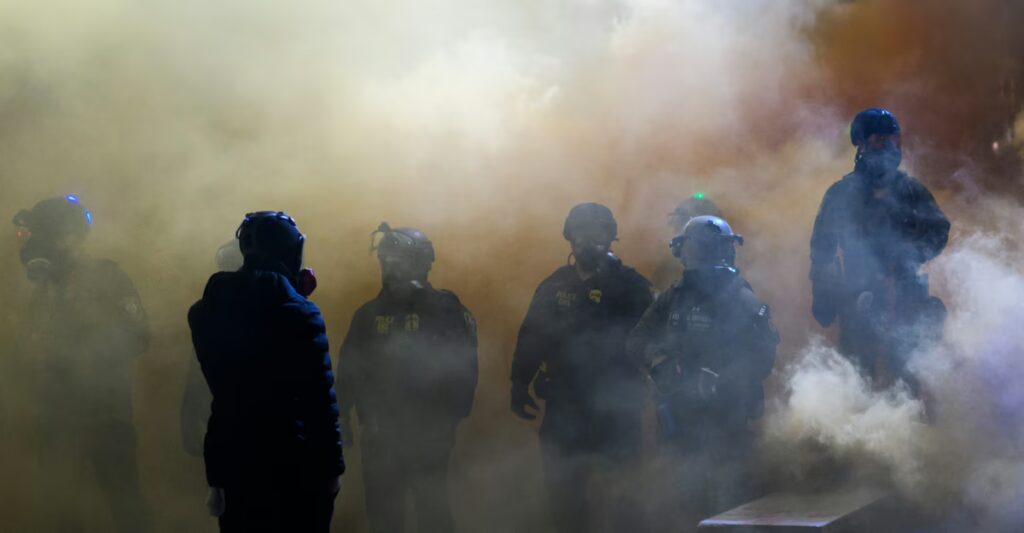
This is an edition of The Atlantic Daily, a newsletter that guides you through the biggest stories of the day, helps you discover new ideas, and recommends the best in culture. Sign up for it here.
On Wednesday, an ICE officer shot and killed Renee Nicole Good, a mother of three and a U.S. citizen, in the streets of Minneapolis. She was at least the fourth person shot and killed by immigration-enforcement officers during Donald Trump’s second term. Two more people were shot yesterday when a Border Patrol officer fired at a car during a traffic stop in Portland, Oregon; their condition remains unknown.
As my colleague Caitlin Dickerson explains in her latest story, the president and his advisers have exerted “overwhelming pressure” on immigration enforcement. The White House has “pumped out rhetoric and imagery that celebrates the merciless, military-style pursuit of deportations,” she writes. “The overall message to employees, including those who carry weapons, is that anything goes.” Last year, the administration effectively kneecapped three offices meant to protect the public from misconduct: the Office for Civil Rights and Civil Liberties, the Citizenship and Immigration Services Ombudsman, and the Immigration Detention Ombudsman. Good’s killing is now being handled exclusively by Kash Patel’s FBI, and local investigators have been barred from accessing evidence.
I spoke with Caitlin, who won a Pulitzer Prize in 2023 for her immigration reporting, about how the Trump administration is encouraging aggressive enforcement tactics while also scaling back oversight.
Will Gottsegen: To what extent is ICE no longer subject to some of the guardrails that once helped keep it in check?
Caitlin Dickerson: Formally and informally, since Donald Trump took office, there’s been this push away from transparency and accountability, which is exactly what would discourage an officer in a tense situation, under pressure, from using deadly force. We still need to learn a lot more about what happened in Minnesota and Portland, and an investigation needs to transpire, but we do know that ICE officers shot more people last year than in 2023 and 2022. There are clear examples of how training and policy seem to have been violated in some recent incidents. So I think the fact that these three offices for accountability are going away is significant in that it’s sending a message to everyday officers that they’re not being watched as closely as they once were and, in fact, that the only thing they can really get in trouble for is not being aggressive enough.
There has been a constant churn within leadership. In addition to high-level reassignments, a significant number of field-office directors were replaced with Border Patrol leadership, who are perceived to be more aggressive. Former officials who spent their whole careers at ICE told me that they don’t recognize the agency anymore. They said things like: I don’t know who these people are anymore, because the standards seem to have changed so much. It’s almost become a completely different agency with a completely different mission.
The pressure that ICE officers are facing is unprecedented, and it’s not just the pressure to carry out as many deportations as possible—the administration is actually celebrating aggression. When you look at its statements, the memes, and the imagery that it’s publishing, all of these signs seem to be encouraging officers to be as aggressive as possible. There’s no emphasis on trying to minimize harm.
Will: How does this pressure on ICE officers affect immigration-enforcement operations?
Caitlin: The kinds of conflicts that we’re seeing on social media every day are not what typical immigration enforcement looks like at all. It’s not what officers are trained to do, and it’s not what veteran officers have any experience with. Normally, with law enforcement, the goal is to have things happen as discreetly as possible: without tension, without conflict, without getting a lot of attention and disrupting the general public. And immigration enforcement looks the opposite of that right now. In the case of Minneapolis and Portland, law-enforcement training 101 says, Do not shoot into a moving vehicle. A retired officer I spoke with today told me what he would have done in that situation: “I’m going to follow them until I get them somewhere where I can control the environment.” Not taking those kinds of precautions could be dangerous for the officers and for people nearby.
Will: Minnesota Governor Tim Walz has said that he’s skeptical that the FBI is going to be able to do an impartial investigation, because multiple federal officials have already adopted the party line that Renee Good got herself killed. The vice president blamed “left-wing ideology” for her death. Do you anticipate that the investigation will be affected by political interests?
Caitlin: It’s going to depend on who’s put on the investigation but also which high-level officials get to review and sign off on any assessments before they’re made permanent and public. What we do know is that there are numerous examples of law-enforcement work being co-opted for political purposes under this administration, specifically under Kash Patel’s FBI, which has at times prioritized going after the president’s enemies and critics despite what the facts show. I think there is cause for concern, making it even more important that certain oversight offices have been eliminated from within the Department of Homeland Security. Historically, the FBI may have done the first investigation, but ideally an objective inspector general would have come in next, followed by the ICE Office of Professional Responsibility and then the Office for Civil Rights and Civil Liberties. There were lots of layers to get to the truth and to mitigate any political bias. And those extra layers are effectively gone now.
Related:
Here are three new stories from The Atlantic:
- The hole in Trump’s rationale for acquiring Greenland
- Peter Wehner on Trump’s folly
- Autocracy in America: Federal agents are violating the rights of Americans.
Today’s News
- The U.S. Coast Guard seized a fifth oil tanker in the Caribbean as part of the Trump administration’s effort to take control of Venezuela’s oil industry. The ship was sanctioned by the United States for its role in transporting Russian oil.
- Iran’s supreme leader, Ayatollah Ali Khamenei, said that the government would not back down amid nationwide protests sparked by a currency collapse, calling demonstrators “vandals” and dismissing Donald Trump’s pledge to intervene if protesters are killed.
- U.S. employers added 50,000 jobs last month and the unemployment rate fell to 4.4 percent, but hiring across 2025 was the weakest it’s been in five years, according to data from the Bureau of Labor Statistics.
Dispatches
- The Books Briefing: Boris Kachka explores what a fantasy can reveal about real life.
Explore all of our newsletters here.
Evening Read

How Sweetgreen Became Millennial Cringe
By Ellen Cushing
Last spring, Sweetgreen did something shocking, at least insofar as the menu adjustments of a fast-casual salad chain can be described that way: It added fries. In interviews, the company’s “chief concept officer,” Nicolas Jammet, paid lip service to “reevaluating and redefining fast food,” but I suspect that Sweetgreen was also “reevaluating and redefining” how to make money in a world that appeared poised to move on from buying what the company was trying to sell.
In the first two months of last year, Sweetgreen’s stock price had declined more than 30 percent …
This is remarkable because, for a golden decade or so, Sweetgreen was the future of lunch. Americans, especially ones who were youngish and worked on computers, were toting green paper bags around coastal cities (and later, smaller towns and non-coastal cities) en masse. Silicon Valley was injecting capital into a restaurant as though it were a software start-up.
More From The Atlantic
- Trump’s unexpected opportunity
- The bones of children’s mouths are being wrenched apart.
- Galaxy Brain: Can we save the internet?
- Jonathan Chait: Trump has odd views on domestic terrorism.
- The two sides of America’s health secretary
- Does Congress even exist anymore?
Culture Break

Read. A colloquial translation of Paradiso might make people actually read it, Eric Bulson writes.
Explore. By not allowing the sale of hunted venison, much of the United States is letting good meat go to waste. Yasmin Tayag tried to get her hands on some.
Rafaela Jinich contributed to this newsletter.
When you buy a book using a link in this newsletter, we receive a commission. Thank you for supporting The Atlantic.
The post ICE Wasn’t Always Like This appeared first on The Atlantic.