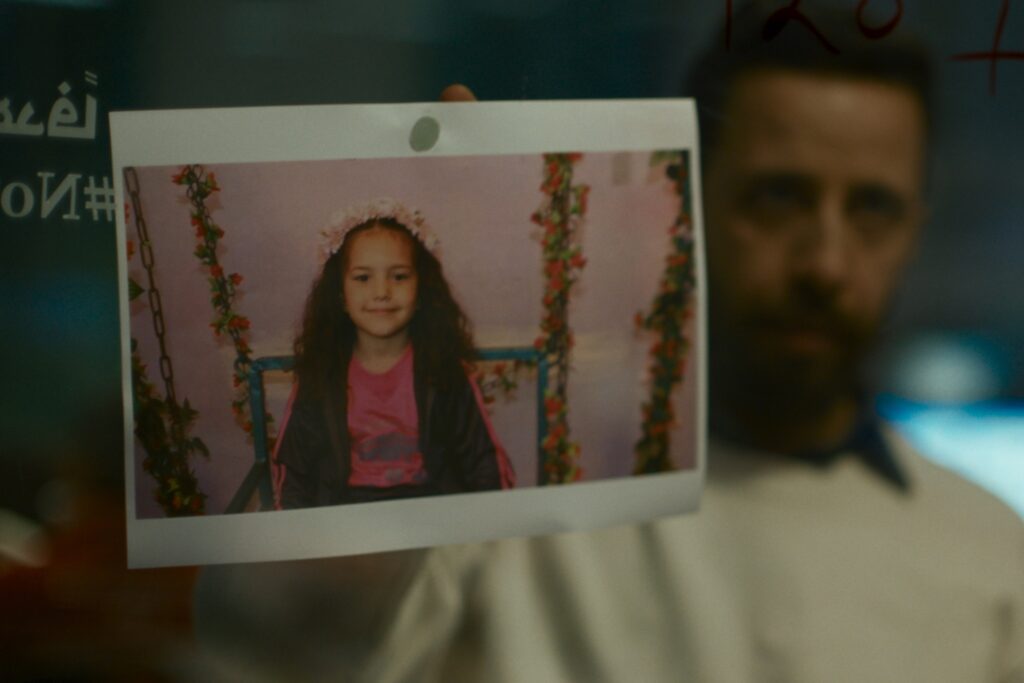
The little girl’s desperate pleas stopped Kaouther Ben Hania in her tracks.
Ben Hania, the Tunisian filmmaker behind the Oscar-nominated features “The Man Who Sold His Skin” and “Four Daughters,” was at the airport scrolling through social media in February 2024 when she came across a snippet of 6-year-old Hind Rajab’s emergency call to the Palestinian Red Crescent Society from the month before. There had been an influx of increasingly cataclysmal news out of Gaza, and Ben Hania made efforts to stay as informed as possible, but Hind’s innocent voice devastated her anew.
“It haunted me,” Ben Hania said in December at the Hyatt Regency on Capitol Hill. “It was like she was asking me to help her.”
Hind had spoken with the emergency dispatchers in Ramallah from inside her uncle’s car roughly 50 miles away, where she hid underneath a seat, surrounded by the dead bodies of her uncle, aunt and four cousins. The family had been trying to flee Gaza City when Israeli soldiers opened fire on their vehicle at a gas station, killing everyone but Hind. (The Israel Defense Forces told The Washington Post in response to an April 2024 investigation that its forces were “not present near the vehicle or within the firing range” of the car but did not comment on two detailed timelines of the incident provided by Post journalists.)
While traveling to promote “Four Daughters,” a gripping meta-documentary about a Tunisian mother whose eldest two daughters are radicalized to join the Daesh fighters in Libya, “I was asking myself a lot of questions about what it means to be a filmmaker, and a storyteller, when reality is beyond what you can comprehend and imagine,” Ben Hania said. Hearing Hind’s voice clarified her mission to help audiences see the world from a new perspective, and to aid their efforts to become more involved citizens. She quickly embarked on “The Voice of Hind Rajab,” a new film following the Red Crescent workers who received Hind’s call.
“Cinema can provide empathy,” Ben Hania said. “You put yourself in the shoes of the other.”
Similar to “Four Daughters,” for which Ben Hania hired actresses to play the women who left their family behind, “The Voice of Hind Rajab” blends fiction with reality. The newer film was shot with actors in Tunisia, where production designer Bessem Marzouk re-created the Red Crescent’s Ramallah office, but features Hind’s real voice throughout. (The Red Crescent provided Ben Hania with access to the entire 70-minute audio file.) In a scene where one of the Red Crescent workers films another as they try to rescue Hind, the live recording we see on their phone screen is real footage captured in January 2024.
Ben Hania consulted numerous journalistic investigations, including the aforementioned Post story, while researching. She led lengthy interviews with the four Red Crescent employees who appear as characters in the film: Omar A. Alqam (Motaz Malhees), the case worker who first speaks with Hind and guides the audience through the narrative; Rana Hassan Faqih (Saja Kilani), another case worker who takes turns handling the call when Omar becomes overwhelmed; Nisreen Jeries Qawas (Clara Khoury), a mental health professional who supports her colleagues while also speaking to Hind; and Mahdi M. Aljamal (Amer Hlehel), a supervisor forced to negotiate with Israeli authorities to avoid endangering the lives of his paramedics.
Aljamal had resigned from his job by the time Ben Hania spoke to him. “He was in an impossible position,” she said, noting that his role required him to play by rules that were continually violated. In the film, Omar fumes over Mahdi’s reluctance to send an ambulance to Hind without the approval of Israeli authorities, accusing him of working with the enemy. Mahdi gestures to a collection of photos on the wall, each one representing a colleague killed by Israeli forces, and says he will resign if he has to add another photo to the wall. The ambulance sent to Hind, manned by two paramedics who died trying to save her, was recovered as a “burned-out shell.”
The entire film takes place inside the Red Crescent office in Ramallah; there are no re-creations of the shot-up car or any images of bloodshed. Ben Hania played the audio of Hind’s voice in the headsets worn by the actors, all of whom have Palestinian heritage, meaning they actually listened to the girl talk about her kindergarten class, wail for her mother and realize her deceased family members weren’t just sleeping — some cast members hearing it for the first time. They took many breaks while filming.
“It was beyond performance,” Ben Hania said. “They were reacting to her voice. At some point, they couldn’t act anymore. That’s why the movie has some moments where they do nothing and only listen to the real voice.”
These creative decisions ground Hind’s story in the present tense, Ben Hania said. For many of the film’s 89 minutes, the girl is still alive and capable of being saved. The stakes remain high, keeping viewers locked in. After various screenings on the festival circuit — including the Venice Film Festival in September, where “The Voice of Hind Rajab” won the Grand Jury prize — Ben Hania has witnessed people sitting in stunned silence, while others sob nearby, before starting to applaud.
“We have showed the movie in many countries with different cultural backgrounds,” she said. “From Doha to Egypt, and now in Marrakesh, Europe and here in the U.S., the reaction is always the same. It’s always the same, very strong reaction.”
This widespread response has validated what Ben Hania and her frequent producer Nadim Cheikhrouha believed to be true from the start: Making this film was a risk worth taking. It was difficult to find funding, Cheikhrouha said in a separate interview. There were the political implications to consider, but also an element of timeliness. Ben Hania, Cheikhrouha and the rest of the team hoped to start production as soon as possible, which didn’t give potential financiers much time to think twice.
“As a producer, it was hard and it kind of felt at times like I was jeopardizing my company,” Cheikhrouha said. “But honestly [I thought to myself], ‘If I don’t do it, what does it mean to continue saying I want to produce meaningful films?’”
<b>The filmmaking process couldn’t begin until the team reached out to Hind’s mother, Wissam Hamada, who still lived in Gaza when the 6-year-old died. “She told me, ‘I don’t want my daughter to be forgotten. I want justice for my daughter,’” Ben Hania recalled of their initial phone call, adding that she received Hamada’s blessing to use the audio recording. Ben Hania consulted throughout production with one of Hamada’s close relatives when it became difficult to reach her in Gaza. The two women didn’t actually meet in person until this past November, when “The Voice of Hind Rajab” opened the inaugural Doha Film Festival. While Hamada hasn’t seen the film — “It’s too hard for her,” Ben Hania said — she told the filmmaker she was comforted by the audience’s emotional response, similar to how she felt speaking to Ben Hania for the first time.
“She told me, ‘When I was in Gaza, because every Gazan is living in tragedy, it’s very difficult to console each other. We’re in survival mode,’” the filmmaker said. “She loves meeting people after and talking to them. It’s like sharing her pain.”
Ben Hania spoke to The Post a year after shooting the film, and a few hours before a screening in Washington hosted by House Reps. Sara Jacobs (D-California) and Delia C. Ramirez (D-Illinois). The next day, Ben Hania was scheduled to show the film at the United Nations headquarters in New York. “Naive as I am, I thought the Hind Rajab killing was the tipping point of this genocide,” she said, adding that she had hoped the bloodshed in Gaza would have lessened by the time the film was released.
On Jan. 8, The Post reported that Israeli attacks killed at least 250 people out of the more than 400 who have died near Israel’s demarcation line in Gaza since the U.S.-backed ceasefire in October. The U.N. and other humanitarian groups say thousands have been displaced.
While there was never going to be a right time to release this film, according to Ben Hania, there wasn’t a wrong one, either.
“I had some resistance in the beginning. People started telling me, ‘Wait.’ ‘It’s too fresh.’ ‘You can’t do a movie right now,’” she said. “But, also because [Hind’s] mother told me she wants justice, I thought, ‘Maybe if I do this movie now, it can participate in some kind of change, accountability or justice.’ Something like that. I can’t stay and wait. Wait for what?”
The post How a Gazan child’s desperate phone call inspired a must-see movie appeared first on Washington Post.