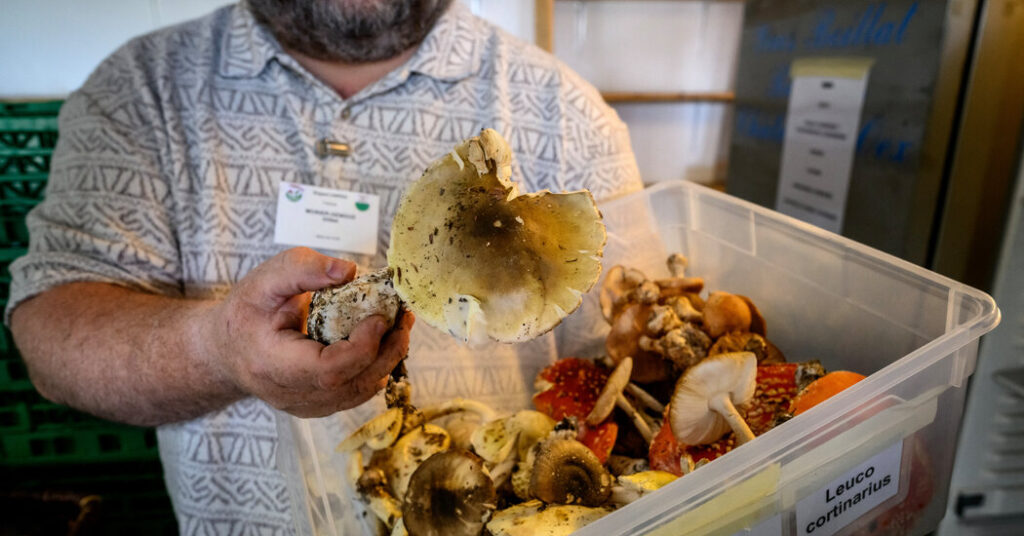
Three people in California have died and more than two dozen others have been poisoned by wild mushrooms, prompting state health officials to discourage foragers from consuming them.
A resident of Sonoma County, north of San Francisco, died last weekend after consuming wild mushrooms, the county’s Department of Health Services said on Thursday. It was the latest death in an unusually active season for mushroom poisonings in Northern California.
There were 35 cases of wild mushroom poisoning in California between Nov. 18 and Jan. 4, resulting in three deaths and three liver transplants, the Sonoma County health department said. In a typical year, the state would expect fewer than five mushroom poisonings, Dr. Michael Stacey, Sonoma County’s interim health officer, said in a statement.
Health officials have previously said the illnesses were linked to the consumption of death cap mushrooms, which contain a potent toxin known as amatoxin. Death caps are among the deadliest mushroom varieties if consumed, and can cause liver and kidney failure.
Early rains and mild fall weather have made the mushrooms abundant in Northern California, Dr. Stacey said.
Last month, an uptick in death cap poisonings prompted the California Department of Public Health to warn against foraging for wild mushrooms.
Significant mushroom poison outbreaks have been reported in the Monterey and San Francisco Bay areas, the California Department of Public Health said in a statement on Dec. 5.
In the 24 hours after consuming a toxic mushroom, people may experience diarrhea, nausea, vomiting, abdominal pain and dehydration.
These symptoms may sometimes disappear in a day, but serious or even fatal liver damage can develop within a few days, according to the Sonoma County health department.
Death cap mushrooms are typically two to six inches tall and yellowish-green in color.
“Eating wild mushrooms gathered without expert identification can be unsafe,” Dr. Stacey said. “Some harmful varieties closely resemble edible mushrooms, even to experienced foragers.”
A majority of pediatric mushroom poisonings occur in children under 6 years old, the Sonoma County health department said. Children and pets should be closely monitored if they are near areas where wild mushrooms grow.
People should eat mushrooms only from reputable grocery stores and retailers, and use caution when buying them from street vendors, the department said. Cooking, boiling, freezing or drying poisonous mushrooms does not make them safe to eat.
Mushroom poisonings are hard to track reliably, but Mycologia, a fungi-focused scientific journal, estimated in 2018 that there were about 7,400 exposures to toxic mushrooms in the United States each year.
Hannah Ziegler is a general assignment reporter for The Times, covering topics such as crime, business, weather, pop culture and online trends.
The post Death Toll From California Wild Mushroom Poisoning Rises to 3 appeared first on New York Times.