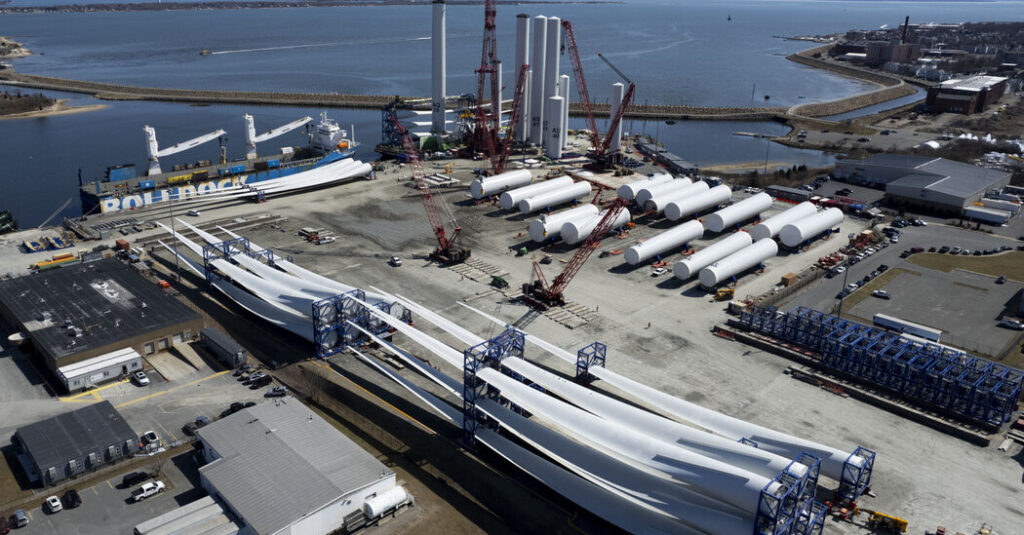
It was three days before Christmas, and Patrick Crowley was getting ready for a holiday party when he got a shocking text.
Mr. Crowley, the president of the Rhode Island A.F.L.-C.I.O., learned that the Trump administration had halted construction on Revolution Wind, a nearly completed $6.2 billion wind farm off the coast of Rhode Island that employed hundreds of his members.
Again.
The same thing had happened in August, stunning leaders in Connecticut and Rhode Island, where the wind farm was expected to power more than 350,000 homes and businesses once completed. But the two states and Orsted, the Danish energy giant behind Revolution Wind, had sued and in September a federal judge had allowed construction on the project to resume.
Months had passed since that initial disruption. Construction was now 87 percent complete, with 58 of 65 wind turbines installed.
“People at the Christmas party were really in shock,” Mr. Crowley said. “We had already gone through this in August.”
Businesses around the world have been roiled by President Trump’s sudden policy shifts. But few have had it worse than offshore wind companies.
In its abrupt Dec. 22 announcement, the Trump administration halted work on all five wind farms currently under construction off the East Coast. They are collectively worth $25 billion and were expected to power more than 2.5 million buildings and create around 10,000 jobs.
The five wind farms were pioneers in what President Joseph R. Biden Jr. had hoped would be a new era of offshore wind power in the United States. The Biden administration had vetted the projects and awarded the permits, allowing the developers to secure financing, sign contracts to sell the electricity to states and utilities, hire workers, lease equipment and begin construction.
The projects — Revolution Wind, Empire Wind and Sunrise Wind off New York, Vineyard Wind off Massachusetts and Coastal Virginia Offshore Wind off Virginia — would join two smaller operating offshore wind farms in U.S. coastal waters.
But as it did in August, the Trump administration said last month that the projects posed undisclosed risks to national security, even though the federal judge had previously rejected a similar claim.
Now, workers are idled in the middle of winter, when other construction jobs are scarce. The companies building the wind farms are hemorrhaging tens of millions of dollars a day. Some have said that if the work stoppage lasts much longer, they may have to abandon their projects altogether, absorbing billions of dollars in losses and laying off thousands of workers.
Developers of four of the five wind farms, along with the states of Connecticut, New York and Rhode Island, are suing to try to restart construction. Court hearings start on Monday and rulings could come as soon as next week.
This account of the turbulence in the country’s nascent offshore wind industry is based on interviews with more than a dozen union workers, energy lobbyists and politicians in both parties as well as a review of hundreds of pages of court filings. Some of the individuals spoke on the condition of anonymity to describe sensitive deliberations.
Several people used the word “whiplash” to describe the shifting status of the five wind farms in the Atlantic Ocean.
The Interior Department notified developers of the latest halt just minutes before Interior Secretary Doug Burgum announced it on Fox News. And Gov. Ned Lamont, a Democrat of Connecticut, found out from a call from Mr. Burgum soon afterward.
Mr. Lamont said that he told the secretary, “You’re a business guy. I thought this was a pro-business administration. This is incredibly anti-business. It’s so erratic, helter-skelter, back-and-forth, on-again, off-again.”
White House officials say their stance on offshore wind power has not changed since Mr. Trump’s first day back in office, when he issued a memorandum freezing approvals of all new wind projects on federal lands and waters. The president has repeatedly called wind turbines ugly, expensive and inefficient.
“President Trump’s position on offshore wind has been consistent for years — from his first-term actions to his campaign trail messaging to his day-one executive order that scrapped offshore wind leases,” Taylor Rogers, a White House spokeswoman, said in an email.
A brief reprieve
In the months leading up to the December stoppage, many lobbyists and executives at offshore wind companies had thought the political turmoil was over and the projects could safely proceed.
The outlook seemed stable enough for Equinor, the developer of the $5 billion Empire Wind project off the coast of Long Island, N.Y., to pour an additional $1.5 billion into the project since May, court filings show.
Trump Administration: Live Updates
Updated
- Judge bars Trump from withholding election funds to states.
- Trump calls for a 10 percent cap on credit card interest.
- Consumer bureau leader requests $145 million for an agency he wants to eliminate.
The Trump administration had paused construction on Empire Wind in April but allowed it to restart in May after weeks of negotiations with Gov. Kathy Hochul, Democrat of New York. The administration suggested it had relented only after Ms. Hochul agreed to approve new gas pipelines in the state, although Ms. Hochul has denied that such a deal was made.
Everything seemed to have returned to normal throughout the fall. Even on Friday, Dec. 19, just three days before the latest stoppage, many developers thought their projects were in the clear, according to two Republican energy lobbyists briefed on the matter.
But that day, senior administration officials met to discuss a classified report by the Defense Department that found the projects could threaten national security by interfering with radar systems, the two lobbyists said. By Monday, the administration announced it was pausing the leases that all five projects hold to build and operate in federal waters.
Representatives for Orsted and Equinor, who had been meeting regularly with officials from the Interior Department and the Coast Guard throughout the fall, were blindsided. Not once had any national security concerns ever come up, the companies both said in legal filings.
The Defense Department had repeatedly reviewed the plans for all five wind farms for years after they were proposed, and the companies had taken steps requested by the military to reduce impacts on radar systems. Dominion Energy, the developer of the largest stalled wind farm off Virginia, had paid $250,000 to upgrade military radar in the area.
Orsted, Equinor and Dominion have asked the Trump administration to give classified briefings on its concerns to representatives who hold national security clearances. But to date the Pentagon has not granted these requests, the companies said in legal filings.
“We have been clear and consistent that we are ready to address any additional national security concerns that were not already addressed over our lengthy engagement with defense agencies,” said Molly Morris, a senior vice president at Equinor overseeing Empire Wind.
“So this does come as a surprise to us,” she added, “and we have not been given access to the top secret evidence that apparently is available now.”
Orsted and Dominion declined to comment beyond what was in their public court filings.
Representative Jeff Van Drew, a Republican of New Jersey and a leading critic of offshore wind power on Capitol Hill, said he thought the national security concerns were legitimate. “If someone were to try to suggest that Trump is just using the Department of Defense as a vehicle or a tool in order to stop wind, I don’t think that’s accurate,” he said.
But experts who have researched radar interference from offshore wind farms have found that it can be addressed with technological fixes and training for boat captains.
“It is a known problem and it has been studied, but it doesn’t seem like the problem can’t be resolved,” said Frank Rusco, the director of natural resources and environment at the Government Accountability Office and an author of an April 2025 report on the topic.
From ‘dire’ to ‘near terminal’
Shutting down a partly built, multibillion-dollar wind farm in the middle of the ocean is neither cheap nor easy.
That’s because these projects involve a careful choreography of specialized workers, equipment and ships. Any delays can cause the entire timeline to unravel.
At Revolution Wind, Orsted is using a 450-foot-long ship called the Wind Scylla to install towering steel turbines. The ship is only under contract until Feb. 22 and then is scheduled to depart for other projects around the world.
Off the shores of Long Island, Empire Wind is in an even more precarious position.
Initially, the Interior Department allowed Equinor to conduct activities deemed necessary for health and safety, such as its work installing a 3,000-ton electrical substation in the ocean that would include lighting systems to help ships and aircraft avoid collisions in the area.
But the agency ordered a halt to most of these activities, too, on Jan. 5 with little explanation.
“This development turned a dire situation for Empire Wind into a near terminal one,” lawyers for Equinor wrote in a court filing. The company said that if it could not resume work by Jan. 16, it would likely have to cancel Empire Wind altogether because the vessel needed to lift the substation onto its foundations has to leave this month and would not become available for at least another year.
Three court hearings are scheduled for next week to determine whether the stop-work orders should be lifted. Judge Royce Lamberth of the U.S. District Court for the District of Columbia, who previously ruled that construction could restart on Revolution Wind, will preside over the first hearing on Monday.
The fate of workers like Nick Reynolds, 35, an industrial painter who has been laid off since the first halt to Revolution Wind in August, now rests with Judge Lamberth, a Reagan appointee.
“There is no work for me in Providence right now,” Mr. Reynolds said. “Hopefully this illegal order doesn’t stand up in court.”
Hillary Bright, the executive director of Turn Forward, an offshore wind advocacy group, said that if the Trump administration prevails in its quest to quash the five wind farms, it could feel emboldened to stop a range of other projects, even if they are already approved and nearly complete.
“This is whiplash that could easily be seen by a lot of different industries,” she said.
Eric Niiler and Lisa Friedman contributed reporting from Washington.
Maxine Joselow covers climate change and the environment for The Times from Washington.
The post Billions at Stake in the Ocean as Trump Throttles Offshore Wind Farms appeared first on New York Times.