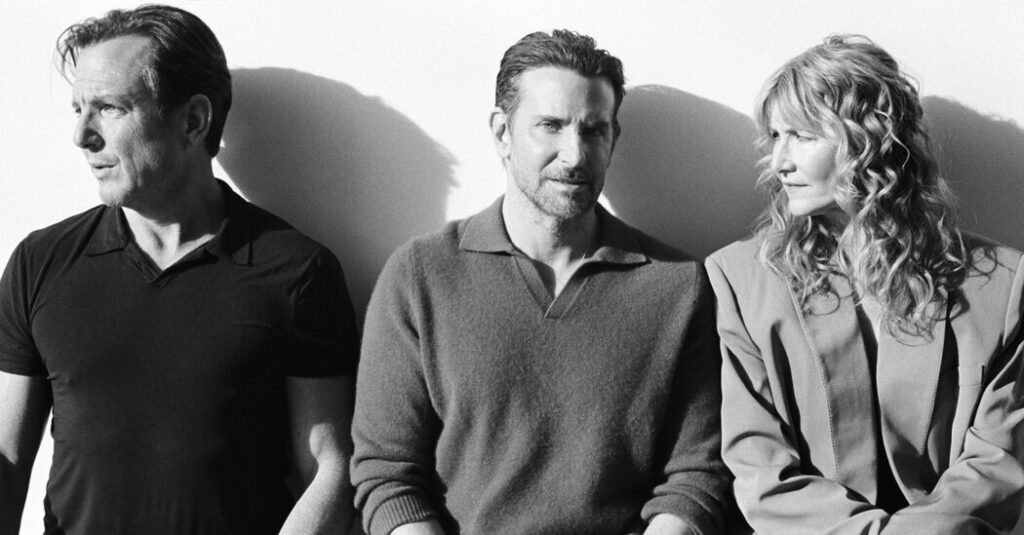
There are two stories in “Is This Thing On?” the dramedy starring Will Arnett and Laura Dern, directed by Bradley Cooper. The first is the narrative of the film: Arnett plays Alex, a married father facing a divorce from Tess (Dern), who’s a frustrated ex-volleyball champ. He stumbles into standup, finding an unexpected emotional outlet.
The other story is about three real-life friends mining their shared histories and foibles, and translating that onscreen. Cooper and Arnett have been close across a quarter-century, Dern and Cooper for a decade. All are in their 50s, with children and divorces behind them. Their familiarity, their in-jokes — even their board game play — show up. “After years of deeply knowing each other,” Dern said, “we made a movie together.” Critics have responded positively, especially to Arnett’s dramatic turn.
Cooper helped Arnett and his writing partner, Mark Chappell, develop the script, which is loosely based on the life of the British comedian John Bishop. Cooper also served as a camera operator, and stars as one of the couple’s friends, an actor named Balls (the comic relief). The film was shot on a shoestring, in quasi-guerrilla style, at New York clubs like the Comedy Cellar, with real-life comedians — and Cooper’s own pet dogs — filling the scenes.
At a recent interview in Manhattan, the stars discussed early career years, doing bits with Conan O’Brien, and a line from the film that resonated: “I want to be unhappy with you.”
There was much laughter, and also much tenderness. Here are excerpts from the conversation.
How did your friendships underpin this story?
DERN We went straight into the core of relationships.
COOPER It was like, can we not skirt around the realities of humanity, and still have a hopeful ending?
ARNETT We all know that you can work through stuff. Bradley has been so helpful to me, even before, holding my feet to the fire in the best way, to really dig deep on a lot in my life, outside of work. He’s been an incredible friend in that way.
The film presents the idea of how necessary an outside outlet can be to a marriage. Can you talk about that?
COOPER It all comes down to me personally feeling like, if I’m not doing something out of my comfort zone, growing — it affects my intimate relationships, no question. So that’s really what the standup means in this movie. It’s not about being funny at all.
ARNETT Doing this was something I didn’t know that I needed. Laura and I would have a very emotional scene, and I was like, “is it always this hard?” Brad was like, “Yeah. To be vulnerable like this, it’s always this hard.” I realized that I hadn’t been stretching myself for a long time. I wasn’t stagnant as a person, but I needed this creative outlet. It really changed me in a lot of ways, similar to how doing standup changed Alex.
COOPER The meta of the movie — we would talk about it every day. We would finish a day and be so gratified and spent.
DERN We’re so blessed if we get to do something we actually like. The majority of the world never has that privilege. But we have to remind ourselves every day. I have been doing this since I was 11. And doing it the way I started, on the million-and-a-half dollar movie, when there’s only 15 of us [cast and crew], and you’re grabbing shots and don’t know if you’re allowed to be there. That’s why I fell in love with it.
Being with this group of women that I was playing [volleyball] with, the fever that I felt from them, like this is their thing, like movies are for me. Something about that really reignited me.
How did the hand-held shooting style, with Bradley as a camera operator, affect your work?
COOPER I always remember Gene Hackman talking about “Royal Tenenbaums,” and his favorite thing is to be free within a very tight structure. That scene outside with Anjelica Huston, they have this conversation, just to the edge of the frame. As an actor, I love that. The tighter you make the space, the more free I feel sometimes.
ARNETT When Bradley first read our draft, what he responded to was this idea of seeing Alex filling the screen, that first close-up.
COOPER Yeah, never seeing him full-on, until that moment in the movie when he reveals himself to us.
ARNETT He says, I’m getting a divorce. And it was the most confined space, standing on that stage, coming into that mark. People ask me, is it uncomfortable having the camera so close to you? Because Bradley was there [in front of Arnett’s face]. Sometimes I’m looking in his eyes, and he’s talking to me. And weirdly, there was a crazy amount of freedom.
COOPER I learned that from David O. Russell. That was the first time I worked with a director who was not in the video village [the far-off crew vantage spot], which I always found added an element of fear for me, as an actor. You hear them whispering and everybody’s waiting, then they come over and tell you what they’re thinking. David, he was just underneath the table. Since that experience, anytime I’d act in a movie I would always ask the director if they could be close.
ARNETT [Watching Cooper shoot], from my vantage point it looked like the camera was part of Laura’s head.
DERN It was! [He] had to be right here [indicating above her waist].
COOPER Luckily we know each other so well, because I had to be like, “I’m so sorry, but you have to spread your legs.”
DERN Other than an OB-GYN, that’s the closest anybody’s gotten.
ARNETT He’s in her face, on her lap, on her. She has no dialogue. But you can hear Bradley [giving direction]. If you walked in that room, you’re like, what is going on? I’m doing standup, Bradley’s an appendage of Laura’s, talking to her face. And Peyton Manning’s next to her (he has a cameo).
COOPER With 120 people —
DERN Watching.
ARNETT And laughing and reacting, because Steve Morrow, the sound mixer, does everything live.
Will, to prepare for this, you did standup. And you bombed.
ARNETT Once!
COOPER He did amazing. That’s the truth.
ARNETT Thank you. At first it’s scary. But ultimately you get to a place where it’s so absurd, because you gotta keep going. You end up laughing yourself. It was really valuable, to not be entertaining.
The first time I went out, Bradley and I went to Austin. Shane Gillis very kindly gave us some of his stage time. You said to me, “take it all in. Each step.”
COOPER It was the best possible rehearsal, because then it’s lived-in — even what it’s like to walk to a stage.
You have all done a lot of comedy — Laura, maybe less so than the guys. What impact has it had on you?
ARNETT She’s done a lot of comedy.
DERN [laughing] They just don’t call it comedy. I thought they were comedies.
COOPER Comedy has been a major part of my life; it’s gotten me through everything. Talking to Zach Galifianakis, minutes after my dad died, and he’s just cracking me up. I’m crying and laughing so hard. It gets us through it all.
My hero growing up was Richard Pryor. And my dad was a huge fan of standup. We actually wrote it into the script — it didn’t stay, but it was basically my story with my dad. Like New Year’s Eve, watching Rodney Dangerfield’s comedy special; Steven Wright, Elayne Boosler.
And memorizing Dice’s album [Andrew Dice Clay] and reciting it in seventh grade to my friends. They’re like, shut up.
ARNETT But we had to recite it, because we didn’t have social media, we didn’t have constant loops. So we had memorize it, and repeat it to each other.
It was your poetry.
COOPER AND ARNETT It was!
DERN Lucy [Lucille Ball] and Carol Burnett, I would memorize characters and do them for my mom.
COOPER And even Sid Caesar and “Your Show of Shows,” “The Colgate Comedy Hour” — with my grandparents, I used to watch that all the time.
ARNETT Well, you guys are much older than I am — those references …
COOPER Imogene Coca! You know who I’m talking about, right?
ARNETT I’d go see a double bill, I’d see Chaplin and Buster Keaton. I remember, I’d call my friend, I’d say Murray Hill 3-2-9, please. [Much laughter.]
Will and Bradley, you were neighbors in L.A. decades ago, right?
ARNETT For two years. Ron Rifkin and his wife, Iva, lived in the main house on the property. And there was a back, split into two apartments.
COOPER You lived in the nice one. I couldn’t afford that one.
ARNETT We had a connecting wall — our doors were like an L, always open.
COOPER I had severed my Achilles’ tendon, left “Alias” [the TV series], was on the couch for six weeks, then a year of rehab.
ARNETT I’d be watching TV, smoking a cigarette, and Bradley would kind of drift in, as if in a conversation.
COOPER We both would be like, gotta put the trash out.
ARNETT Ron Rifkin got really mad at me for not taking the trash out. Another person said, there’s no way he’s mad at you. Then somebody — within the last year — said, “Oh yeah, you used to live next to Ron Rifkin, I heard you never took the trash out.” Twenty years later!
COOPER We love Ron Rifkin. I don’t know if he loved Will. He and I were great.
DERN You took the trash out!
Can a bit go on too long?
ARNETT I was just thinking about how I have so many bits with people throughout my life. Like Conan, the first time I met Conan was at the Emmys in 2004. I saw him across the room. He pointed at me, and he goes, “You!” And I go, “No!” We’re like 30 yards away from each other, tons of people between. He pretended to chase me, and I climbed over a table. We had never met. Now we’ve been friends for 20 years.
You can never have enough bits. Bits make the world go round.
COOPER The funniest times are when bits go too long. Then they go south.
DERN The way they would play a bit, when they’re acting together — you learn that if you keep going, it becomes almost absurd. And then you go further, and the depth of the truth shows up. I was in bliss whenever I got to be with them together. I’m sad I didn’t have more time with Balls, because —
ARNETT A great headline, by the way.
[Laughter]
ARNETT I mean, I don’t know if clicks are important to you. “Laura Dern opens up: I’m sad I didn’t have more time with Balls.” Is that at the heart of the Dernaissance?
COOPER That’s the mission statement.
DERN Speaking of bits, a friend called me yesterday in tears. She goes, “in the middle of the movie, my boyfriend and I realized our relationship was falling apart. He’s like, ‘we need to get help; we’ve got to start talking.’ We’ve called a couple’s therapist. I think we’re going to get married — like, this is my person. He was holding me and he said, ‘I want to be unhappy with you. And forever we’re going to know the movie that brought us together. The movie that has a dog flush a toilet in it.’”
[Delightedly] That’s the movie we wanted to make.
Melena Ryzik is a roving culture reporter at The Times, covering the personalities, projects and ideas that drive the creative world.
The post Will Arnett, Laura Dern and Bradley Cooper: 3 Friends Walk Into a Comedy Club appeared first on New York Times.