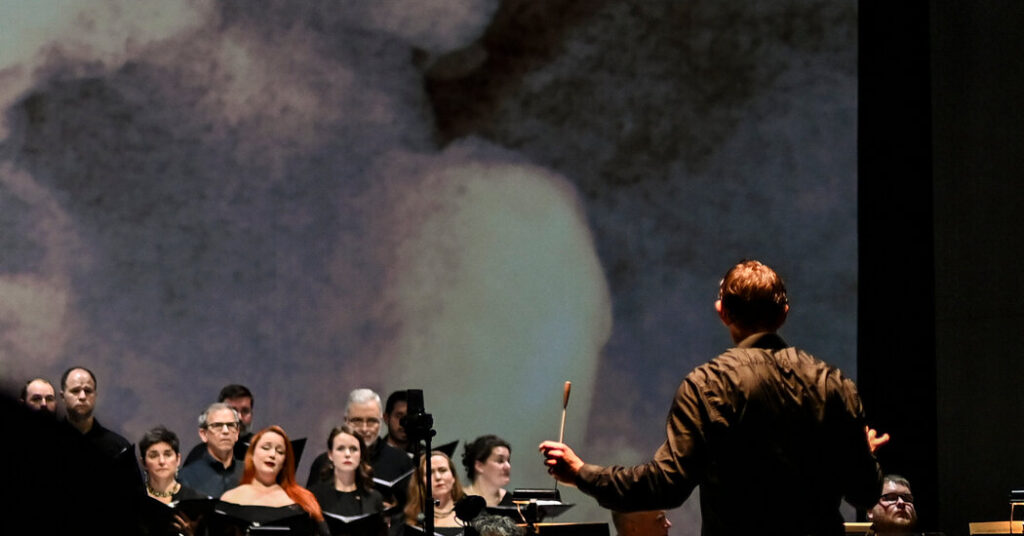
The Washington National Opera decided on Friday to move its performances out of the John F. Kennedy Center for the Performing Arts, abandoning the hall where it has played since 1971 in perhaps the largest artistic rebuke yet to President Trump’s campaign to remake the Kennedy Center in his image.
The opera company is seeking to sever its ties with the Kennedy Center after a tumultuous year in which both groups have faced cancellations by artists, empty seats and the retrenchment of donors protesting Mr. Trump’s intervention. Within weeks of beginning his second term, the president named himself chairman of the center and installed a political ally, Richard Grenell, as its executive director, while filling its board with supporters.
A resolution to leave was approved by the Washington National Opera’s board of trustees on Friday, according to a statement the opera provided to The New York Times.
“Today, the Washington National Opera announced its decision to seek an amicable early termination of its affiliation agreement with the Kennedy Center and resume operations as a fully independent nonprofit entity,” the statement said.
The resolution calls for the opera to move its performances out of the Kennedy Center’s 2,364-seat Opera House as soon as possible and to reduce the number of performances for the next season as a cost-saving measure. Opera officials said that new sites in Washington have been lined up but that no leases have been signed. They declined to name those venues.
The officials said that details about the new schedule would be announced shortly. The Kennedy Center’s website currently lists the opera’s lineup of spring performances, including Scott Joplin’s “Treemonisha” and “West Side Story” as well as its upcoming gala, but a separate website is being set up.
The resolution also calls for the Washington National Opera to begin negotiations with Mr. Grenell and the Kennedy Center about ending an affiliation agreement that has bound the cultural institutions since it was signed in 2011, when the opera was facing financial challenges.
The opera declined to release a copy of the resolution, which was being negotiated until shortly before it was approved by the 37-member board during a virtual meeting on Friday. But details of its contents were provided to The Times by officials involved in the deliberations.
The Kennedy Center did not immediately offer a response to the opera’s decision to leave when reached for comment.
The opera’s impending departure is the latest sign of resistance to Mr. Trump’s effort to drastically change an institution that was created in 1971 in tribute to John F. Kennedy, who had been assassinated eight years earlier.
Opera leaders said the decision to leave was in response to a drop in attendance and a decline in donor contributions during the president’s second term, as well as an escalating number of artists who have refused to appear at the Kennedy Center since Mr. Trump’s name was added to the building last month. The authority of the board to overrule Congress and rename the center is disputed, and The Times has continued to refer to its legal name.
“I am deeply saddened to leave the Kennedy Center,” Francesca Zambello, who has been the opera’s artistic director for 14 years, said in a statement to The Times. “I have been proud to be affiliated with a national monument to the human spirit, a place that has long served as an inviting home for our ever-growing family of artists and opera lovers.”
Any negotiation over the affiliation agreement promises to be fraught: It was first negotiated when Barack Obama was president, setting a framework for the organizations to work cooperatively in hiring the opera company’s general director (currently Timothy O’Leary) and artistic director, as well as to make decisions on its programming. The Kennedy Center also leases space to the opera company for storage, offices and rehearsals.
Among the most difficult issues that need to be resolved is the future of the opera’s $30 million endowment, which has already become a matter of dispute. The opera contends that the affiliation agreement makes clear that both entities control the fund, the result of a history of donations from opera supporters in Washington.
Officials with the opera said they would move all performances out of the center, regardless of whether a deal to end its formal ties is struck. They asserted that taking their shows to other venues would free the company of the management entanglements with the Kennedy Center — in particular, programming and the selection of top opera personnel — that are addressed in the affiliation agreement.
The Washington National Opera was established in 1957, with an inaugural performance of Mozart’s “The Abduction From the Seraglio” at George Washington University. With a few exceptions — it performed at Constitution Hall while its home on the Potomac was being renovated — it has been performing at the Kennedy Center since the building opened.
The opera was founded by Day Thorpe, the music critic of The Washington Star, and has provided a stage to some of the most prominent performers of the generation, including Plácido Domingo (who also served as its artistic director), Anna Netrebko, Denyce Graves and Renée Fleming. It has staged warhorses like “Carmen” and a new production of the “Ring” cycle in 2016, which was directed by Ms. Zambello. It also created the American Opera Initiative to showcase young composers.
“The Washington National Opera is one of our most prominent companies,” said Marc A. Scorca, the president emeritus of Opera America, a service organization for opera companies. “It has presented a mix of work from our inherited repertoire and new works from a wonderful young artists program.
“To have a major opera company produce such a mix of repertoire is very important,” he said.
Since early in his second term, Mr. Trump has sought to put his imprint on traditionally nonpartisan Washington institutions like the Smithsonian and the Kennedy Center. His appointment of Mr. Grenell came with a clear message from Mr. Trump that he wanted changes in the way things were done at the Kennedy Center.
“Ric shares my Vision for a GOLDEN AGE of American Arts and Culture, and will be overseeing the daily operations of the Center. NO MORE DRAG SHOWS, OR OTHER ANTI-AMERICAN PROPAGANDA,” the president said then in a post on social media.
Before long, the center ordered the National Symphony Orchestra to open all concerts with the national anthem (Mr. Grenell took the baton and conducted one of them) and hired a dance director who had complained to Mr. Grenell about “radical leftist ideologies in ballet.”
Officials with the Washington National Opera noted that operas often advance strong political and moral points of views — whether they were written two centuries or two years ago — and that they were worried they would be blocked from performing operas that did not follow Mr. Grenell’s edicts. Among its programming this season is Robert Ward’s “The Crucible,” based on the Arthur Miller play that explored the waves of paranoia overtaking a small town during the Salem witch trials of the 17th century.
In addition, Mr. Grenell said he wanted all productions at the Kennedy Center to be revenue neutral, taking in as much money in ticket sales and contributions as they cost to mount. Operas are expensive to produce and are typically not revenue neutral.
Ms. Zambello publicly raised the possibility of leaving the Kennedy Center in an interview with The Guardian in November, saying that the Trump administration’s policies had “shattered” the confidence of donors and resulted in a 40 percent drop in ticket revenues. “If we cannot raise enough money, or sell enough tickets in there, we have to consider other options,” she said at the time.
After her remarks produced an uproar, Ms. Zambello and other leaders of the opera reaffirmed their intention to stay. But since then, she and other opera officials said, the situation has only grown worse.
Béla Fleck, the celebrated banjoist, recently announced he was pulling out of performances with the National Symphony Orchestra, and the “Wicked” composer Stephen Schwartz said he would not host the opera’s gala. Both said that appearing at the Kennedy Center had become a political statement.
Adam Nagourney is the classical music and dance correspondent for The New York Times.
The post Washington National Opera Is Leaving the Kennedy Center appeared first on New York Times.