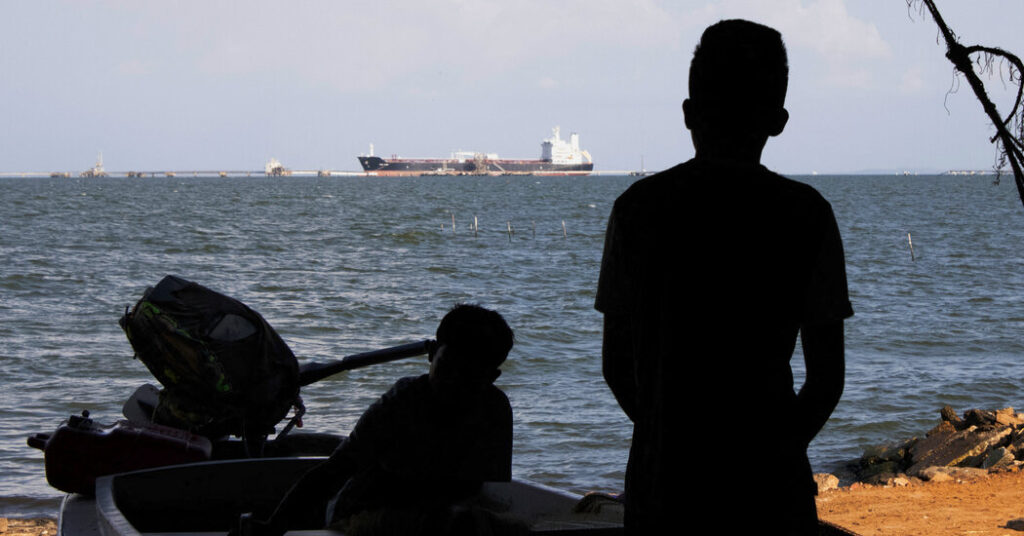
A joint U.S. Coast Guard and Navy team boarded and seized an oil tanker in the Caribbean Sea early Friday, the U.S. Southern Command said, in the latest operation tied to the Trump administration’s effort to control Venezuela’s oil exports.
The tanker, the Olina, is the fifth to be boarded or seized by U.S. forces in the last month. On Wednesday, U.S. forces intercepted and took control of two other ships, including one, the Marinera, seized between Iceland and Britain after a weekslong chase across the North Atlantic. Unlike in that case, the U.S. authorities did not have a court-issued warrant to seize the Olina, according to an official familiar with the operation who was not authorized to speak publicly.
In a statement, the U.S. military’s Southern Command said on Friday that the operation had been carried out before dawn by Marines and sailors assigned to Joint Task Force Southern Spear, working in coordination with the Department of Homeland Security. The forces were launched from the aircraft carrier Gerald R. Ford, a nuclear-powered vessel deployed in the Caribbean, and apprehended the tanker “without incident.”
“Once again, our joint interagency forces sent a clear message this morning: there is no safe haven for criminals,” the statement said.
The vessel, the Olina, had been sailing under a false flag registered to Timor-Leste, according to the International Maritime Organization, a tactic that the U.S. military had cited before as grounds for interception at sea.
The tanker had loaded roughly 700,000 barrels of oil in late December and early January at Venezuela’s José Terminal, according to Kpler and TankerTrackers.com, firms that track global oil shipments, and independently verified by The New York Times. A video of the U.S. forces boarding the vessel, posted by the U.S. Southern Command, showed the vessel sitting low in the water, indicating it was carrying cargo.
The vessel departed Venezuelan waters late last weekend, after the U.S. raid that ousted Venezuela’s president, Nicolás Maduro. It was one of several tankers that left the area in defiance of the partial U.S. blockade on Caracas’s oil trade.
The Olina’s recent voyage follows a pattern used by tankers seeking to obscure their origins. The ship had not broadcast a location signal for nearly two months, according to ship tracking data. The tactic, known as “going dark,” is often employed to conceal oil shipments that are subject to sanctions.
On Thursday, The New York Times reported, based on satellite imagery, that the vessel was at the edge of the Caribbean and headed northeast toward the open Atlantic. The Olina was part of a group of ships being chased by U.S. forces at sea, The Times’s analysis showed.
Over the past five years, the Olina primarily transported oil from Russia, and occasionally from Iran, to buyers in Asia, according to Kpler and TankerTrackers.com. Last January, the U.S. placed sanctions on the vessel, then named Minerva M, citing its role in helping finance Russia’s war in Ukraine by moving Russian energy exports to foreign markets.
Note: The International Maritime Organization issues an IMO number, a permanent identification number, that remains associated with a vessel throughout its lifetime unlike a ship’s name, which can change frequently. The ships in this article are Marinera (9230880, previously known as Bella 1) and Olina (9282479, previously known as Minerva M).
Christiaan Triebert is a Times reporter working on the Visual Investigations team, a group that combines traditional reporting with digital sleuthing and analysis of visual evidence to verify and source facts from around the world.
The post U.S. Seizes Another Tanker Carrying Venezuelan Oil appeared first on New York Times.