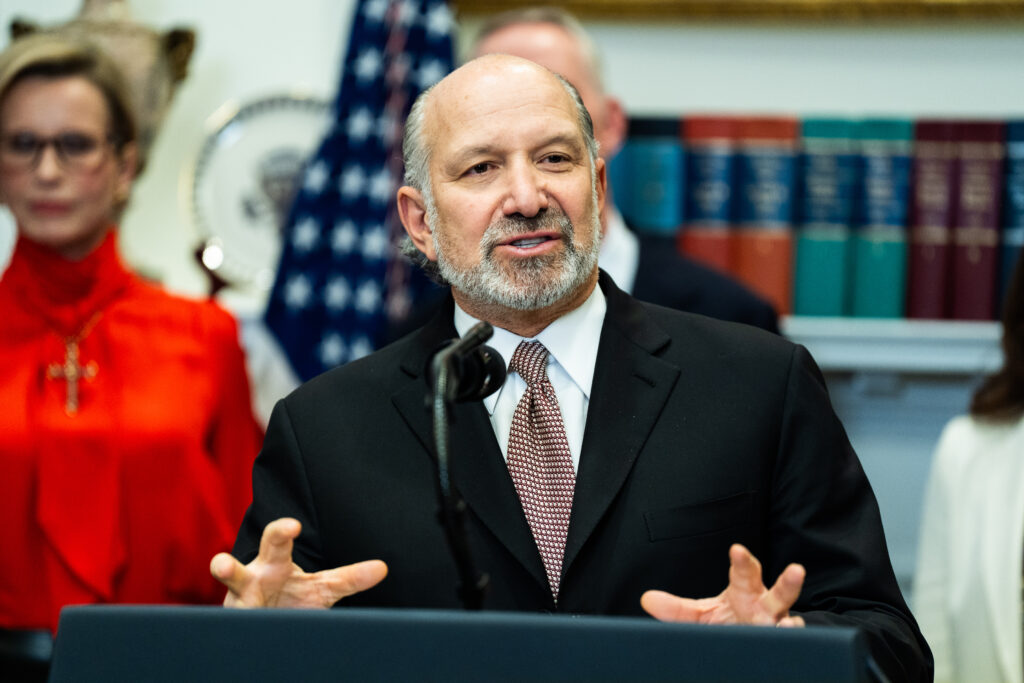
NEW DELHI — The trade deal between the United States and India which has failed to materialize after many months of negotiations may have faltered at the finish line due to India’s Prime Minister Narendra Modi not calling President Donald Trump to finalize the pact, according to the U.S. Commerce Secretary Howard Lutnick — an account that Indian officials have disputed.
Lutnick, in comments made on the All-In podcast in the past day, said as trade negotiations were finalized between Washington and New Delhi, he told Indian officials that “you have to have Modi call the president,” adding that “they were uncomfortable doing it. So Modi didn’t call.”
Lutnick went on to say that the U.S. made “a bunch” of trade deals with other countries after failed negotiations with India, and later New Delhi called Washington and said “‘Okay we’re ready.’ And I said ‘ready for what?’ You’re ready for the train that left the station three weeks ago?’”
Randhir Jaiswal, the spokesperson for India’s Ministry of External Affairs, said in a news briefing Friday in New Delhi that Lutnick’s reported remarks are “not accurate,” adding that India remains “interested in a mutually beneficial trade deal” and that Modi and Trump spoke on the phone on eight occasions in 2025.
The White House did not immediately respond to an overnight request for comment.
The episode may prove to be another in a long line of missteps and misunderstandings between Washington and New Delhi as they’ve tried to finalize a trade deal but have become hampered by Trump’s mercurial dealmaking style, Indian diplomats’ seeming inability to negotiate in a similar manner and Modi’s desire to mollify his conservative domestic base and not be seen as capitulating to the West, political analysts said.
Lutnick indicated that any deal between the two countries may remain far-off, representing another setback in the relationship between the two countries that had a promising start but became far more complicated after they sparred over issues related to the 2025 conflict between India and Pakistan, New Delhi’s purchases of Russian oil and difficulties reaching a deal on core Indian sectors of agriculture and dairy.
One person familiar with U.S.-India trade negotiations, who spoke on the condition of anonymity to discuss sensitive negotiation dynamics, sought to downplay the significance of Lutnick’s comments, saying that the U.S. Trade Representative’s office and Secretary of State Marco Rubio would be the key staff level facilitators on any trade deal.
Trump said in recent days that Modi was “not that happy with” him because the president raised tariffs on India due to its purchases of Russian oil, and noted they could increase even further if imports of the commodity aren’t curbed. The U.S. tariff on many Indian goods stands at 50 percent — one of the highest for Washington’s trade partners.
Milan Vaishnav, director of the South Asia Program at the Carnegie Endowment for International Peace, said the state of the U.S.-India relationship has exposed a “trust deficit” between the two countries and the public litigation of missteps may do long term damage.
“Those feelings of mistrust create limits on what the two countries can do together,” he said.
The relationship between Washington and New Delhi seemed primed for success at the start of Trump’s second term. When Modi visited the president in the Oval Office in February, the leaders pledged to increase trade between the two countries to $500 billion by 2030.
Behind the bonhomie were signs of tension. For years, Trump had called India a “big abuser” of tariffs and a “tariff king.” Indian officials, for their part, were reluctant to make trade concessions on the agriculture, dairy and seafood sectors which, taken together, employ a majority of India’s workforce.
India’s conflict with Pakistan in May introduced another irritant. Trump repeatedly claimed that he helped solve the crisis, annoying Indian officials who denied his role as a mediator. As India-U.S. tensions festered, Pakistan thanked the president for helping and nominated him for the Nobel Peace Prize.
In August, just before 25 percent tariffs on India were to go into effect, Trump announced that he would levy an additional 25 percent tariff on New Delhi as punishment for buying Russian oil, further inflaming the diplomatic crisis.
Trump’s top advisers, such as trade adviser Peter Navarro, said Russia’s conflict with Ukraine is “Modi’s war” and that New Delhi has become a “laundromat for the Kremlin.” U.S. Treasury Secretary Scott Bessent said “some of the richest families in India” are profiting off the war in Ukraine, seemingly taking aim at India’s most influential and politically connected figures.
A Washington Post investigation found the conglomerate Reliance Industries, India’s largest oil purchaser owned by India’s richest man and Modi ally Mukesh Ambani, purchased roughly $33 billion in Russian oil since the war in Ukraine started, accounting for roughly 8 percent of Moscow’s crude oil sales during that period.
The issue of Russian oil purchases became a significant hurdle in conversations. Since 2023, New Delhi has been the largest buyer of Russian seaborne crude oil, while China remains Moscow’s overall largest purchaser. Trump told trade negotiators that India would have to scale back its purchases of Russian oil if a trade agreement was to be finalized, The Post reported in September.
In October, Trump told reporters in the Oval Office that Modi had pledged to scale back purchases of Russian oil, a claim Indian officials said they were “not aware” of the next day. Indian negotiators had previously told the Trump administration in private that they would be willing to cut back on oil purchases from Moscow, but couldn’t announce it publicly for fear of domestic political backlash.
In November, Reliance Industries said itstopped importing crude oil from Russia to refine for export amid looming U.S. and European Union sanctions on Moscow’s energy sector. Sen. Lindsey Graham (R-South Carolina) on Wednesday said Trump had “greenlit” a sanctions bill that would penalize countries such as India and China that buy oil and gas from Russia in a bid to starve Putin’s war funding.
In November, India’s imports of Russian crude were roughly 1.85 million barrels per day, mirroring imports in previous months, according to data from the independent energy think tank Center for Research on Energy and Clean Air. India’s imports of Russian crude oil amounted to 1.23 million barrels per day in December, the data also showed.
The road ahead for India to get a deal with the U.S. may be difficult, Lutnick said in the podcast. He noted New Delhi was “on the wrong side of the seesaw” in trade negotiations last year and since other countries are finalizing deals in the meantime, “they’re just further in the back of the line.”
Vaishnav said the trade negotiations may continue to be challenging for Indian diplomats, who are much more used to negotiating through official channels and long-standing diplomatic processes. “That structure has completely broken down in the United States,” he said.
“It’s really about who you know; what have you done for them lately? And kind of whose ear can you whisper into?” he said. “That’s just a very, very different sort of diplomacy that has got India on the back foot.”
The post U.S.-India trade deal stalled because Modi didn’t call Trump, Lutnick says appeared first on Washington Post.