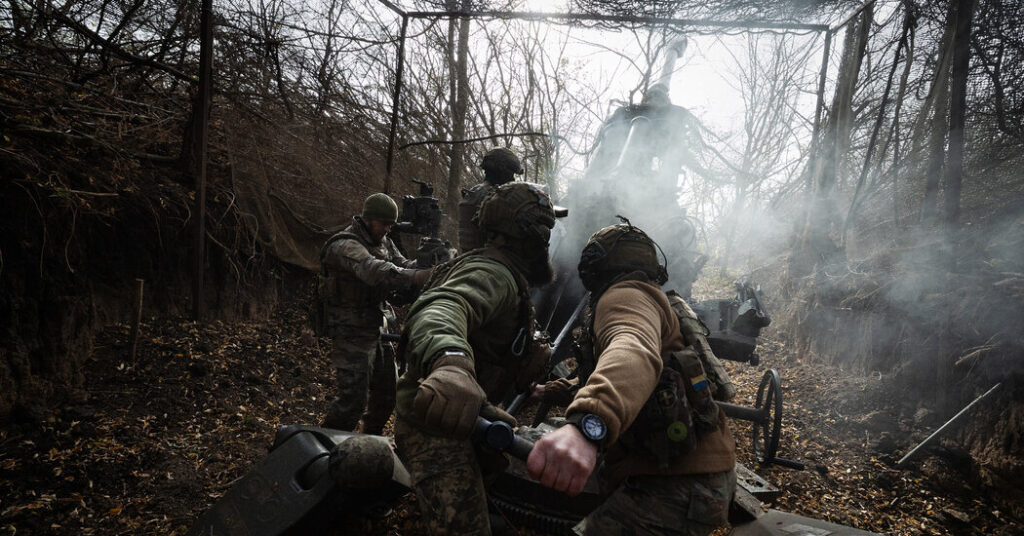
President Trump indicated that he was ready to commit to the United States being involved in Ukraine’s future defense — but only, he said, because he was confident that Russia would not try to invade the country again.
“I feel strongly they wouldn’t re-invade, or I wouldn’t agree to it,” Mr. Trump said in an interview with The New York Times on Wednesday.
Mr. Trump was responding to a question about whether he would be prepared to go to war to defend Ukraine if Russia were to break the terms of any cease-fire and invade again. As part of the negotiations over ending Russia’s invasion, President Volodymyr Zelensky of Ukraine is seeking security guarantees from Western countries, particularly the United States. He wants them to pledge to help defend his country if a cease-fire with Russia is reached.
Mr. Trump’s comments went further than he has before in signaling an openness to sign up for such a commitment, at least in a supporting role. But they also showed that he remained convinced of President Vladimir V. Putin’s professed desire for peace, despite Russia’s unwillingness to end the war after nearly a year of negotiations with the Trump administration.
“I think he wants to make a deal,” Mr. Trump said of Mr. Putin. “But I’ve thought about that — I’ve thought that for a long time.”
Asked about a potential peace agreement that would require the United States and its allies to offer Ukraine military support if there is another invasion, Mr. Trump interrupted to underscore that the United States would play a secondary role in such a situation.
“Let’s put it this way: its allies, all of Europe, other countries that are going into it — and the United States,” Mr. Trump said.
At a summit in Paris earlier this week, the leaders of France and Britain committed to providing troops to dissuade Russia from invading again if it agreed to a cease-fire. But the meeting, attended by the White House special envoy Steve Witkoff and by Jared Kushner, Mr. Trump’s son-in-law, left the extent of American support for such a multinational force unclear.
Mr. Witkoff said the group “made significant progress on several critical workstreams” that would be part of a final peace deal.
But it is unclear whether Mr. Putin would accept any kind of agreement that would stipulate Western backing for Ukraine and its military. The Russian Foreign Ministry said on Thursday that the promise of a force to support Ukraine represented “militarization, escalation and further conflict aggravation.”
Mr. Trump, however, insisted in his interview with The Times that he believed Mr. Putin was still prepared to make peace.
“I’ve had cases where I had Putin all done and Zelensky wouldn’t make the deal, which shocked me,” Mr. Trump said. “Then I’ve had cases where it was the reverse. I think now they both want to make a deal, but we’ll find out.”
Mr. Trump declined to detail how quickly he hoped to end the war, a departure from his practice last year, when he set out numerous deadlines for achieving a deal that went unmet. He also said he was not prepared to promise an increase to U.S. support for Ukraine if Mr. Putin continued to balk at a cease-fire.
“I just don’t want to be in a position to say that, because I have an obligation to see if I can save lives,” Mr. Trump said.
Asked about a timeline, he said: “We’re doing the best we can. I don’t have a timeline.”
Anton Troianovski writes about American foreign policy and national security for The Times from Washington. He was previously a foreign correspondent based in Moscow and Berlin.
The post Trump Appears Open to Defending Ukraine, but With a Caveat appeared first on New York Times.