Venezuela’s oil industry has undergone radical changes since it was established over a century ago, including tumultuous boom-and-bust cycles and two major waves of nationalization.
It is now entering a new and uncertain phase in which President Trump has said it would be run by the United States after the capture of the country’s president, Nicolás Maudro.
Venezuela’s oil history stretches back centuries to the country’s precolonial era, when Indigenous peoples used the liquid they called “mene” as fuel and medicine, and to help waterproof boats, sails and woven baskets.
The modern oil industry in Venezuela began in the early 20th Century, when the discovery of some of the world’s largest oil fields quickly drew the attention of international oil companies — and the United States.
Here’s a look at some of the industry’s major events:
1914-1928: The Rise of an Oil Titan
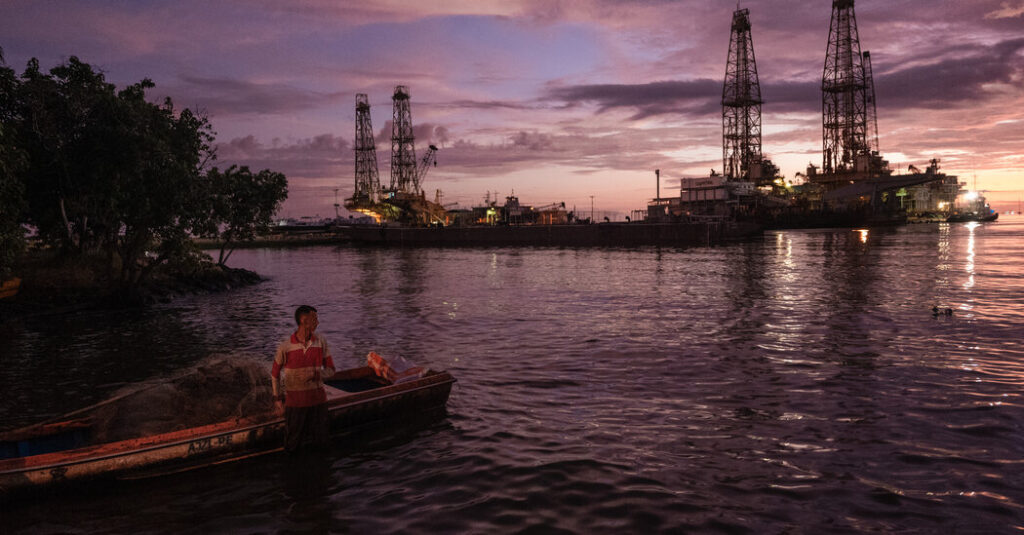
While oil seepages had lured commercial prospectors to Venezuela since the late 1800s, the country’s first successful commercial oil well was established in 1914 near Lake Maracaibo, in northwestern Venezuela, setting off the country’s transformation from a sleepy producer of coffee, cacao and cattle into a petroleum powerhouse.
In 1922, a blowout at another well near the lake unleashed a massive geyser that spewed oil 200 feet into the air at a rate of around 100,000 barrels a day for more than a week. The blowout was one of the largest in the world and caused a major ecological disaster, according to Orlando Méndez, an oil field historian. The event also signaled the vast potential of the country’s oil reserves.
Oil workers soon flocked to Venezuela, and within a matter of years dozens of companies were pulling oil out of the ground there, backed by the dictator Juan Vicente Gómez. By 1928, Venezuela was the largest oil exporter in the world.
1940s-1970s: A March to Nationalization
Unlike the abrupt nationalizations elsewhere in the world at the time, the first takeover of oil companies in Venezuela was a largely peaceful event that followed decades of incremental legislative changes.
An early step came in 1943, when the Venezuelan government forced companies operating in the country to share 50 percent of their oil profits with the state. In 1958, as the country transitioned to democracy after the fall of the dictatorship of Marcos Pérez Jiménez, the government increased its share of oil profits and stopped issuing new concessions to oil companies.
In 1975, President Carlos Andrés Pérez signed a law nationalizing the country’s petroleum industry, ending more than a half-century of dominance by overseas firms.
The move was an attempt to assert control over the country’s national resources, to end contracts with foreign companies that were seen as exploitative and to respond to Venezuela’s growing nationalist movement.
“We are reluctant to continue accepting that our interests be manipulated from centers of power in the world,” Mr. Pérez told Time magazine as the country was considering the law.
Around 20 corporations or their subsidiaries were affected. At the time, American companies including Exxon, Gulf, Mobil, Texaco, Chevron and Arco controlled more than 70 percent of the crude oil production in the country.
Venezuela paid the companies the value of their assets in bonds, which a government agency valued at around $1 billion (about $5.5 billion in inflation-adjusted dollars), far short of the $5 billion that oil companies said they had invested in plants and equipment.
In 1976, the state-owned company Petróleos de Venezuela, or PDVSA, took over the extraction and production of oil in the country. The oil wealth led Venezuela to have one of the highest standards of living well into the 1980s.
In the 1990s, Venezuela reversed course. It began to open some oil fields to private companies to help it reach the country’s vast heavy-oil deposits, which PDVSA lacked the technical ability and resources to extract.
1990s-2010s: Chávez and a Tighter Grip
Hugo Chávez was elected president in 1998 and soon began to use resources from PDVSA to fund social programs, creating a rift between the company and his government.
Tensions escalated, and in 2002, months after a failed coup briefly removed Mr. Chávez from power, thousands of the company’s employees went on strike in an attempt to oust him as president.
The strike lasted for nearly two months, virtually halting oil production. Mr. Chávez responded by purging 18,000 of the company’s employees and replacing them largely with his loyalists — a move that many saw as a shift toward the political rather than technical management of the company.
In 2007, as the price of oil rose, the Venezuelan government demanded that oil companies reduce their stakes in the country’s projects without compensation. Some companies, including Chevron, reached agreements with the government, but two American companies, ConocoPhillips and Exxon Mobil, rejected deals, left the country and sued the Venezuelan government.
The companies have tried for years to force Venezuela to pay through international arbitration and court cases.
In recent years, tribunals from the World Bank and the International Chamber of Commerce have awarded nearly $11 billion to ConocoPhillips and $2.5 billion to Exxon Mobil. Both companies say more compensation is due. .
2010s-2026: Crash, Collapse, Intervention
Overproduction led global oil prices to crash in 2014. At the time, PDVSA was mired in a cash-flow crisis and was forced to take out millions of dollars in loans from Venezuela’s central bank.
In 2017, the United States, under the first Trump administration, began to place sanctions on Venezuelan officials and companies, including PDVSA. The sanctions were in response to what officials said was widening repression in the country and attempts to consolidate power by Nicolás Maduro, who succeeded Mr. Chávez upon his death in 2013.
Venezuela soon found itself in the midst of a historic economic collapse, marked by rampant inflation, widespread hunger, the failure of its health care system and a mass migration of people out of the country.
During the early 2020s, oil production in Venezuela hit historic lows as the country experienced widespread power failures.
In 2025, tensions between the United States and Venezuela escalated, as the Trump administration began a military buildup in the Caribbean that some Trump officials said was meant to drive Mr. Maduro from power.
On Jan. 7, 2026, after the capture of Mr. Maduro, Trump administration officials outlined a plan to effectively assume control of selling oil from Venezuela indefinitely.
Mr. Trump has said U.S. oil companies would “spend billions of dollars, fix the badly broken infrastructure” and “start making money” for Venezuela. It’s a proposition that experts say will not come easily.
Jonathan Wolfe is a Times reporter based in London, covering breaking news.
The post The Century-Long Tug of War for Venezuela’s Oil appeared first on New York Times.