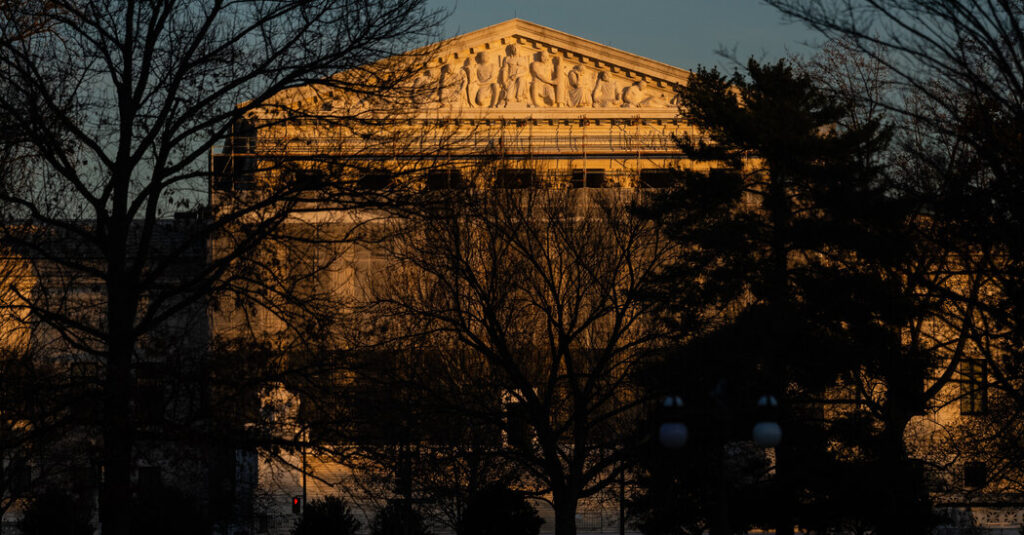
The Supreme Court on Friday issued its first decision of the term that began in October. Rather than a highly anticipated ruling on President Trump’s tariffs program, it released a tangled and decidedly minor ruling on when federal prisoners may challenge their convictions.
Over the last 80 years, the Supreme Court has only once before waited until January to issue its first opinion in an argued case. The reason for that extraordinary lag did not strike lawyers who specialize in Supreme Court advocacy as particularly mysterious: the rise of the emergency docket.
Opinions like the one released on Friday have long been considered the court’s core responsibility. They are issued on the court’s merits docket, after elaborate care and consideration absent from the court’s emergency rulings.
The justices decide merits cases after receiving two rounds of briefs, often including scores of supporting filings, hearing oral arguments, deliberating and exchanging draft majority opinions.
The court’s term starts on the first Monday in October and usually ends by late June. These days, the court issues around 60 signed merits decisions, often saving blockbuster rulings for the end of the term but releasing others steadily before then, usually starting by late fall.
President Trump’s first year in office has seen a spike in action on the court’s other docket, with the justices fielding more than 20 emergency applications from the administration seeking immediate relief. Dealing with those applications and others like them seems to have diverted the court from its merits docket, potentially shifting the nature of the court’s work in a critical way.
The court has responded with emergency orders based on thin briefs, usually without oral arguments and generally yielding terse orders with scant reasoning, issued through the spring, summer and fall.
The court has dealt Mr. Trump occasional setbacks, notably in refusing to allow him, at least for now, to deploy National Guard troops in Illinois. But the court has generally sided with the president in emergency cases.
“The increasingly slow pace of opinions is another sign of how much the court’s workload has been impacted by the demands of its growing emergency docket,” said Gregory G. Garre, a lawyer with Latham & Watkins who served as U.S. solicitor general in the administration of George W. Bush.
Sarah Harrington, a lawyer with Covington & Burling and a veteran of the solicitor general’s office, pointed to the volume of emergency applications filed by the Trump administration.
Trump Administration: Live Updates
Updated
- 5 Democratic states sue the Trump administration over $10 billion funding freeze.
- Amid protests, ICE told agents to take ‘decisive action’ if threatened.
“The federal government has asked the Supreme Court for emergency relief from lower court orders and injunctions this term at a rate not previously seen,” she said.
Indeed, the volume and pace of emergency applications from the executive branch is new. Over the 16 years of the Bush and Barack Obama presidencies, those administrations filed a total of eight such applications. The Biden administration filed 17 in its four years.
The lack of extensive reasoning in many of the unsigned majority opinions in emergency cases does not mean the justices did not devote considerable time and energy to their deliberations, as reflected in the often lengthy concurring and dissenting opinions that accompany the orders.
And even some of the majority opinions in emergency cases have been getting longer. That could be “perhaps partially in response to some public criticism of the court’s practice of issuing consequential orders without explanation,” Ms. Harrington said.
The majority opinion in the Illinois case was two-and-a-half pages long, but that was enough to set out its basic conclusions and to prompt, to all appearances, President Trump to abandon his efforts to deploy National Guard troops, for now, in Chicago; Los Angeles; and Portland, Ore.
There is a second possible reason for the slow pace of the court’s merits decisions: their importance. “The court’s workload this fall was further heightened by the enormity of the cases on its merits docket,” Mr. Garre said, “especially the challenges to the president’s tariffs and authority to remove independent agency heads.”
The courtroom on Friday had been buzzing in anticipation of a ruling on tariffs. Justice Sonia Sotomayor paused to dampen expectations before summarizing her majority opinion about prisoners’ challenges to their convictions.
“Seeing who’s here,” she said, “it’s not the case you thought.” The justices laughed.
The court will also hear arguments this term on Mr. Trump’s efforts to curtail birthright citizenship.
Whatever the reason, the court’s current pace is almost without modern precedent. In 70 of the last 80 terms, the first merits decisions were issued in October or November, based on an analysis by Lee Epstein, a political scientist and law professor at Washington University in St. Louis, of data compiled on the Supreme Court Database.
The court, led by Chief Justice John G. Roberts Jr. since 2005, has on seven occasions waited until December to issue its first merits opinion, and it once did not issue its first such decision until Jan. 23. That was in 2023, and the occasion was noteworthy.
It marked the first announcement of a decision from the bench since the start of the coronavirus pandemic almost three years before. In the intervening years, the court had announced its decisions simply by posting them online.
Ann E. Marimow and Abbie VanSickle contributed reporting.
Adam Liptak covers the Supreme Court and writes Sidebar, a column on legal developments. A graduate of Yale Law School, he practiced law for 14 years before joining The Times in 2002.
The post Supreme Court, Swamped by Emergencies, Neglects Rest of Docket appeared first on New York Times.