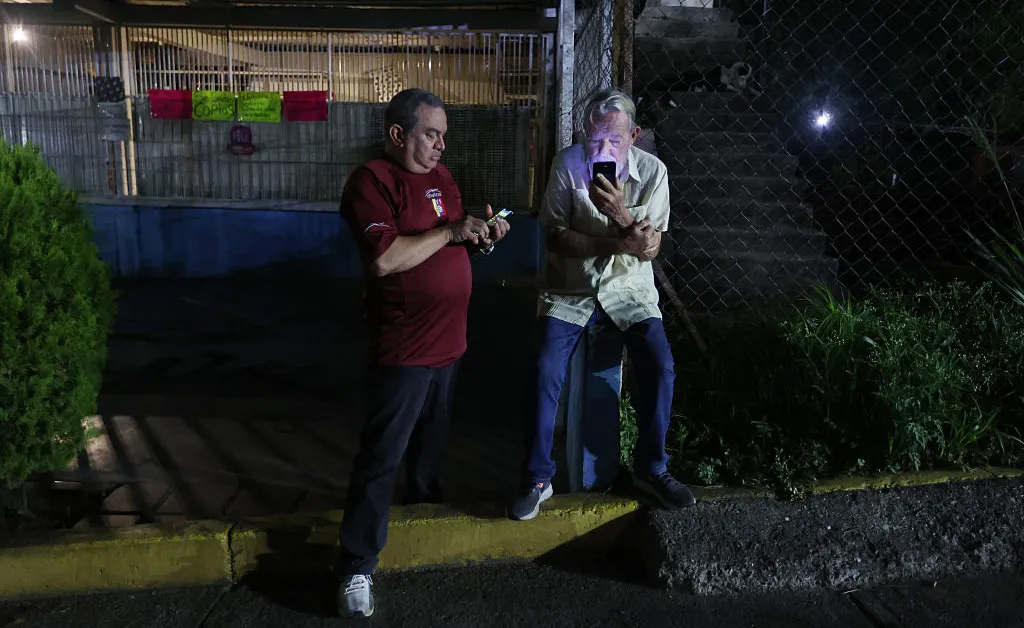
In the early hours of Saturday, January 3, a man living on the outskirts of Caracas heard explosions. “I had never heard a bomb go off, never in my life,” he said, asking not to be identified by name for safety reasons. “There is no way that you could mistake a bomb for a firework… it’s horrible.”
[time-brightcove not-tgx=”true”]
The target of the explosions was a cluster of antennas on a hill about a mile from his house, which caught fire. The following day, he found that Movistar, his cellphone provider, was down.
He wasn’t worried—he had multiple backups: an eSIM from another mobile provider, fiber-optic internet that continued to work after the explosions, and two Starlink receivers—one registered in Colombia, the other in Argentina—which connect to satellites operated by Elon Musk’s SpaceX. “You’re always over-prepared here,” he says.
Starlink’s ability to provide connectivity in conflict zones has turned Elon Musk into a geopolitical force. That night, after news broke of the U.S. capture of Venezuelan leader Nicolás Maduro, he saw an email from Starlink giving him a month of free credit for the service. “In support of the people of Venezuela,” wrote Elon Musk on X, in reference to the company’s announcement that it would provide “free broadband service to the people of Venezuela through February 3.”
The internet was a way to understand what was happening. “I thought it was a domestic coup. I didn’t think it was the U.S.,” the man, who is a lawyer, says. It wasn’t until his daughter, who lives abroad, told him to check X that he realized what was going on.
Starlink doesn’t officially provide service or directly sell receivers in Venezuela—it is one of the only Latin American countries that remains dark on Starlink’s service map, with no information about when official service might begin.
But that hasn’t stopped Venezuelans from accessing the service for a reliable connection to the internet in remote regions and as a way to get around the censorship of state-run internet providers. They rely on receivers brought in from neighboring countries, such as Colombia and Argentina. “People can get access to kits. While it’s contraband, it is accessible,” says Alp Toker, founder of the internet monitoring group NetBlocks. In the days following January 3, receivers were for sale in a Telegram group dedicated to discussing Starlink in Venezuela, ranging from $60 for older models to over $600 for the newest kit. (Starlink did not respond to a request for comment.)
Since Starlink doesn’t officially provide service in Venezuela, users register with addresses from neighboring countries. “[Starlink] knows we are outside of the country we are [registered in]” but the company has turned a blind eye, explains the Caracas-based lawyer. “That is indeed something to be grateful for.”
Many users of the service welcomed the news. “We’re starting the year off right with Uncle Elon,” wrote one member of the Telegram group, attaching a photo of the email from Starlink. The group contains more than 1,000 members.
“There is precedent for Starlink and SpaceX stepping in when communications are degraded in conflict zones,” says Lauryn Williams, deputy director of the CSIS Strategic Technologies Program. “There’s certainly a business case for SpaceX and Starlink here.”
The service was rolled out in Ukraine in 2022 shortly after Russia’s invasion. SpaceX initially bore the cost. “SpaceX was in communication with the U.S. government, with the Department of Defense, with USAID at the time, even prior to the Twitter announcement by Elon Musk,” says Williams, who worked at the Department of Defense at the time.
A few months later, the company gave the U.S. government an ultimatum: pick up the tab (reportedly about $400 million annually) or the internet would go out. Ultimately, the Pentagon awarded the company a contract for ongoing provision of the service in June 2023.
Although his fiber-optic internet was still working, having Starlink as a backup reassured the Caracas-based lawyer that he could stay connected to the outside world. “It’s like an emotional support dog,” he says. “Psychologically, it makes a big difference.”
The post Starlink’s Quiet Role in Venezuela’s Political Crisis appeared first on TIME.