The Russian Defense Ministry said on Friday that it had struck western Ukraine with a nuclear-capable intermediate-range ballistic missile, an ominous warning by President Vladimir V. Putin of Russia as U.S.-led negotiations to end the war have gained steam.
The attack was only the second time in the war that Moscow had fired that type of missile, known as the Oreshnik. The choice of western Ukraine — near the border with Poland, an E.U. and NATO member — as the target seemed intended to send a message to Europe as it strongly backs Kyiv in the settlement talks.
With the strike, Russia is escalating the fighting in Ukraine even as it has offered a muted response to challenges in other places around the globe, including in Venezuela. There, the Trump administration ousted a Russian ally, President Nicolás Maduro, last week. On Wednesday, the United States seized a Russian-flagged oil tanker in the North Atlantic that Washington had placed under sanctions for illicit oil shipments.
Russia said on Friday that it had used the Oreshnik missile and other weapons to hit drone-making and energy infrastructure in Ukraine. Explosions were reported early Friday near the western city of Lviv after the Ukrainian military warned of a potential missile launch from a Russian strategic nuclear testing site, the Kapustin Yar facility near the Caspian Sea.
The Oreshnik can carry conventional or dummy warheads in addition to nuclear ones. A Ukrainian assessment found that the warheads used on Friday contained no explosives, according to Col. Roman Kostenko, the secretary of the defense and intelligence committee in Ukraine’s Parliament. Those findings suggested that Russia fired the missile largely in an attempt to send a message, one that some European officials said they took as a threat.
The Russian Defense Ministry called the strike a response to an attempted Ukrainian attack last month on one of Mr. Putin’s residences in Russia. Ukrainian officials have called the Kremlin’s claims of an attack on the residence a lie intended to derail the peace talks, warning that Russia may be seeking a pretext to intensify strikes. U.S. intelligence agencies have concluded that there is no evidence that such an attack occurred on the Putin residence.
President Volodymyr Zelensky of Ukraine demanded global action to punish Russia in response to the Oreshnik strike.
“A clear reaction from the world is needed. Above all from the United States, whose signals Russia truly pays attention to,” he wrote on social media. “Russia must receive signals that it is its obligation to focus on diplomacy, and must feel consequences every time it again focuses on killings and the destruction of infrastructure.”
No casualties were reported in the strike by the Oreshnik. It was just one of 36 missiles fired by Russia early on Friday in an hourslong assault across Ukraine that the Ukrainian Air Force said also involved more than 240 attack drones.
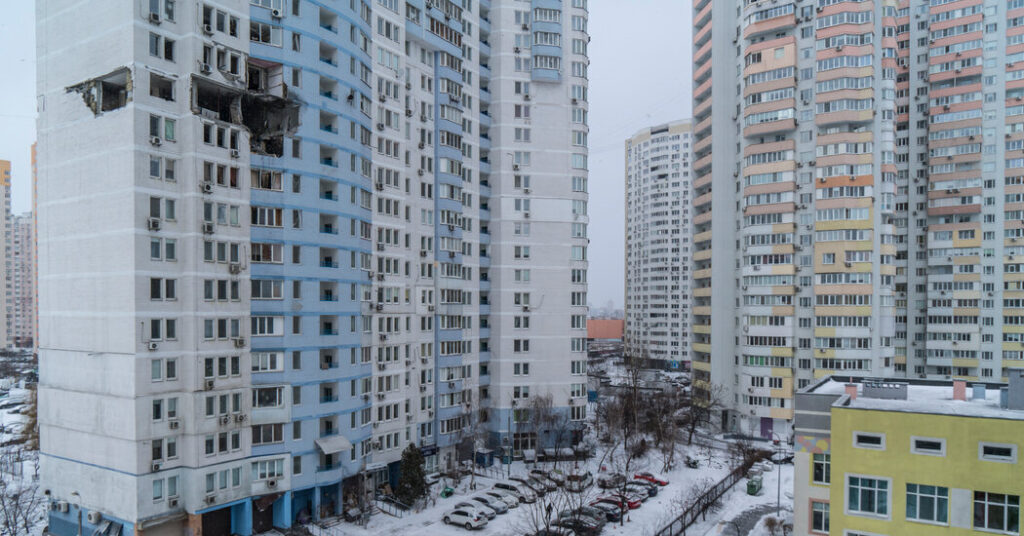
Kyiv, the capital, appeared hardest hit. At least four people were killed there, including a medic, and about two dozen others were wounded. Strikes hit several high-rise apartment buildings and also critical infrastructure, knocking out water supply in some places and heat to half of the city’s apartment buildings, according to the mayor, Vitali Klitschko.
With temperatures in Kyiv at around 17 degrees Fahrenheit, or -8 degrees Celsius, and forecast to drop further, Mr. Klitschko urged residents who could to leave the city and find warmth and electricity elsewhere.
European officials said the strikes underscored the need to not only provide more air defenses to Ukraine, but also to ramp up pressure on Russia to end the war.
“Russia’s reply to diplomacy is more missiles and destruction,” the European Union’s top diplomat, Kaja Kallas, said in a statement. “This deadly pattern of recurring major Russian strikes will repeat itself until we help Ukraine break it.”
The Oreshnik strike near Lviv, she said, was “a clear escalation against Ukraine and meant as a warning to Europe and to the U.S.”
Ukraine’s foreign minister, Andriy Sybiha, said in a statement that Ukraine had informed the United States, European nations and international organizations about the attack. He called it a “grave threat to the security of the European continent and a test for the trans-Atlantic community.”
“It is absurd that Russia attempts to justify this strike with the fake ‘Putin residence attack’ that never happened,” Mr. Sybiha wrote. Mr. Putin, he said, had fired the missile near an “E.U. and NATO border in response to his own hallucinations — this is truly a global threat.”
There was no immediate comment from the Trump administration about Russia’s use of the Oreshnik, a class of missile that was banned for decades under a now-defunct treaty.
That pact, the Intermediate-Range Nuclear Forces Treaty, was signed in 1987, and it was seen as a major breakthrough in defusing Cold War tensions. While it was effective for years, the United States later argued that Russia had been violating the pact and ultimately pulled out of the agreement in 2019, during President Trump’s first term.
Russia, which denied any knowledge of violations, said last August that it would no longer abide by the terms of the treaty. Well before that, though, Russia had been known to use missiles with ranges banned by the treaty in its war against Ukraine.
When Moscow first fired the Oreshnik in a 2024 strike on central Ukraine, Mr. Putin promoted the missile as a new development in Russia’s arms industry and a reason for the West to back away from its assistance to Ukraine.
But the Oreshnik was not an entirely new design. The Pentagon said that it was based on an intercontinental missile, the RS-26 Rubezh, which was redesigned with a shorter range. The missile carries multiple warheads that separate in flight and plummet down on a target. Ukraine has no air defense systems capable of shooting it down.
Firing it is seen as a barely veiled nuclear threat: The missile is an integral part of Russia’s strategic nuclear force.
Its launch in November 2024, Mr. Putin said, was in retaliation for a move by the United States and Britain to grant Ukraine permission to use Western-made weapons to strike deep into Russian territory.
That first Oreshnik hit an aerospace factory in the central Ukrainian city of Dnipro. It caused only minimal damage because it carried dummy warheads, suggesting then, too, a purely symbolic use of the weapon.
On Friday, the Ukrainian Air Force said that the threat of a launch from Russia was detected at about 11:30 p.m. on Thursday, before the explosions were heard in the Lviv region. The mayor of Lviv, Andriy Sadovyi, wrote in a post on social media that explosions had damaged infrastructure, but he did not offer specifics.
Andrew E. Kramer is the Kyiv bureau chief for The Times, who has been covering the war in Ukraine since 2014.
The post Russia Says It Used Nuclear-Capable Missile to Strike Western Ukraine appeared first on New York Times.