Minnesota officials and federal authorities escalated their dispute Thursday over an immigration officer’s fatal shooting of a woman in Minneapolis, with state leaders saying the Trump administration was blocking local agents from an FBI investigation into the killing and preventing them from accessing evidence.
The move, a day after a U.S. Immigration and Customs Enforcement officer shot and killed 37-year-old Renee Nicole Good in Minneapolis, ignited protests there, outrage across the country and sharp disagreements between the Trump administration and local and state authorities about what happened.
On Thursday, Border Patrol agents were involved in a separate shooting in Portland, Oregon, when trying to apprehend an alleged undocumented immigrant in a traffic stop.
The administration has repeatedly defended the ICE officer in Minneapolis and said he was protecting himself when Good threatened him with her vehicle. Vice President JD Vance on Thursday called Good’s death “a tragedy of her own making.”
Minnesota leaders have excoriated these claims, with Minneapolis Mayor Jacob Frey (D) denouncing what he called a “garbage narrative” and “bull—-” from the administration.
Gov. Tim Walz (D) said it is “very, very difficult” to believe a federal probe into the ICE shooting that excludes state investigators will lead to “a fair outcome.”
“I say that only because people in positions of power have already passed judgment,” Walz said at a news conference Thursday.
Video from the scene raises doubts about some parts of the administration’s portrayals of the shooting. Footage showed that while the vehicle did move toward the ICE agent as he stood in front of it, he was able to move aside and fire at least two of his three shots from the side, according to a Washington Post analysis.
The administration’s decision to take sole control of the investigation, combined with President Donald Trump and other officials’ staunch backing of the ICE officer’s actions, marks a break from some past instances in which local, state and federal officials worked together on high-profile probes, including in Minnesota.
After then-Minneapolis police officer Derek Chauvin murdered George Floyd in 2020, prompting widespread social justice protests, the FBI and the Minnesota Bureau of Criminal Apprehension (BCA), a state agency, carried out a joint investigation.
Minnesota has been a recurring target for Trump, his allies and officials within the administration. Republicans have recently spotlighted cases of social services fraud in Minnesota, while Trump has vehemently lashed out at the state’s large Somali immigrant population.
In December, Trump ordered immigration officials to ramp up their presence in Minneapolis. A lawsuit filed that month by the American Civil Liberties Union of Minnesota said federal officials had “violently subdued” observers and protesters opposed to the immigration enforcement efforts.
Good’s killing prompted another wave of protest, with large crowds of demonstrators gathering on Minneapolis streets overnight Wednesday and again Thursday morning. Later in the day, Walz signed an executive order authorizing National Guard troops to be deployed and “help keep the peace, ensure public safety, and allow for peaceful demonstrations.”
Homeland Security Secretary Kristi L. Noem on Thursday said that before the shooting in Minneapolis, “individuals had followed our officers all day, had harassed them, had blocked them in.” She again defended the ICE officer who killed Good, calling him “an experienced officer who followed his training.”
According to the Department of Homeland Security’s use-of-force policy posted on its website, the agency’s officers should use force “only when no reasonably effective, safe, and feasible alternative appears to exist.” The document also said officers should get medical assistance “as soon as practicable” for anyone who appears injured.
The Homeland Security policy posted online was updated in 2023. Tricia McLaughlin, a DHS spokeswoman, said in a statement Thursday that the agency’s use-of-force policy remained “the same as it was in 2023 under President Biden’s administration.”
“ICE law enforcement officers are trained to use the minimum amount of force necessary to resolve dangerous situations to prioritize the safety of the public and our officers,” she said. “Officers are highly trained in de-escalation tactics and regularly receive ongoing use of force training.”
Emily Heller, who witnessed the shooting, told The Post that the ICE agents appeared to give conflicting instructions to Good, indicating they wanted her to move her car before advancing on the vehicle.
Video from Heller’s phone, which she shared with The Post, showed a neighbor identifying himself as a doctor and trying to approach Good’s car to provide aid. The neighbor was rebuffed by officers, one of whom said: “Give us a second. We have medics” en route.
A little more than a minute after the shooting, an ICE agent knelt nearby and began to open what appeared to be a trauma kit, according to available video reviewed by The Post. Paramedics arrived on the scene nearly seven minutes after the shooting, the video showed.
Authorities initially said the investigation into the shooting would be carried out by the FBI and the BCA. On Thursday morning, however, the BCA said in a statement that it had been told by the FBI that the U.S. attorney’s office in Minneapolis “had reversed course: the investigation would now be led solely by the FBI, and the BCA would no longer have access to the case materials, scene evidence or investigative interviews necessary to complete a thorough and independent investigation.”
As a result, the BCA said, the agency “reluctantly” pulled out of the investigation.
The FBI declined to comment on the BCA’s statement regarding the investigation. The U.S. attorney’s office in Minneapolis and the Justice Department’s headquarters in D.C. did not immediately respond to requests for comment.
The shift prompted pushback from local and state authorities. The city of Minneapolis called the decision “deeply disappointing” in a statement. Sen. Amy Klobuchar (D-Minnesota), a former prosecutor, said in a statement that the FBI should work with the BCA “to conduct a thorough and transparent investigation” into the shooting.
“Minnesota must be part of this investigation,” Walz said Thursday.
The BCA said Thursday it was ready to rejoin the investigation if the FBI were to reverse course. Barring that, however, the agency said it anticipated that state officials would eventually gain access to the FBI’s investigative records.
“We expect the FBI to conduct a thorough and complete investigation and that the full investigative file will be shared with the appropriate prosecutorial authorities at both the state and federal levels,” the agency said in its statement.
Excluding the BCA from the probe “represents a change,” said W. Anders Folk, who served as acting U.S. attorney for Minnesota during the Biden administration. “That process in Minnesota has looked a certain way for a long time, and this is different.”
Folk collaborated closely with local and state officials during a years-long investigation into Floyd’s killing. He said federal authorities generally deferred to the BCA to take the lead on investigating shootings involving law enforcement officers, owing to its expertise and connections in the state. Minnesota investigators would then share their findings with both local and federal partners, he said.
Several Minneapolis police officers were convicted of both state and federal charges connected to Floyd’s death. The Minnesota Department of Human Rights and the Biden administration also both negotiated separate agreements with the Minneapolis Police Department mandating sweeping changes to policies, training and accountability.
The Trump administration last year abandoned the federal Minneapolis agreement, along with a similar pact in Louisville, days before the fifth anniversary of Floyd’s death.
Federal officials dismissed the outrage from Minnesota authorities about being frozen out of the investigation. Noem, asked about it at a news conference, said they “do not have any jurisdiction in this situation” and pivoted to attacking Minnesota’s leaders.
“They’re allowing this situation to be volatile, they’re not doing their work, they haven’t for years, and maybe they should get to work a little bit on the unprecedented fraud that we’re seeing in Minnesota,” she said. “Minnesota is a train wreck. It’s corrupt.”
Vance similarly waved away Minnesotan ire, calling the ICE officer “a federal law enforcement official engaging in federal law enforcement action. That’s a federal issue.”
Speaking at the White House, Vance also claimed without evidence that Good, a poet and mother of three, had been “brainwashed” and “a victim of left-wing ideology.” He accused her of “trying to obstruct a legitimate law enforcement officer” and called the incident “an attack on federal law enforcement.”
As protests continued following Good’s death, Minnesota leaders urged residents to continue demonstrating peacefully.
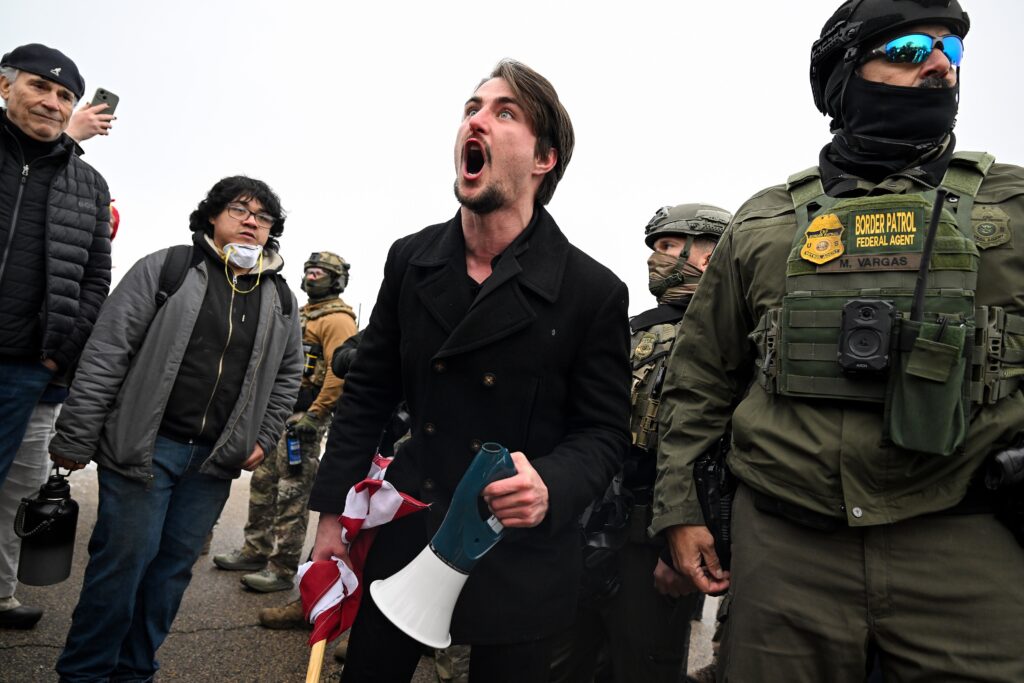
On Thursday morning, hundreds of demonstrators angered by the shooting gathered outside a government office building to heckle and scream at federal officers as they drove in and out of the parking lot.
“No more Minnesota nice; we don’t want your fascist ICE,” they chanted.
Several protesters in yellow vests stretched across the roadway, slowing federal officers as they drove into work. Another group stood along the median, shouting at them as they turned into the parking lot. Others stood farther back along the sidewalk.
One woman recorded cars as federal officers came into work, and she recited their license plate numbers into her phone. Another recorded them with one hand and flipped them off with the other.
Teresa Thomas, 58, handed out snacks during the demonstration, while a man passed out whistles so people could alert others if they saw ICE agents in their neighborhood.
“It feels like we are reliving the George Floyd moment,” Thomas said.
Marley reported from Minneapolis. Mariana Alfaro, Justine McDaniel, Derek Hawkins, Brianna Tucker, Maegan Vazquez, Amy B Wang, Caroline O’Donovan, Maria Sacchetti, Jonathan Baran, Aaron C. Davis, Annie Gowen, Jeremy Roebuck and Perry Stein contributed to this report.
The post Minnesota leaders escalate dispute over federal handling of ICE shooting appeared first on Washington Post.