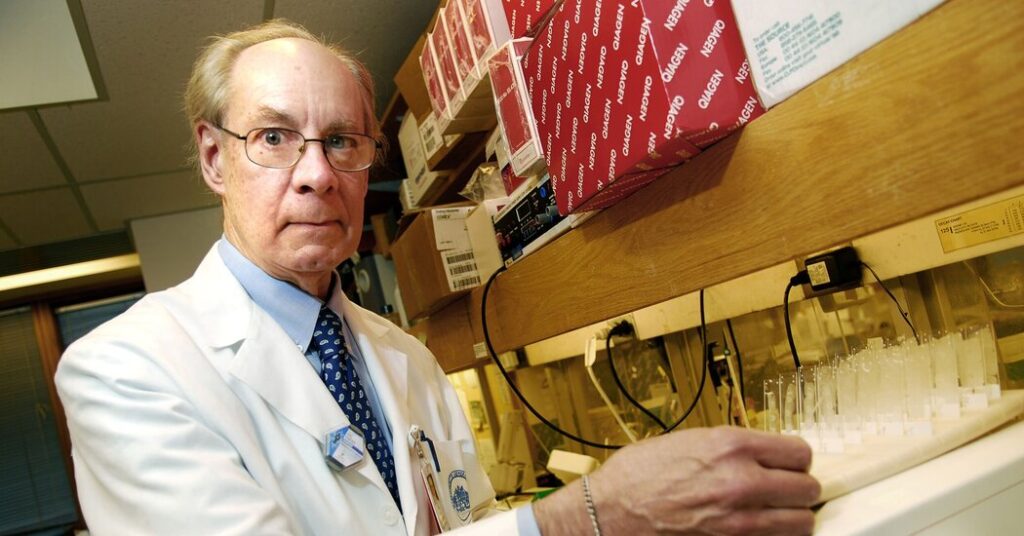
Joel Habener, an American endocrinologist who discovered GLP-1, the protein fragment that became the basis of Ozempic, Wegovy and other blockbuster weight-loss and diabetes drugs that are transforming 21st-century medicine, died on Dec. 28 in Newton, Mass. He was 88.
His death, in a retirement community, was confirmed by his brother, Stephen, who said the cause was a heart attack.
Researchers and drug companies long tried and failed to find an effective treatment for obesity, and many companies gave up on what they viewed as a lost cause.
But the drugs based on GLP-1, which have exploded in popularity in recent years, are game changers, researchers say. For the nearly 42 percent of Americans with obesity, they offer the first safe and effective way to lose weight.
The new drugs also treat diabetes and help combat fatty liver disease, sleep apnea, kidney failure and complications of heart disease. They are being studied for other conditions, too, while companies around the world race to make even more effective versions than the ones currently manufactured by Novo Nordisk and Eli Lilly.
Dr. Habener’s discovery of GLP-1, in 1987, came about almost by accident. “It was a eureka moment,” he said in a 2023 interview, “which rarely happens in science.”
He was a researcher at the time at Massachusetts General Hospital, where he arrived in 1971 and remained until his retirement in 2023.
In 1976, Dr. Habener received a Howard Hughes fellowship, a coveted research award that gave him ample, continuing support. But he had to produce.
“The demand was to show up every four or five years with an amazing discovery that was new and exciting,” J. Larry Jameson, the president of the University of Pennsylvania, who spent years in Dr. Habener’s lab, said in an interview.
Dr. Habener sought a project involving diabetes, his research focus, that was different from what other scientists were pursuing — something ambitious but achievable.
He decided to try to find the gene for glucagon, a pancreas hormone that is the opposite of insulin. Insulin lowers blood sugar levels; glucagon raises them. Dr. Habener’s hope was that if he found the glucagon gene, he could use it to help control blood sugar, which is the goal of diabetes treatments.
He wanted to work on rats, planning to isolate their islet cells, the pancreas cells that make the hormones. But someone in his lab suggested working with fish, which seemed ideal: In fish, a marble-size separate organ produces insulin and glucagon, so there would be no need to isolate pancreas cells.
Dr. Habener also had a connection: One of the scientists in the lab had a brother who was a commercial fisherman.
So, using anglerfish, Dr. Habener began to search for the glucagon gene.
But instead he found something surprising: a gene for a previously unknown protein fragment that resembled glucagon and that was able to regulate blood sugar. It acted only on the insulin-producing cells of the pancreas, and only when blood sugar was high, telling the pancreas to release insulin. It would, in theory, be a perfect diabetes drug.
The gene was glucagon-like peptide 1, or GLP-1. (Another researcher, Jens Juul Holst at the University of Copenhagen, independently stumbled on the same discovery.)
Dr. Habener said when he went home that night, he told his wife, “Hey, we made an interesting finding today,” adding, tongue in cheek, about his prospects for a Nobel Prize: “I’m going to Stockholm.”
As his research continued, Dr. Habener and his colleagues tried giving GLP-1 to human volunteers. But there was a side effect: Many subjects became so nauseated that the dose had to be reduced. The substance was making food unappealing.
“That side effect,” Dr. Habener said in 2024, “has now become useful for treatment.”
It was the beginning of what became a sea change in the treatment of obesity.
But the process of fully understanding GLP-1’s potential and making it stable enough to be a drug took years, and more discoveries by scientists in Dr. Habener’s lab and elsewhere, including Daniel Drucker (now at the University of Toronto) and Svetlana Mojsov (now at Rockefeller University), as well as work at the pharmaceutical company Novo Nordisk led by Lotte Bjerre Knudsen.
Joel Francis Habener was born on June 29, 1937, in Indianapolis, the eldest of four sons of Arthur and Evelyn (Gaebe) Habener. The family moved to Anaheim, Calif., when Dr. Habener was a child.
He graduated from the University of Redlands in California in 1960 with a bachelor’s degree in chemistry and received his M.D. from the U.C.L.A. School of Medicine in 1965. He decided to become a researcher during his residency at Johns Hopkins in 1966-67.
“Rather than caring directly for patients, I wanted to try to seek out the causes and treatments of diseases,” he said in 2023.
He spent the next two years at the National Cancer Institute doing DNA research. Then, in 1971, he got an entry-level position at Massachusetts General, a teaching hospital for Harvard Medical School, as an instructor in medicine. He remained there for the rest of his career, becoming a full professor in 1989.
In 2020, he was elected to the National Academy of Sciences. The following year, he, Dr. Holst and Dr. Drucker were awarded the Warren Alpert Foundation Prize for their work on GLP-1. In 2024, Dr. Habener, Dr. Knudsen and Dr. Mojsov won the Lasker-DeBakey Clinical Medical Research Award. All five scientists shared the Breakthrough Prize in Life Sciences in 2025.
He married Ann McFarlin, a laboratory technician at the U.C.L.A. Medical Center, in 1963.
In 2005, The Boston Globe reported that Dr. Habener had been accused of attacking his wife that June. He was indicted on charges of assault with intent to murder a victim over age 60, assault with a dangerous weapon of a victim over 60, and illegal possession of a firearm.
In 2006, he waived his right to a jury trial and was found not guilty of assault with intent to murder, guilty but not criminally responsible for the other assault charge, and guilty of illegal firearms possession. The police in Newton, Mass., said they could not offer more information about the incident because it was a domestic dispute.
A spokesman for Massachusetts General Hospital said that Dr. Habener went on a medical leave of absence after the incident and returned in 2006, in a non-patient-facing role, to continue his research.
Dr. Habener and his wife remained married after the incident. She died in 2017. His brother is his only immediate survivor.
Stephen Habener said in an interview that Dr. Habener had joined a Protestant church around the time his wife died.
“I told him awards were nothing to what he had received” by finding faith, Mr. Habener said.
Dr. Habener lost his Howard Hughes fellowship in 2006. He was then supported by grants from the National Institutes of Health until 2016, as well as by funding from Massachusetts General, pharmaceutical companies and diabetes advocacy groups.
“By the time he retired, he had a lab manager, and that was the only person he was supporting,” Jose Florez, the chair of the department of medicine at Massachusetts General, said in an interview.
Scientists who worked with Dr. Habener recalled his excitement and enthusiasm, as well as his social awkwardness.
“He was more nervous than I was,” Heather Hermann, his longtime technician, recalled of her interview to join his lab.
But Dr. Drucker, who led the GLP-1 discovery efforts on Dr. Habener’s team, recalled his creativity and enthusiasm.
“Lab meetings with him were a shower of ideas,” he said. “They were like meteors coming out of his brain.”
Sheelagh McNeill contributed research and Ash Wu contributed reporting.
Gina Kolata reports on diseases and treatments, how treatments are discovered and tested, and how they affect people.
The post Joel Habener, Whose Research Led to Weight-Loss Drugs, Dies at 88 appeared first on New York Times.