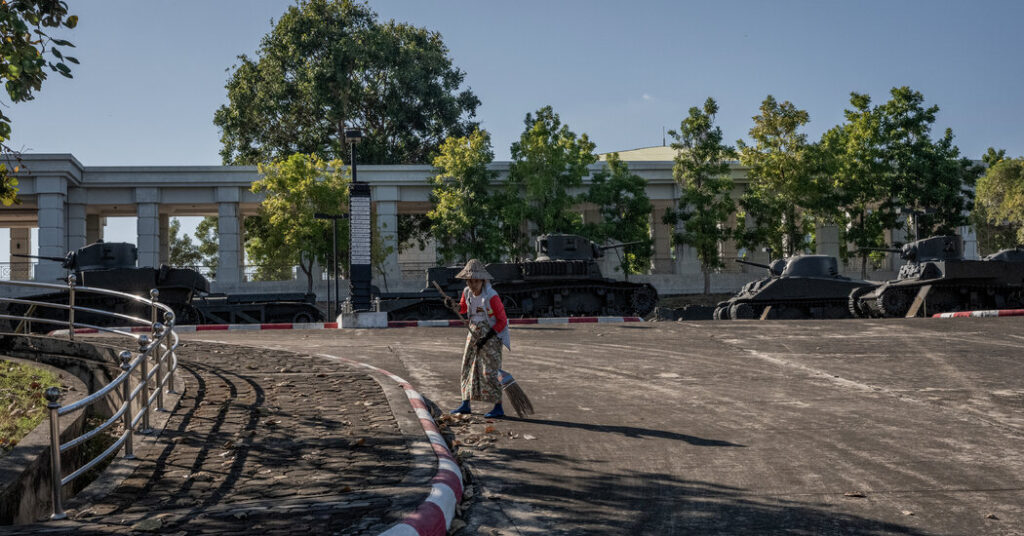
In the dictators’ capital, a worker swept a broom across a 16-lane highway. Another snipped wayward fronds from palm trees and manicured unruly rhododendrons. This was the height of a stage-managed election season in Myanmar, but there was no traffic.
There is never any traffic in Naypyidaw.
Built early this century, Naypyidaw, the capital of Myanmar, means the “abode of kings.” In reality, it is a vast bunker for the top brass of this Southeast Asian nation, who have stolen power for themselves for more than a half century. With its defensive layout and gargantuan scale, Naypyidaw stands testament to the junta’s fear of invasion — and to its tastes for the trappings of a tropical totalitarianism.
When I arrived in Naypyidaw in December, it had been more than five years since I’d visited Myanmar’s strange capital. A lot has happened since then: a 2021 military coup that yet again unseated an elected government, the re-imposition of a culture of fear in which a stray word can earn prison time, and a raging civil war that has claimed thousands of lives and displaced 3.5 million people. Through it all, the junta, led by Senior Gen. Min Aung Hlaing, has cocooned itself in Naypyidaw.
While the rest of the country suffers — from electricity and food shortages, from airstrikes and drone attacks — the generals live in luxurious villas spread across a hot plain, far from the people they have spent decades repressing. In Naypyidaw, there are electric vehicle charging stations and sculpted topiaries.
Late last month, as the junta began the monthlong election period that has been roundly dismissed by Western nations as a sham, the photographer Daniel Berehulak and I were given permission to watch General Min Aung Hlaing vote in the capital, along with a group of Myanmar journalists.
Naypyidaw is divided into strict zones: the military zone, the hotel zone, the ministry zone. Many miles separate each sector and some, like the parliament zone, have been particularly unpopulated since the putsch in 2021. Well before dawn, we gathered on the side of the highway by the Information Ministry. Then we boarded a bus, a vintage vehicle still showing the route it took decades ago in Japan.
At a checkpoint near the commander in chief’s office, marked by a flashy sign with multicolored lights, a Chinese-made X-ray machine examined the undercarriages of each vehicle. We lined up at a booth to have our faces registered and scanned by another piece of Chinese technology. But after processing a few journalists, the system appeared to give up. We entered the military zone, which is usually off limits for civilians, unscanned.
At a chandeliered hall, a red carpet unfurled and various generals, dressed in fine silk sarongs, arrived to vote. We watched General Min Aung Hlaing emerge with his left pinkie dipped in purple ink. He grinned the kind of smile reserved for someone who has left nothing to chance in these elections. The National League for Democracy, the winner of the last two polls, has been dissolved. Its civilian leader, Daw Aung San Suu Kyi, is now imprisoned somewhere in Naypyidaw.
The N.L.D.’s emphatic victories in 2015 and 2020 extended to the capital, where the electorate is composed of civil servants, the families of military officers and the armies of attendants who keep the capital clean. Yet to the generals, it was inconceivable that N.L.D. candidates, including a once-imprisoned rapper and a political poet, had prevailed in the military’s custom-built city.
The military’s overthrow of the civilian government in 2021 was rationalized as a corrective to alleged voter fraud, even if international monitors had deemed the 2020 polls free and fair. The precise moment of the putsch was unintentionally recorded in a livestream from Naypyidaw when armored vehicles rumbled behind a woman filming a jazzy aerobics routine.
Officially, about a million people live in Naypyidaw. Like so much else in Myanmar, the population figure is a farce. While generals decorated their mansions, civil servants forced to move here from the bustling former capital, Yangon, were given grim accommodations in color-coded buildings: green for the agriculture ministry and blue for health.
Even some top brass acknowledge the new capital’s deficiencies.
“I like Naypyidaw, but people who move from Yangon may not like it,” Gen. Zaw Min Tun, the spokesman of the junta, said in a rare interview. “But we are soldiers. We have to live here. We are used to places more difficult than Naypyidaw.”
In the days after the 2021 coup, Myanmar erupted into protest. Naypyidaw was not immune. Shopkeepers, drivers, gardeners, short order cooks, jewelry shop owners, timber merchants, the occasional general’s daughter — they all marched on the wide avenues, demanding the resumption of civilian rule. Perhaps it wasn’t surprising, then, that the first deadly crackdown on the nationwide peaceful uprising occurred in the capital, when a sniper killed a 20-year-old woman standing near a bus stop.
One polling station for the current election season is at a school across the street from where the woman was shot. Some Naypyidaw residents quietly told me they had been ordered to vote to counteract a boycott effort by Myanmar’s government in exile. In 2015, a parliamentary seat in this constituency was won by U Phyo Zeya Thaw, the rapper once imprisoned for his political lyrics. After the coup, he was convicted of terrorism, a travesty of justice according to rights groups. He was executed by the junta in 2022.
Naypyidaw is only two decades old, but it has aged ungracefully. The devolution has accelerated since the coup, with tiles chipping and mold creeping into corners. Hotel occupancy is abysmal. About the only regular guests are foreign military advisers and Asian businessmen willing to trade with a regime that has been targeted with international financial sanctions. So few cars travel the wide boulevards that a line of white oxen can saunter across the many lanes without fear of getting hit.
At the Naypyidaw Zoo, where I’d once watched penguins with the zoomies careen in their air-conditioned enclosure, I was told that all the birds had died. The prime exhibits, a gaunt white tiger and a pair of lions named Michael and Cindy, looked dispirited. At the entrance, two 14-year-old boys sweated in animal suits, earning about 60 cents for 10 hours of work.
When an earthquake struck central Myanmar in March, killing thousands, hundreds of buildings were affected in Naypyidaw. The earth swallowed the ground floors of civil servant housing. Many of those employees are now homeless, including women working at the Agriculture Ministry who have been consigned to bamboo shelters.
Despite Covid, the coup and the 7.7 magnitude earthquake, profligate construction continues in Naypyidaw. An enclosure for auspicious white elephants — in fact, they are more pinkish — has expanded, with beasts brought in from far western Rakhine, where armed rebels have seized most of the state.
In 2023, General Min Aung Hlaing unveiled the world’s largest sitting marble Buddha, a beatific 5,000 tons of stone that is more than 60 feet tall and cost nearly $30 million to build. About half of Myanmar’s population is now impoverished.
“Politics should not be mixed with religion,” said Ashin Nanda, a Buddhist monk in Naypyidaw.
The generals’ ostentatious displays of faith notwithstanding, their fortress capital is not impenetrable. From Naypyidaw, the view over the plains of central Myanmar ends in the Shan Hills. Just over the mountains, Myanmar’s civil war rages. Last year, rebel armed drones buzzed the capital.
Early on Dec. 28, the first date of voting, a bomb detonated near a school serving as a polling station in Naypyidaw. No one was hurt. A day later, a rebel militia briefly took over part of the highway leading from the capital to the city of Mandalay — guerrilla soldiers wandering past a road meridian bright with bougainvillea.
Hannah Beech is a Times reporter based in Bangkok who has been covering Asia for more than 25 years. She focuses on in-depth and investigative stories.
The post Inside the Generals’ Gilded Fortress, Empty Streets and Moldy Corners appeared first on New York Times.