The U.S. operation to capture President Nicolás Maduro of Venezuela was swift: In a matter of hours, helicopters carrying commandos, supported by fighter jets and a cyberattack, swept into Caracas and departed with Mr. Maduro and his wife.
But in President Trump’s broader pressure campaign against Venezuela’s government, he has leaned on a 19th century military and diplomatic philosophy that had largely fallen out of fashion: “gunboat diplomacy.”
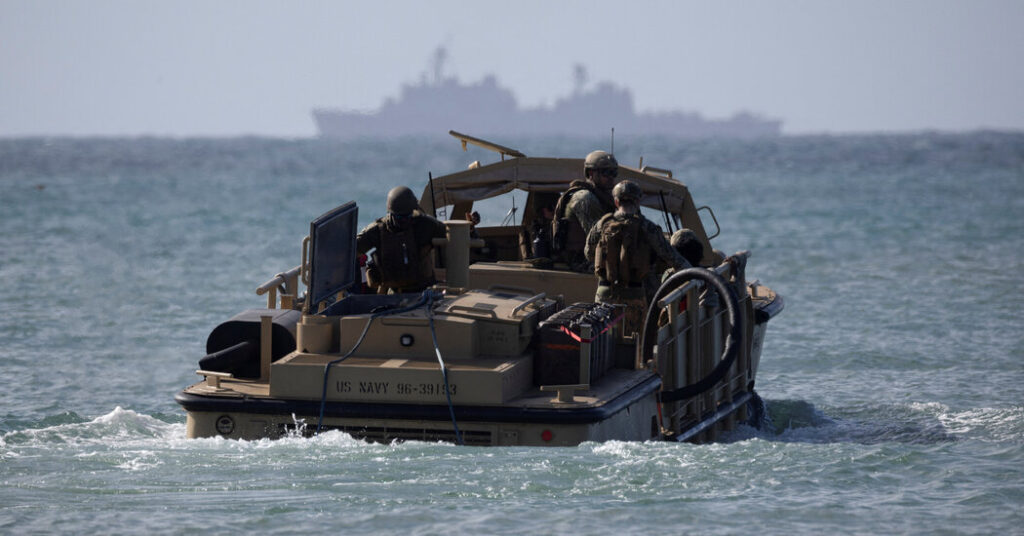
The U.S. military, which built up a large naval force in the Caribbean last year, began enforcing a blockade in December on sanctioned oil tankers going to and from Venezuela to pressure Mr. Maduro’s government. In recent days, U.S. military vessels have chased oil tankers across the Caribbean and Atlantic, seizing two. Less than a month ago, President Trump announced plans for a new “Trump class” of Navy warships to “inspire fear in America’s enemies all over the world.”
It has all amounted to a return to prominence for the idea of “gunboat diplomacy.” Here’s what to know about it.
What is ‘gunboat diplomacy’?
The term refers to the threat or use of military force to negotiate foreign policy. Traditionally, “gunboat diplomacy” employs threats and intimidating displays of naval force to pressure a sovereign nation to behave a certain way.
It harks back to 19th century imperialism, when the seas were a key battlefield for global powers like the United States and Britain, as ships were the fastest way to mobilize militaries at the time. In the American context, experts widely trace the term to 1853, when Commodore Matthew Perry led a group of Navy warships to the bay of Tokyo, hoping to pressure Japan to negotiate trade agreements and diplomatic relationships with the United States (including for oil, historians say).
While Commodore Perry was prepared to engage with force, he arrived with four ships to find that the Japanese government had decided to negotiate.
Gunboat diplomacy was a precursor to the “Big Stick” diplomatic tactics of President Theodore Roosevelt, who virtually trademarked the use of military posturing and threats to pressure other nations. (The term refers to a phrase popularized by Roosevelt, “Speak softly and carry a big stick.”) While Big Stick diplomacy applies to broad displays of military power, gunboat diplomacy is more closely associated with displays of naval force.
But the practice of using naval force to bring an adversary to heel is as old as civilization itself, said Steven Wills, a former U.S. Navy officer who is a researcher at the Center for Maritime Strategy, a nonpartisan think tank that studies maritime issues.
“Navies have been using this ever since the Egyptian pharaoh Hatshepsut,” Dr. Wills said, noting the ruler once deployed a fleet of ships to the shores of present-day Somalia.
What are some other examples of gunboat diplomacy?
The clearest examples of traditional gunboat diplomacy are mostly from the 19th and early 20th centuries, and primarily by the era’s naval superpowers, including Britain’s Royal Navy, the Dutch and the Americans.
Along with the Americans in Japan, the British Royal Navy used gunboat diplomacy in the First Opium War, deploying powerful warships to force the Qing dynasty in China to negotiate on trade and diplomatic relations.
This is not the first time Venezuela has been on the receiving end. In 1908, the country was plunged into crisis when it cut off trade to the Dutch Caribbean islands and expelled the Dutch ambassador. The Dutch responded by dispatching three warships to Venezuelan shores, where they strong-armed and intercepted ships until the Venezuelan government capitulated, and reestablished trade with the Dutch.
Does gunboat diplomacy still happen?
After World War II, as global battlefields shrank and the seas became less contested, gunboat diplomacy took a back seat to soft power negotiation tools, like “dollar diplomacy” and other types of economic pressure including sanctions.
The United States, specifically, backed away from gunboat diplomacy even before World War II, after centuries of using the strategy to influence its neighbors in South and Central America.
“The Latin Americans really resented gunboat diplomacy,” said William LeoGrande, a professor who specializes in Latin American and U.S. relations at American University’s School of Public Affairs.
Sensing bad relations could be problematic in the event of a global conflict, President Franklin D. Roosevelt embraced a “good neighbor” doctrine. He vowed to stop bullying the United States’ southern neighbors, and overt displays of force by the American military in the region faded.
But gunboat diplomacy is still used in parts of the world, particularly where contested territory has a coastline. In the South China Sea, the Chinese government regularly uses its naval assets to menace Taiwan, a democratic state whose independence China has long contested. The Israeli military employed naval blockades of Gaza starting in 2007, when Hamas took power in the enclave, sometimes detaining and diverting humanitarian vessels carrying aid.
Still, the term is dated in a 21st century threat environment, said Stephen Walt, a professor of International Affairs at the Harvard Kennedy School.
“I probably wouldn’t use the term ‘gunboat diplomacy’ anymore,” Mr. Walt said. “There are no gunboats involved.”
A more appropriate term, he said, is the broader “coercive diplomacy,” or using the threat of force to make another country do what you want, regardless of the specific type of force.
Is what happened in Venezuela this week really a good example?
“It’s a perfect example in some ways,” Dr. LeoGrande said, noting the use of a traditional naval blockade off Venezuela’s shores.
But there are some key differences between traditional gunboat diplomacy and what the Trump administration has done in Venezuela, experts said. Unlike most examples of the strategy, the operation that captured Mr. Maduro was not bloodless posturing — about 40 Venezuelans and at least 30 Cubans were killed in the operation. The C.I.A. was involved, and so were elements of the Justice Department and various other components of the military.
“It’s more than just basic gunboat diplomacy. This really gets into what navies can do,” Dr. Wills said.
But the Trump administration’s actions in the sea around Venezuela before and after the raid — stationing large Navy ships, creating a blockade and seizing ships — is drawn from the gunboat diplomacy playbook honed over thousands of years.
Ali Watkins covers international news for The Times and is based in Belfast.
The post In Venezuela, Trump Revives ‘Gunboat Diplomacy.’ What Is It? appeared first on New York Times.