Angry orange flames crackled in every direction. Mario Miralles was hiking more than two miles into a canyon northeast of Los Angeles, clearing fallen tree limbs off the road to create a possible escape path.
He desperately needed to reach his cabin in the forest, his place of refuge, where he had crafted world-class violins for decades. When he and his girlfriend, Noël Shimizu, made it to the workshop at last, he felt himself spinning as he scanned the room and wondered: “What can’t I afford to live without?”
She told him to take his hang-glider harness. He would surely need to decompress, she reasoned, whenever all the chaos ended.
He scooped up his brother’s Martin guitar. He could not fathom letting it burn.
And he seized a violin he had been making for the better part of 10 years. It was almost finished. He owed it to the conductor Gustavo Dudamel.
A year later, the breadth of the Eaton fire’s destruction in Altadena, Calif., is vast: residents killed, thousands of buildings destroyed, a neighborhood forever changed and a deep wound to Miralles’s livelihood.
Miralles, 62, is a renowned luthier who has made a cello for Yo-Yo Ma, violins for decorated musicians, and countless string instruments for principal players and young students alike. His craftsmanship and expertise are prized. “Every maker’s personality is imprinted — like their DNA is part of the instrument,” said the violinist Anne Akiko Meyers.
Making a world-class string instrument requires world-class wood. And gathering that wood required frequent trips to European vendors over a career of more than 40 years.
Like a wine enthusiast, Miralles had refined his collection. Spruce from the Dolomites in Italy for the tops of the instruments. Maple from countries in and around Bosnia for the backs, sides and necks. Cello wood that was at least 150 years old. He might spend three days at a vendor and end up with five pieces, some of which cost as much as $5,000 each.
He kept his collection in a rented storage unit before moving it into an insulated shed outside his home in Altadena, a suburb tucked beneath the mountains where he had spent much of his childhood. Sometime in 2024, he allowed himself two thoughts: “I finally have enough wood for the rest of my life” and “I love it all.”
The house was a place for Miralles to interact with customers and also to protect his raw materials, his artwork, his copious notes and his grandfather’s drafting tools — “all the stuff that I wanted to make sure was safe,” he said. It brought him comfort that there was a fire station just down the street.
‘Clearly Mario’s Sound’
Miralles, one of seven children to architects, was a decent cellist as a child, but his interest fizzled as a teenager. After he returned to music, he applied to the Violin Making School of America in Salt Lake City, where he met Peter Beare, the son of an internationally renowned violin expert.
Beare, who helps run the family company, would invite Miralles to London to study Stradivari violins. Even after Miralles won recognition when one of his cellos was entered into a competition, all he wanted to do was go to Europe to learn more.
“The great instruments are better teachers than any living human,” Beare said.
Miralles realized that though he had learned a very Germanic and symmetrical method of instrument making, there was nothing uniform about the great 16th-, 17th- and 18th-century pieces he was inspecting. He became fixated on unearthing century-old transcripts and unraveling complex geometric designs.
He also observed that some of the most sublime instruments seemed to be made of the same kinds of wood. He became a “nightmare for wood dealers,” he said. He would measure a plank’s flexibility, its weight, its density. He would examine its figure and grain width. He found that by drawing his thumbnail across certain wood, he could almost strum it: hard grain, soft grain, hard, soft. He could listen, and hear how a piece would transmit sound.
Business exploded after Miralles made a violin for the principal of the Los Angeles Philharmonic in 1996. When Ma approached to ask him for an instrument, which these days can cost $50,000 to $80,000, Miralles replied: “You’ll have to wait three-and-a-half years.”
Meyers entrusts Miralles to care for her own extraordinary instrument, crafted by Guarneri del Gesù in 1741, and has played Dudamel’s violin at a concert. “It sings,” she said. “It has this resonance through it that is clearly Mario’s sound.”
That Miralles saved the instrument during last year’s deadly wildfires in Altadena and the Pacific Palisades gives it extra meaning for Dudamel, who will finalize his transition from the Los Angeles Philharmonic to the New York Philharmonic this year.
“It carries the memory of resilience, strength and hope in the face of destruction,” Dudamel said in a statement. He added, “Every time I play it, I am reminded of how the people of Los Angeles rose with humanity, generosity and grace during a moment of profound loss.”
Rubble and Repairs
When Shimizu, Miralles’s girlfriend, insisted they evacuate his cabin on Jan. 7, 2025, he could not be bothered. He was buried in his work. Still, they packed up and drove west to Shimizu’s home.
It was only when Miralles got a text from his ex-wife at 3:27 the next morning that he became concerned. She was being ordered to leave their Altadena house and would flee with nothing but a laptop.
So that afternoon Miralles decided to see what he could save. High winds had whipped trees and power lines onto the road. As he and Shimizu drove through the smoke, they passed burning houses and could make out the figures of firefighters standing helplessly nearby, without any water to use.
The roads were closed. So they parked in southern Altadena and began to hike. They would stop at his home, a little cottage made of beautiful redwood, on the way to the cabin. He wanted to see if his home and the precious cache of wood in the shed were OK.
But even from a distance, Miralles could tell that the house was gone. He walked up to the smoldering rubble anyway. He felt its heat.
The fire had reduced the shed — and all of the wood within it — to ash.
Miralles put his hands on his knees and leaned forward as if he might suddenly collapse. Instead, he circled what was left of the structures and said, “It’s all gone.”
They stayed for only five minutes. The sun was setting, the winds could pick up and they needed to get to the cabin. After rescuing Dudamel’s violin and his brother’s guitar from it, he hiked back out, assuming the cabin would be destroyed.
Miraculously, it is still standing, even though many of the buildings nearby are completely gone. But the roads have been impassable for months. And although he is still trying to assess the damage, the cabin is uninhabitable.
His house in Altadena has not yet been rebuilt.
“Almost every night I wake up with a nightmare about something that I’ve lost,” Miralles said.
Someone might ask for a grinder and he happily offers his own, only to realize he does not have one anymore. He might seek to start on a new instrument, only for it to dawn that he must redo his meticulous drawings.
A season hang-gliding in Europe helped his recovery. Friends from that community brought him clothes in the days after the fire and helped raise funds so he could get by. Another violin maker invited Miralles to Providence, R.I., so he could finish Dudamel’s instrument without distraction.
These days, Miralles is mostly doing repair work. The Colburn School in downtown Los Angeles offered him an office, and he has enjoyed helping high school and college-age students when they drop by, with their enthusiastic smiles and sharp ears.
“He’s kind of a Zen master at assessing what’s wrong with an instrument,” said Margaret Batjer, the director of Colburn’s music academy and the concertmaster of the Los Angeles Chamber Orchestra.
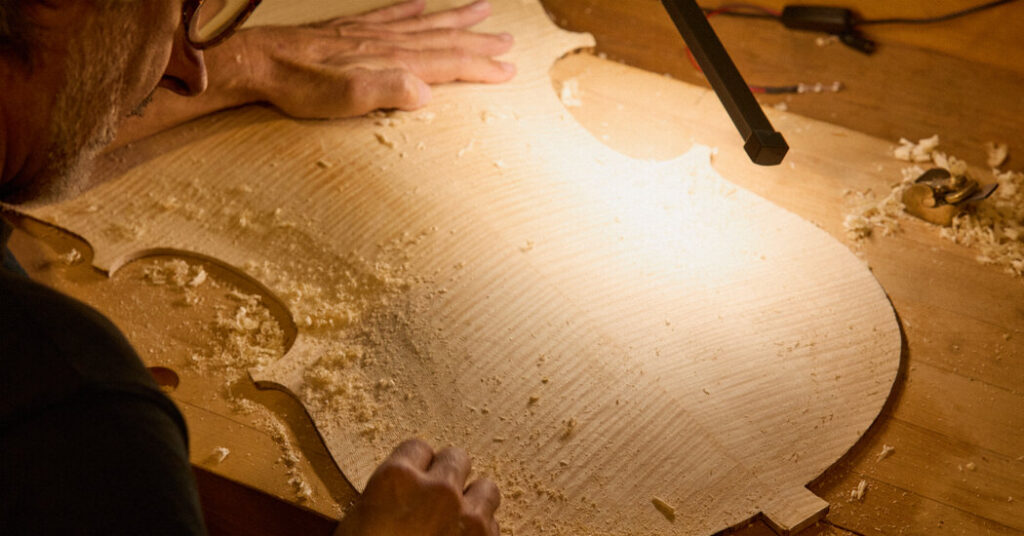
Just before Thanksgiving, Miralles plunged his gouges and planes into wood to begin crafting a pair of cellos, his first new instruments since the fire. The carving felt good, said Miralles, who has also found joy in rebuilding his wood collection. Friends donated some of their own, and during his travels he visited some favorite vendors.
In his adopted office, a few seemingly unremarkable planks rest against the wall, atop a cabinet. He had coveted one in the past but could not afford it then, so the vendors set it aside. Now was the time to finally make the purchase: a piece of maple, cut more than 100 years ago, that could sing for centuries.
Matt Stevens is a Times reporter who writes about arts and culture from Los Angeles.
The post In the Path of a Raging Wildfire, a Luthier’s Precious Wood appeared first on New York Times.