President Trump called his telephone conversation Wednesday night with President Gustavo Petro of Colombia a “Great Honor.” In return, Mr. Petro said it was “Historic.”
It was a complete break with the two leaders’ approach, for nearly the past year, of using social media to attack, often in derisive and caustic posts, each other’s politics and personalities.
That unexpected shift in tone — and a possible return to dialogue between two countries that have long been staunch allies — has the potential to alter the course of events in a newly volatile region after the United States seized Venezuela’s president.
If it does, it would be thanks to a call hastily arranged by members of both governments after Mr. Trump seemed to threaten Colombia, and other countries, with military action on Sunday.
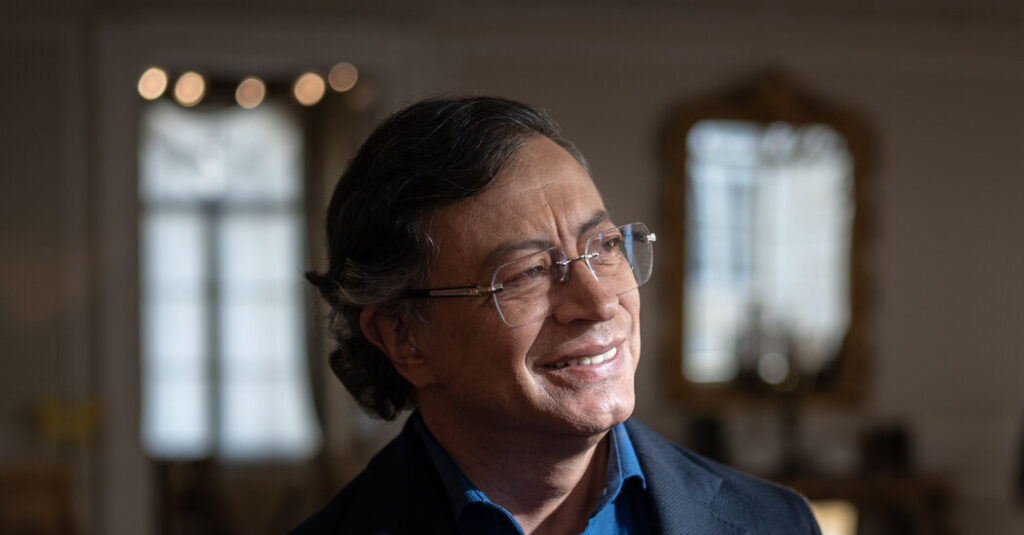
In an interview with The New York Times on Thursday, his second in two days, Mr. Petro, a strident, 65-year-old leftist who tends toward meandering monologues, said he had spoken for most of the 55-minute call, the first between the two leaders, allowing Mr. Trump to speak only in the last 15 minutes.
Mr. Petro said no demands or concrete proposals for collaboration were made; that would come later — perhaps during an upcoming White House visit that Mr. Trump announced in a warmly worded social media post after the call.
The exchange raised the possibility that Mr. Petro, like left-leaning leaders in Brazil and Mexico, might be able to avoid the punishment threatened by Washington, such as unilateral military action or additional tariffs, and walk a fine line between fulfilling Mr. Trump’s demands and remaining true to his ideology. Mr. Petro, facing term limits, leaves office this year, and elections are scheduled for May.
While Mr. Petro described the call as “friendly,” he also made clear that he would not conceal his beliefs to appease Mr. Trump and would seek to make his case through dialogue.
In the interview on Thursday, Mr. Petro indicated that he still planned to question Mr. Trump’s support for fossil fuels over renewable energy. He also called U.S. Immigration and Customs Enforcement, or ICE, whose agents were involved in a fatal shooting this week in Minnesota, “fascist.”
Asked if he had been counseled to temper such language in advance of the White House visit, he laughed and said, “I have to say what I think.”
The topic on which the two leaders seemed to agree was the need to aggressively tackle drug production and trafficking, Mr. Petro said. “He didn’t talk about Venezuela, or any global topic. He wanted to focus on one specific topic, narco-trafficking,” Mr. Petro said of Mr. Trump, who spoke with Mr. Petro as officials including Vice President JD Vance and Secretary of State Marco Rubio were in the room.
Mr. Petro’s own stance on the issue seems to have hardened, with the suspension of peace talks with the E.L.N., a Colombian revolutionary group turned narco-guerrilla that has increasingly clashed with government forces and rival groups, especially along the border with Venezuela, and which was named in the U.S. government’s indictment against Mr. Maduro. Mr. Petro said that last weekend he had told his security council to authorize an intensification in military operations against the group.
Mr. Petro also reiterated to Mr. Trump that cocaine seizures were at a record high. The growth rate of coca cultivation in Colombia has been slowing, but it is still at historic levels, as is cocaine production.
Just days before their cordial phone call, Mr. Trump accused Mr. Petro of being a “sick man” running “cocaine factories” shipping drugs to the United States and, when asked about the possibility of military action against Colombia, responded, “sounds good.”
Mr. Trump’s threats were taken seriously by Mr. Petro, and also by his foreign minister, who said the Colombian military was powerful and prepared to respond.
At the same time, however, some in the Petro government were scrambling for a way out of what, at least on the surface, seemed like an escalating crisis.
At the center of that effort was Colombia’s ambassador to the United States, Daniel García-Peña, and Senator Rand Paul, a Republican from Kentucky, who Mr. Petro and Mr. García-Peña said was instrumental in arranging the phone call between the two leaders.
Mr. Paul has fiercely opposed U.S. foreign intervention. Mr. García-Peña said he had talked to more than 100 U.S. lawmakers in recent months in an attempt to arrange a meeting between Mr. Trump and Mr. Petro, but that Mr. Paul’s concern that Mr. Petro might meet the same fate as Mr. Maduro, dragging the United States further into conflict, was sincere.
“We had a long, long conversation,” Mr. García-Peña said, referring to Mr. Paul, “And that’s when I asked him if he could help us to reach out to President Trump.”
The senator’s office did not immediately respond to a request for comment, but Mr. Paul told reporters on Thursday that Mr. Trump’s response to his request for a phone call had been “of course,” and added that, “Mr. Trump, I think, still does want diplomacy and peace.”
Prominent politicians in Colombia across the political spectrum — including Juan Manuel Santos, the former right-wing president who won the Nobel Peace Prize for negotiating a pact to end Colombia’s decades long conflict — largely breathed a sigh of relief.
Senator Iván Cepeda, a supporter of Mr. Petro and a left-wing candidate to succeed him as president, not long ago defended Mr. Petro when he accused Mr. Trump of “murder” for the lethal U.S. airstrikes on boats the Trump administration claims were smuggling drugs.
After the call with Mr. Trump, Mr. Cepeda, in an interview, said Mr. Petro’s dialogue with the American president “is what’s desirable, necessary,” adding, “From my perspective, not as a candidate but as a Colombian citizen, I welcome whatever initiative may lead to a path of peace in our region.”
Mr. Petro spent much of the week warning online that Mr. Trump’s threats had awakened the “jaguar” in Latin America, using a word used to refer to anti-imperialist sentiments in the region, and called on the nation to demonstrate on Wednesday night.
The rally in Plaza Bolívar, in Bogotá’s historical center, left behind anti-American graffiti and posters with slogans like, “We are a dignified and sovereign people.” A Colombian flag was tied around the statue of Simón Bolívar, Colombia’s liberator from Spanish rule.
The mood was far different the next day.
As Mr. Petro sat down for another interview with The Times on Thursday, he said, “When did we speak last? Yesterday afternoon? There are days that feel like years.”
Jorge Valenciaand Genevieve Glatskycontributed reporting from Bogotá, Ana Ionovafrom Río de Janeiro, Jack Nicasand Emiliano Rodríguez Megafrom Mexico City, and Robert JimisonandEdward Wongfrom Washington.
Annie Correal is a Times reporter covering Mexico, Central America and the Caribbean.
The post How an Abrupt Call Between Trump and Colombia’s President Averted a Crisis appeared first on New York Times.