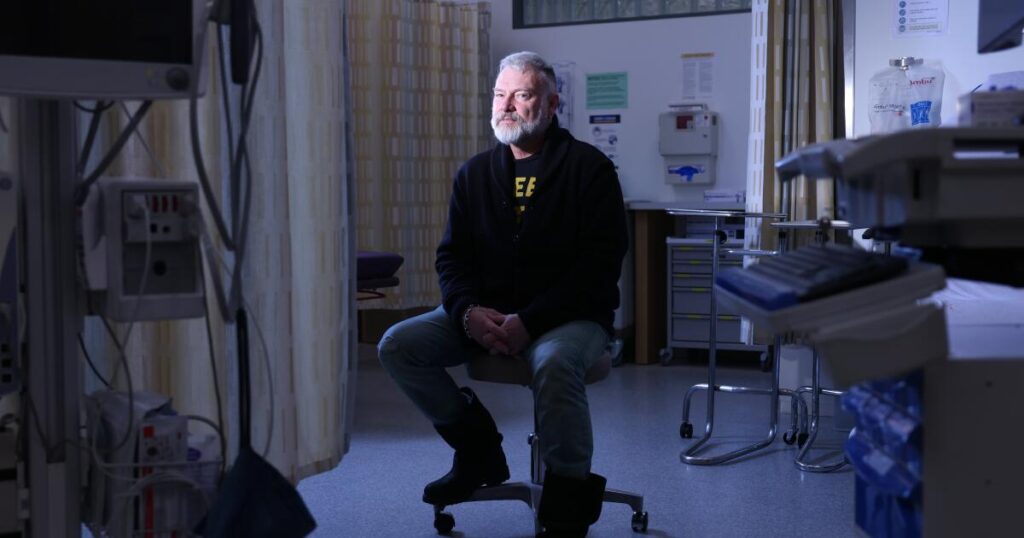
R. Scott Gemmill, the creator and showrunner of “The Pitt,” has always felt comfortable in a hospital.
He initially had ambitions of going into medicine — he studied gerontology, which explores the processes and problems of aging, and did some volunteer work at hospitals. He also took a nurse assistant course.
“I really thought I was going to try and get into a med school,” he said recently while seated in the recognizable lobby of the show’s fictional hospital set on the Warner Bros. lot in Burbank. “I just wanted to have a job and medicine seemed like there was always going to be a need. I’m comfortable in a hospital. I wish I followed through on a certain level because I loved that ability to go in and solve problems. But my writing kicked in and that’s it — I never went back.”
But in TV land’s school of medicine, Gemmill has gone far. He did a rotation at Chicago’s County General Hospital, joining the writing staff of NBC’s popular medical drama “ER” in its sixth season. And now his turn at Pittsburgh Trauma Medical Center, through HBO Max’s “The Pitt,” has been a breakout success, revitalizing the medical drama genre with a fresh spin on the format — each episode tracks one hour in a shift — and energizing its audience with a traditional weekly rollout. The Emmy-winning series returned Thursday for its second season that revolves around a shift on the Fourth of July. But the fireworks arrived well before that, with HBO Max announcing on the eve of the show’s premiere that the drama has been renewed for a third season.
In the hiatus before shooting began on this season’s finale, Gemmill, whose other TV credits include “Jag” and “NCIS: Los Angeles,” talked about the show’s momentum heading into the new season, navigating how personal to get with characters, and introducing a new doctor to the mix.
You started breaking Season 2 last January, as people were discovering the show week to week. People love to be critical of sophomore seasons of a breakout hit. How did that shape the second season for you and the writers?
It was weird because we wrote [Season 1] without any feedback. Not just wrote it — we shot it and produced it. We had started thinking about Season 2 before people had responded. It was a slow build. I felt like the healthcare professionals found us first, then spread through word of mouth. We were just moving forward with what we thought were the next stages of these characters’ lives. It wasn’t until later on that the accolades came and there was more pressure then. When we first started, we didn’t know if anybody was going to watch or not. We had finished it without any pressure whatsoever because nobody had weighed in on it. It was a very rarefied situation, which was nice. We hope for the best. And it seemed to work out OK. There’s a little bit of concern going into the second season because we were successful, you wonder, can you maintain that? But we try not to focus on that, and just really focus on the characters and the stories and do what we did the first season — tell really authentic, strong stories.
The season picks up 10 months after that initial shift where we met everyone. How did you decide on the time jump, landing on July 4?
It really came from wanting to have Langdon [Patrick Ball] back, so I knew he had to do about 10 months of rehab. Then we were looking at what time of year would that be. We’re also somewhat limited by when we shoot in Pittsburgh. We decided to do the Fourth of July because it comes with a bunch of shenanigans.
Season 2 opens with a helmet-less Robby riding in on a motorcycle.
The motorcycle goes back to some part of Robby’s past. We don’t really talk about it, but it has a link to his father, and his father being a tinkerer of old cars and Robby needing a vacation, a hiatus of sorts. Pennsylvania is a no-helmet law [state]. And some of us who have motorcycles sometimes enjoy riding them without a motor helmet. It’s not a smart thing to do, and it speaks to Robby’s current attitude of a certain amount of carelessness on his part.
Yes, we learn that he’s going to be taking a three-month sabbatical. How soon will we discover what led to that? Is it an amalgamation of different things?
Yeah, he’s long overdue for a vacation. He knows that something’s not working in his life and this is one way he thinks that he can fix things.
How did you land on Head-Smashed-In Buffalo Jump in Canada as his choice for a getaway?
It was a place I knew about and it just sounded like an interesting place for him to go that has some foreboding associations with it.
The season introduces a new character, Dr. Baran Al-Hashimi, played by Sepideh Moafi, who’s going to be taking over when Robby is out. She’s an advocate of generative AI and trying to get everyone on board with this idea of saving time with charting. What were your conversations with doctors in the field about that topic and what intrigued you about how healthcare professionals are thinking about this technology?
She’s someone who’s a little different with her approach, a little more contemporary and forward, as opposed to Robby; he bridges contemporary medicine and old-school medicine with his relationship that he had with Dr. Adamson, who showed him a lot of the old-school techniques that he still has in his wheelhouse if he needs them. AI is pretty much here to stay and it’s infiltrating every aspect of our lives — medicine is no exception. I would say it’s still in its infancy in the ER, but there are ways that it’s trying to be implemented. Like any other tool, it has potential to be used wisely and potential for disaster. We’re not really exploring the disastrous side of it yet but just what the realities are. The fear is that it will make the doctors more efficient, especially with things like charting, but then will that time go back to the patients or will they just have to see more patients? And so they’ll have even less time. That’s the challenge at this point.
How do you feel about it in your own industry?
I try not to think about it. I guess I’m probably in denial more than anything. I don’t have any place for it and I don’t really want to really know too much about it at this point.
We see a lightness to Robby this season. He’s involved in a situationship at work. This is a workplace drama. It hasn’t shown us the interior lives of its staff beyond the nuggets they share during their shift. How much do you want the viewers to know about them versus how much do you want your actors to just understand their characters?
It comes with the job. He’s not a monk. He’s in a relationship of convenience more than anything. I don’t think he’s a long-term planner. The fact that he hasn’t had a vacation in forever is proof of that. Robby is very good at putting on a good face until he’s not. I think what we’ll see over the course of the season is that facade start to slide.
It’s a process. The 15-hour nature of the show limits how much of that information you can dole out organically, but it also allows you to be authentic in terms of how much you actually learn about someone in a day. Most of us not just spilling our guts and saying our life story to the people we work with. As we start the season, we’ll think about: What is the journey we’re going to take this character on, and what information needs to be learned in order to achieve that? And then what medical stories will help maybe bring that out. You do it in little layers.
Is there something coming up that you think will be particularly illuminating?
There’s some stuff about Robby. We pulled back a lot on it, but we’ll learn a little bit about him. We’ll learn some things about Whitaker [Gerran Howell]. We know what Langdon is going through, his marriage.
To stay on Langdon — physicians and people in the healthcare profession are vulnerable to addiction for a variety of reasons. What was important for you in that storyline and what did you want to explore through him?
To show somebody who’s made a mistake and was doing their best to hide it as is sometimes the pattern of behavior. I don’t think most people enjoy their addiction. So, seeing someone who’s doing their best to try and heal themselves. Just because you’re going through the program and doing the steps, it doesn’t mean everyone’s going to welcome you back with open arms. There are still some bad feelings and you have to mend some bridges and fences along the way.
It’s not just Robby and Langdon. Langdon feels he owes a sort of mea culpa to almost everyone he works with, especially Santos [Isa Briones]. And whether or not she’s willing to accept that is debatable. Robby, obviously, has some really strong feelings about it because Langdon was his student, and he made Robby look kind of stupid. Robby is angry at himself for not seeing it.
How are you figuring out who’s going to shuffle in and out?
Some of it’s based on the reality; for instance — I was thinking of this today — next season would be Whitaker’s third year, so he has one more year to stay here, and then he would have to go. It’s really about where they are in their careers and what makes the most sense story-wise.
I want to talk about some of the procedures and cases that we’ll see this season because they’re pretty gnarly. Do you keep a log of cases and try to figure out how they can fit into the story as you go?
We never really start with the medicine. Sometimes we say the medicine is the wallpaper that reflects everything in the room, but what’s going on between the characters is really what’s at stake, and it’s either something going on between them and the patient, between the doctors and nurses, or internally. Ideally, it touches on a little bit of everything.
When we came back, I probably had 150 ideas of just cases. I don’t know how many of them we actually did. We had never done a hot toddler story, [where a child was overheated] but that is something that’s a real problem. That was one where we knew we were going to try and do that story, but whose is it going to be? Who does it reflect most? Then we work backwards into it. We pull from everywhere — things we think of, things we’ve heard, things we imagine. We don’t really do ripped-from-the-headlines, but we do things that seem like that because a lot of times we’re talking to professionals, asking them what was concerning them. What do they worry about? We’re extrapolating their concerns. That’s what happened with [Season 1’s] measles story. There was no measles outbreak when we wrote that story, but we knew, based on what was going on, that there would be eventually, and we just happened that the timing was in our favor.
Is there like a line you won’t cross in terms of squirm factor? Have you had to pull back?
I don’t think so, because we’ve never done anything for the sake of that. We’ve never done anything that’s not done in the ER. As long as it serves a story and a character, then I think it’s fair. We do something big for the finale that Abbot [Shawn Hatosy] and Robby are doing with a bunch of others — it takes all hands on deck. I’m interested to see how that comes out, and I’ve seen elements of it now that are terrific.
Can you share more of what kinds of topics or cases we’ll be seeing this season?
We did a sexual assault, [and] we’re looking at how budget cuts are affecting healthcare. There’s a story about someone who’s been rationing their insulin and the downsides of that.
When the One Big Beautiful Bill Act was signed into law by the president, did you have a lot of calls with professionals?
Oh, yeah, because it’s a huge issue. You figure out with the changes in the Affordable Care Act, if you suddenly have 8 to 10 million people that don’t have insurance, what’s going to happen is they’re going to stop going to their doctors. Anything that was an issue is going to get exacerbated by not being treated. So, where do they end up? Well, they’re going to end up in the ER, but they’re going to be even sicker than they would have been. We’re going to get more people, and their conditions are going to be worse. It only makes what’s already a strained system even more likely to break. Because we were just starting to shoot in the summertime, we could make some adjustments, but I don’t remember going back and changing things. We saw it coming.
I know there had been some discussion about an ICE story? Will we see that this season?
Yes, we have some ICE agents show up, and how that affects people in the hospital. That’s been a tricky one to try and get right without being heavy-handed and being fair to everyone on both sides of that conversation. What else do we do this year? Some fun stuff. The kind of things you would expect over the Fourth of July weekend.
How do you feel about the shipping that’s taking shape with “The Pitt” fan base?
I’m not on social media, I’m not really a part of that. My writers would tell me about things like that. The Langdon-Mel of it — I’m like, he’s married. That’s more of a big brother relationship. And Abbot and Robby — I just sort of shake my head. Our show’s not really like that. It’s not a show where people are sneaking off to have sex in a closet or anything. Those things are very subtle. And we do see a little bit this season between a couple of people, but it’s very much secondary because it’s not something we actually see, per se.
Just as he did last season, Noah Wyle is writing again this season. He’s also directing. Tell me what it’s like when you have the lead of your show involved in different aspects of the show’s creative elements?
It’s really great because he’s up to speed on everything. And because he is the centerpiece of the show, I rely on Noah a lot for guidance and help figuring out how to steer through all the icebergs. He’s a good writer and he’s a good director, and it just adds a whole other level to the writers room, in terms of the connection between us and the set. He’s there right up until, basically, we start shooting. Even when we are shooting, if he has a day off, he’s in the room or we’ll do meetings at lunchtime so he can join in and weigh in. It was Noah’s idea to do the Shema prayer for his breakdown. That was a very coordinated effort because I knew I was asking a lot of him. That’s what’s really nice about having Noah be a writer and a director. He has the vernacular to have these conversations about what he needs from me to get him to where he needs to be. It’s a very symbiotic relationship.
Do you ever worry about him being overextended?
Yes. That’s why I don’t mind when he has a day off. But he’s just gonna fill it with work.
In Hollywood, when something’s a success, there’s an immediate impulse to figure out a way to broaden that success. Has there been talks of spinoffs, ways to build out the universe?
No, not really. We’ve talked about doing a night shift. In time, maybe that’s something we’ll explore. The show still has lots of life in it, so I wouldn’t want to distract from what we’re doing now. But I think there’s a potential to do all the craziness that comes out at night.
Like Dr. Al-Hashimi, you’ve had experience being the newcomer joining a well-oiled machine. Tell me about becoming a writer on “ER” in Season 6.
I hated it when I first went on. They had done so many stories already, and there were multiple stories told per episode, so they had gone through so many stories that it seemed like anything I suggested was already done. They all felt like Ivy League professors and I was a college dropout; I felt like I so didn’t belong there. I remember calling my wife and saying, “I hate this. This is horrible. I should never have left ‘Jag.’” But over time, I found my way and found my voice on the show.
That was the season with one of the episodes I revisit often — when Dr. Carter (Wyle) gets stabbed.
I remember having a big debate over whether Kellie Martin’s eyes should be open or closed. I was adamant that she had to have her eyes open. I’m glad I won, but that was intense. The whole show was very intense.
George Clooney has teased that he would be open to the idea of appearing on “The Pitt.” Could you see a world where that happens?
I take that with a grain of salt but, hey, I’m up for anything. I’ll try anything once.
What I appreciated about the season finale last year, especially in this world of TV where you feel like you need to have this epic cliffhanger, was how true to life it felt. Since you’ll be shooting the finale in January, what can you share about how you’re thinking about it?
There’s something really fun at the end of this season. I hope that we do it as a little Easter egg for the fans in the finale, so I’m looking forward to doing that.
The post Healthcare cuts, ICE and AI: ‘The Pitt’s’ creator on telling authentic stories in Season 2 appeared first on Los Angeles Times.