Can Big Astronomy be nimble and economical?
Eric Schmidt, the former chief executive of Google, and his wife Wendy are betting on yes.
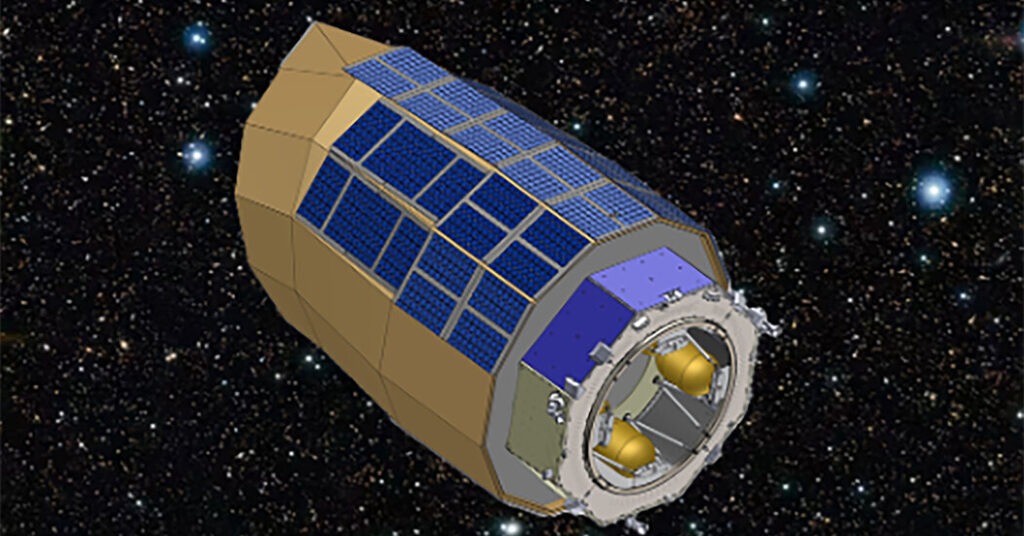
Schmidt Sciences, which is part of the Schmidts’ philanthropic efforts, is financing the construction of four major new telescopes, including one destined for orbit, that will rival the capabilities of NASA’s Hubble Space Telescope.
And the organization aims to have all four telescopes up and running within four years, a sprint compared with the decade or longer span that world-class astronomical facilities often take to complete.
“This is an experiment in accelerating astrophysics discovery,” Arpita Roy, the lead of the Astrophysics and Space Institute at Schmidt Sciences, said on Wednesday at a meeting of the American Astronomical Society in Phoenix.
The projects largely take technologies already available, especially the high-performance computer chips that have powered advances in artificial intelligence, and remixes them in novel, cutting-edge ways to offer new capabilities to astronomers.
“We accept much more risk,” Dr. Roy said. But she described that additional risk as “calibrated, thoughtful.”
Schmidt Sciences has for several years quietly financed preliminary design studies, technology development and prototypes.
The organization is now revealing its overall plan. Agreements with universities that will manage the ground-based systems are in place, and the manufacturing of components for the telescopes has begun.
“We’re in a position of saying these things are a go,” said Stuart Feldman, the president of Schmidt Sciences.
In addition to the space telescope, named Lazuli, the other projects are the Argus Array, which will continually photograph the entire night sky of the Northern Hemisphere; the Deep Synoptic Array, or D.S.A., which will scan cosmic radio frequencies; and the Large Fiber Array Spectroscopic Telescope, or LFAST, which will collect light of specific colors of distant stars, planets and galaxies.
The four fall under an umbrella name: the Eric and Wendy Schmidt Observatory System.
While federal investment has been the mainstay of funding for science in the United States for decades, astronomy has long benefited from the benevolence of wealthy patrons like Percival Lowell, who financed the Lowell Observatory in Arizona so that he could study what he thought were canals and other signs of an alien civilization on Mars.
But the Schmidt Sciences projects is different, following a more Silicon Valley mindset: faster and cheaper, with focused and limited goals. The pieces of the Schmidt Observatory System are intended to remain in scientific service for a few years, not decades.
While the Schmidt telescopes could last longer, the idea is that they could also be replaced by new observatories that take advantage of ever-improving technologies. That could still be less expensive than the traditional approach.
“We think that we should operate these experiments for defined useful lifetimes and then move on to the next exciting thing,” Dr. Roy said. “The lifetimes we are committing to now are three to five years.”
Officials with Schmidt Sciences acknowledged the turbulence in science over the past year as the Trump administration sought deep budget cuts at NASA and the National Science Foundation. But they said they want to complement, not replace, federal science efforts.
NASA and the N.S.F. “have been very good at very long-term, amazing, 10-, 20-year instruments and missions, and they’re unbeatable,” Dr. Feldman said in an interview. “Since we have a straight funding model — either we do it or we don’t, and the Schmidts either choose to give us the appropriate amount of money or not — we can say, let us fast-track these projects.”
He said the Schmidts did not want to divulge exactly how much they are spending. “Lazuli is hundreds of millions of dollars,” Dr. Feldman said. “The ground telescopes are not inexpensive either.”
Lazuli is particularly ambitious.
At the astronomy meeting, Dr. Feldman said that the space telescope will have a mirror a bit larger than the one inside the Hubble Space Telescope.
But it was to have been even larger: Dr. Feldman said that a 20-foot-diameter mirror had been manufactured for the space telescope, which would make it more than twice as wide as Hubble’s. But that mirror consists of a single piece of glass, and there is only one rocket capable of sending it to orbit: Starship, currently under development by Elon Musk’s SpaceX.
Because the development of Starship has been bumpier and slower than Mr. Musk promised, Schmidt Sciences pivoted in the fall of 2024.
“Starship schedules are malleable,” Dr. Feldman said. “We will revisit that in the future.”
The project originated from discussions between Dr. Feldman and Saul Perlmutter, a Berkeley astrophysicist who shared the Nobel Prize in Physics in 2011 for the discovery that the expansion of the universe is accelerating, not slowing down as had been expected. Somehow, “dark energy” is pushing the universe apart.
Lazuli will be more capable of measuring the colors of exploding white dwarf stars. The shifting of the wavelengths of emissions to the redder part of the spectrum tells how quickly distant galaxies are moving away.
More recent observations indicate that white dwarf supernovas are not all exactly the same, and that the nature of dark energy has changed over time. Lazuli could provide the data to help unravel the mystery.
“It allows us to start telling what’s going on,” Dr. Perlmutter said. “Is there some really new physics? It appears that it’s likely.”
The spacecraft is also able to pivot in space more quickly than Hubble or the James Webb Space Telescope, allowing it to measure newly discovered supernovas as they peak in brightness.
Lazuli will also be able to study the planets around other stars, using a coronagraph to block the glare from the stars.
One of the planned ground telescopes, the Argus Array, sounds a lot like the Northern Hemisphere’s version of the new Vera Rubin Observatory, largely financed by the National Science Foundation and the Department of Energy. That telescope, on a mountaintop in Chile, will scan the sky of the Southern Hemisphere every few days.
But Argus looks very different. Instead of one big telescope with a 27.6-foot-wide primary mirror, Argus will consist of 1,200 small telescopes, each with an 11-inch mirror. Nicholas Law, a professor of astronomy and physics at the University of North Carolina, which will build and manage Argus, said the array aims to cover different astronomical goals.
The small telescopes will not easily spot fast-moving objects like asteroids and they are not designed to peer out as far. But they will scan the full sky more quickly, within minutes.
The 1,200 telescopes are arranged on top of eight circular mounts that move in unison. That design does not include a traditional protective telescope dome, but is instead housed within what looks like a warehouse with skylights — a simpler, cheaper structure.
Because it is continually covering the entire sky, it can instantly follow up when another instrument makes a discovery. For example, if LIGO — the Laser Interferometer Gravitational-Wave Observatory — detects the shaking of space-time from a black hole collision somewhere in the sky of the Northern Hemisphere, Argus will be able to see if there is some visual counterpart to the event.
Because it will save all of the data collected over the preceding week, astronomers will be able to go back to see if there were signs of something happening that preceded LIGO’s detection of the gravitational waves.
“It can act almost as a time machine,” Dr. Law said.
The site of the array has not yet been announced, although Dr. Law said it would likely be in Texas. He said he hoped it would collect its first light in 2027. (Alex Gerko, a Russian-born British billionaire and financial trader, is cofinancing the project with Schmidt Sciences.)
The Deep Synoptic Array and LFAST similarly take the approach of using many small telescopes to act as one large instrument.
D.S.A. surveys the sky like the Rubin observatory, but at radio wavelengths instead of visible light. It will consist of 1,650 radio dishes, each 20 feet wide, spread over 60,000 acres in Nevada.
“It’s unparalleled compared to any telescope now or in the future that’s currently envisaged,” said Gregg Hallinan, a professor of astronomy at the California Institute of Technology, which will build and manage D.S.A. “Every radio telescope ever built in the last century combined has found about 10 million radio sources. We’ll double that in the first 24 hours.”
Over the course of the five-year survey, it is expected to find a billion radio sources in the universe, Dr. Hallinan said. Construction could begin next year, he said.
LFAST will consist of many optical telescopes, but its chief purpose will be to measure spectra, or colors, not take photographs. That color information is the key to understanding brief events, like supernovas, and identifying the contents of atmospheres of planets around other stars. But measuring spectra takes time.
“You have to collect enough photons because you’re spreading them out,” said Chad Bender, an astronomer at the University of Arizona, which is in charge of LFAST.
Dr. Bender said that astronomers want to collect many more spectra, but there is not nearly enough time available on current telescopes.
Because many smaller telescopes are less expensive than one big one, the hope is that LFAST will provide that capability at a lower cost.
The Arizona team is currently building a prototype to be tested, and depending on how that works, the design can be modified and expanded.
About 150 people squeezed into the presentation in Phoenix, and more watched online. Astronomers appeared to like what they had heard. Heidi Hammel of the Association of Universities for Research in Astronomy said she was excited that Schmidt Sciences was trying something new.
“Time will tell if they are successful,” she said. “If they can, as they said, create new paradigms, that’s fine.”
The new telescopes will not surpass the most ambitious programs like NASA’s Webb telescope or the planned Habitable Worlds Observatory.
“They are providing alternatives that pursue very specific and clear science goals,” Dr. Hammel said. “That’s exciting.”
Kenneth Chang, a science reporter at The Times, covers NASA and the solar system, and research closer to Earth.
The post Google’s Former C.E.O. Wants to Build a Cosmic Search Engine appeared first on New York Times.