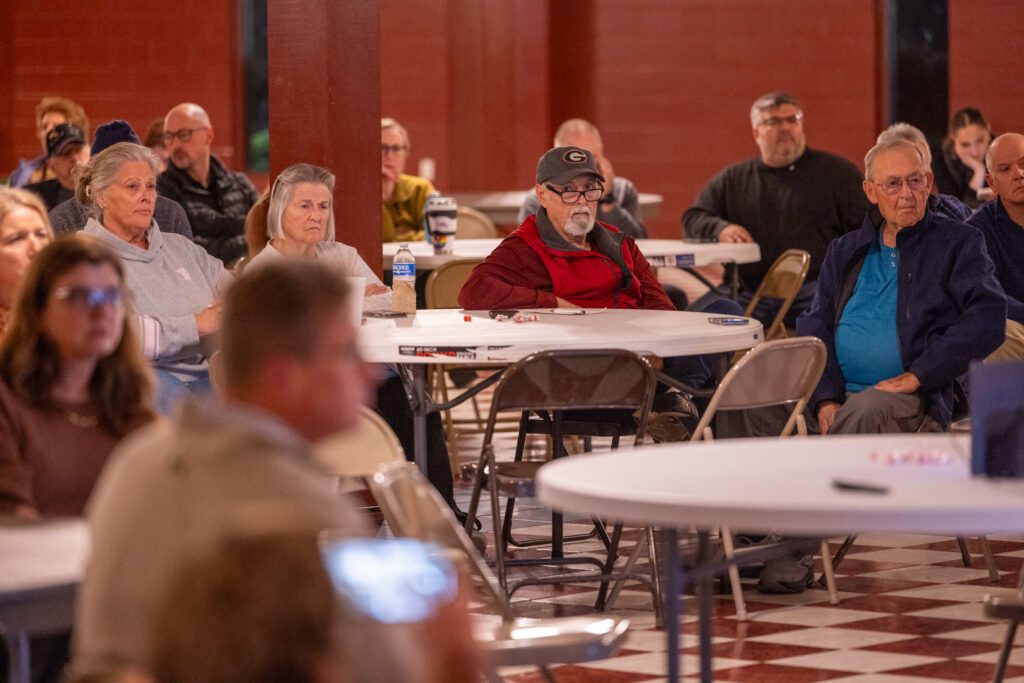
SOCIAL CIRCLE, Ga. — The latest movement to resist President Donald Trump’s immigration agenda didn’t announce itself with protest signs, chanted slogans or bullhorns. It arose inside a dimly lit assembly room in this Republican stronghold 45 miles east of Atlanta, where residents voiced their anger over a U.S. Immigration and Customs Enforcement plan to convert a local warehouse into one of the nation’s largest immigrant detention centers.
“I’m supportive of the president, but I don’t particularly want this,” Victor Crawley, 57, said in an interview following the town-hall discussion. The city learned about the plans from a recent report in The Washington Post, but has heard nothing from federal officials.
Crawley, like many at the Tuesday night gathering, doesn’t see the logic in his small town of 5,000 people being saddled with a massive facility holding up to 9,000 migrants at a time, as outlined in an internal ICE document.
Social Circle’s water and sewer systems are already near capacity. The town usually has only two to three police officers on duty. And residents have raised concerns that the warehouse most likely to be used for the project is a 20-minute walk from the town’s elementary school.
The frustrations in Social Circle reflect the confusion and unease in many of the 23 towns and cities across the country where the administration plans to convert warehouses into immigrant detention centers. A draft solicitation the federal government prepared for potential contractors suggests that these facilities would have capacity for 1,500 to 10,000 people each.
While Trump critics have attacked the warehouse plan as an example of his administration’s inhumane treatment of migrants, the plan is now fomenting backlash from communities that supported Trump’s reelection but say their towns cannot support large-scale detention.
In Roxbury, New Jersey, an area Trump won by three percentage points in 2024, residents have packed municipal meetings and staged outdoor protests, hoping to convince elected leaders to take a stand against what they see as a federal incursion into their community.
In Jefferson, Georgia, part of a county Trump won by 55 points, Mayor Dawn Maddox says she wouldn’t support a detention center due to “possible safety concerns that could affect our citizens and our school system.”
And in Orange County, New York, where Trump won by eight points, local officials have voiced opposition to the federal government buying a warehouse because that could remove the building from the city’s tax revenue. “We would prefer something on the tax rolls like a film studio,” Rebecca Sheehan, a spokeswoman for Orange County, said in an emailed statement.
ICE says in its internal document that it aims to create a streamlined system of processing centers that will feed into large-scale warehouses where people will be prepared for deportation. Currently, immigrants are shuffled between more than 200 facilities across the country based mainly on where bed space is available, according to interviews with former ICE officials.
But the government has not yet publicly confirmed any details about the project, including how it selected the cities on the list, whether it plans to buy or lease the industrial buildings and how quickly it plans to convert them into detention centers capable of housing people.
Tricia McLaughlin, assistant secretary for the Department of Homeland Security, said in an email that the department has “no new detention centers to announce at this time” but that the planned projects “are not warehouses — they are detention facilities.”
“While we cannot get into contract specifics, Secretary [Kristi L.] Noem has stated that she is willing to work with officials on both sides of the aisle to expand detention space to help ICE law enforcement carry out the largest deportation effort in American history,” McLaughlin said.
The Post contacted the local governments in all 23 cities on ICE’s list. Many said they had not heard anything from federal officials about the plans to build detention warehouses and could not yet comment on those plans. But some said they will try to block the facilities.
ICE has long faced local opposition in the places where it operates detention centers, but few towns have successfully stopped their development. Rick Su, a law professor at the University of North Carolina who researches the intersection between local government and immigration policies, said courts have frequently sided with the federal government’s authority to circumvent local laws when it can argue that those ordinances obstruct its ability to carry out federal policy.
“That’s kind of the big challenge you’re going up against,” Su said. “The federal government is considered immune or supreme versus any state or local regulation.”
But, he added, local laws may sometimes be enforced when they impact the federal government without blocking its actions.
Last year, a state court in Kansas temporarily stopped CoreCivic from reopening a former prison as an ICE detention center after the town of Leavenworth claimed the company failed to obtain proper permits. CoreCivic sued Leavenworth, arguing the city’s zoning laws obstructed the company from carrying out federal policies, but a federal judge threw out the lawsuit, saying it had no standing in federal court.
In December, CoreCivic applied for a special-use permit from Leavenworth. In an email, CoreCivic spokesman Ryan Gustin said the company still believes it should be allowed to operate without the permit, but is “assessing all available avenues,” including by filing for the permit.
The city will review the application in a planning commission hearing next month.
Social Circle city manager Eric Taylor’s phone hasn’t stopped buzzing since Christmas week, amid a flurry of media reports, social media posts and panicked calls to officials in a community where rows of Queen Anne-style homes are punctuated by farms and distribution centers.
People in online forums accused local officials of hiding information from the public about ICE’s plans. Taylor said in an interview that couldn’t be farther from the truth: Even after calling the offices of his congressman, two senators and Gov. Brian Kemp (R), he could not confirm any facts about the project.
Based on his own research, Taylor said he believes the only available building that could house that many people is a vacant one-million-square-foot warehouse on the edge of town that was completed last year. Shane Short, who runs the economic development authority of surrounding Walton County, had been helping to market the property to prospective buyers.
Short said the building’s owner, PNK Group, asked him to take down promotional videos of the building from a county website in November. The following month, PNK applied with the city to subdivide the property in preparation for a sale, according to a copy of the application Taylor shared with The Post. The document does not say the name of the buyer or anything about their intended use of the building.
Ilissa Miller, an outside spokeswoman for PNK, said in a statement that the developer agreed to keep the identity of the prospective buyer confidential.
“The building is actively being offered for sale and several potential buyers have expressed interest,” Miller said in an email. “Because this is a sales transaction, any future use of the property will be determined solely by the eventual purchaser and will be subject to the required local review and approval processes.”
Late last month, Social Circle’s government, which is led by a mayor and four elected city council members, posted a statement on Facebook calling the plan for a detention facility “infeasible.” According to city data Taylor shared with The Post, the town is permitted to pump up to 1 million gallons of water per day, and for much of the year, its peak usage is already above 800,000 gallons.
“We’re not taking a political position on this,” he said. “Our position is, we simply do not have the infrastructure to support it.”
Social Circle’s city council could deny PNK’s request for a subdivision when the matter goes before the town council later this month, Taylor said. But he added that there is little the town could do to enforce local land-use laws if the federal government buys the property itself.
The feeling of powerless among residents was captured during a prayer led by Nathan Boyd, a city council member and local pastor, at the conclusion of the town hall meeting.
“Lord, we need your help to overcome this,” Boyd told the gathering. “It feels a little bit like David and Goliath.”
Jonathan O’Connell, Aaron Schaffer and Clara Ence Morse contributed to this report.
The post Georgia town of 5,000 vows to fight ICE plan to warehouse 9,000 detainees appeared first on Washington Post.