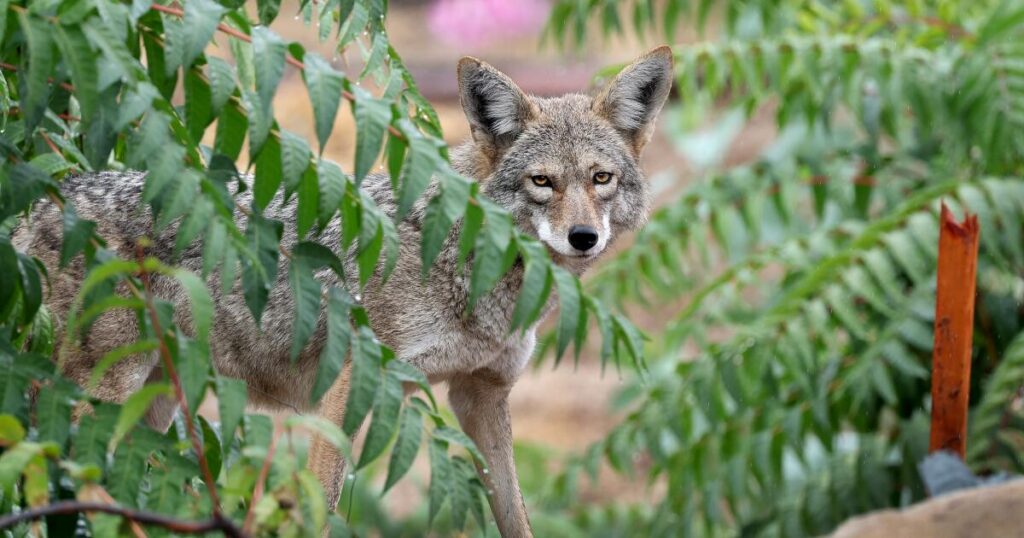
If you’ve noticed more coyotes than usual in your neighborhood, it’s because it is the animal’s mating season, which usually runs from January to March.
Authorities, including the Huntington Beach Police Department, say coyote mating season is a time to be more cautious about the wily canines that live among us.
“The peak of their mating activity happens around February, so it’s kind of romantic and coincides with the month of Valentine’s Day,” said Maximiliano Regis, chief deputy of the Los Angeles County Department of Agricultural Commissioner.
During this time adult coyotes are moving around and in some cases traveling long distances in search of mates and food sources.
“In order for them to have genetic diversity they move somewhere else, because if they stayed in the same area, they would be mating possibly with their siblings,” Regis said.
You might see a coyote looking for their life partner or a couple of the animals patrolling and protecting their den. The coyote pups won’t emerge from the den with their mother until April or May.
Here’s what you need to know about your four-legged neighbors and what to do if you encounter them.
Coyotes’ long history in Los Angeles’ ecosystem
Coyotes are native to Southern California, so much so that they’re the third-most abundant animal found at the La Brea Tar Pits, with skeletons dating back more than 40,000 years to the Pleistocene Era, long before humans showed up, according to the museum.
“They’re so successful that they have made it all the way from the West Coast to the East Coast and all the way down to the Panama Canal,” Regis said.
In the last 50 years coyotes increased their numbers and geographical range especially in suburban environments where an ample food supply is available, according to the University of Agriculture and Natural Resources. Suburban areas of Southern California have some of the highest coyote population densities in the nation.
Several years ago Los Angeles County authorities collared some coyotes to track their movement within the region, Regis said. “Some were perfectly happy just being in one neighborhood,” he said. “Others moved from San Gabriel Valley all the way down to Long Beach.”
These animals play a vital role in the ecosystem as their diet consists of small rodents such as mice, rats and squirrels. But coyotes aren’t picky: They will eat what’s available including rabbits, raccoons, birds, insects, fruit, vegetables, the contents of your garbage or compost, outdoor pet food and small pets.
The facts on coyote attacks on humans
Coyotes are generally shy and wary of people. But their curiosity often gets the better of them and they have been known to check out human activity from “what they perceive to be a safe distance,” according to the Department of Agricultural Commissioner.
There has been only one documented fatal coyote attack on a human in California, in Glendale in 1981. A coyote attacked and mauled 3-year-old Kelly Keen about 20 feet from her front door. At the time Keen’s neighbors were regularly feeding coyotes, LAist reported.
A coyote can attack if it becomes dependent on humans for food and can become demanding and even aggressive for a meal, according to the county agricultural commissioner.
In some cases a coyote might follow you, but Regis said don’t take this as predatory behavior, “they’re making sure you’re leaving the area.”
What to do when you encounter a coyote
If you stumble upon a curious coyote that doesn’t run away when it sees you, experts say you should haze them by walking toward the coyote while waving your arms and making loud noises.
Do this until the coyote retreats, the U.S. Department of Fish and Wildlife advises.
How to keep coyotes away from your home
Local and state officials recommend you do the following to keep coyotes away:
- Do not feed coyotes.
- Remove attractants such as outdoor pet food. Bring in your bird feeders overnight to avoid attracting coyote prey. Do not leave your pets unsupervised outside.
- Secure the lids of your trash and compost bins.
- Clear brush and dense weeds from around your property.
The post Expect to see more coyotes in your neighborhood. Here’s why appeared first on Los Angeles Times.