What does it feel like to fall down a rabbit hole?
Considering the number of people obsessed with cabals and cover-ups, there must be some comfort in conspiracy theories. A secret plot is less scary than the unknown. Listen to enough podcasts and you can tell that the paranoid mind-set can also evoke a sense of connection, some solace in a chaotic and lonely world.
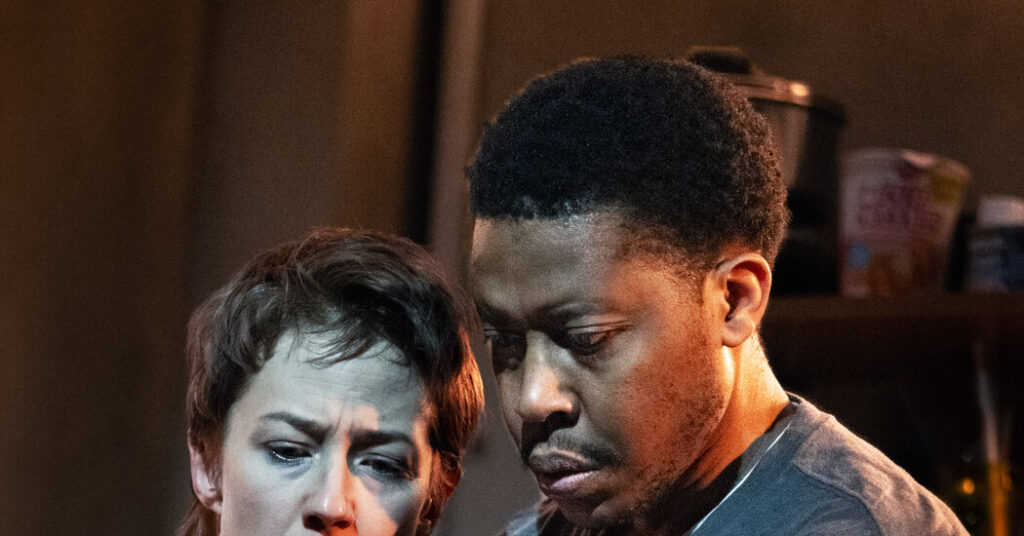
No play this century dramatizes this better, and with as much twisted horror, as “Bug,” Tracy Letts’s nerve-rattling shocker whose eerily topical Broadway production stars a ferocious Carrie Coon as a waitress getting red-pilled.
When it premiered in New York two decades ago at the intimate Barrow Street Theater, “Bug” played like a downtown freakout: a visceral, blood-soaked American gothic dominated by Michael Shannon’s breakthrough performance as the conspiracy theorist Peter, eyes flared as he scurried across the stage like an overgrown insect.
This new Manhattan Theater Club production, which opened Thursday at the Samuel J. Friedman Theater, is more tender and balanced, with Namir Smallwood rendering Peter as a gentler, less alien figure. The focus has shifted to his romantic partner, Agnes (Coon), a desperate sad sack haunted by a loss in her past. In a superb performance, Coon provides the alpha energy this time, her eruptive anger masking an inner conflict worn on her weary face. The director David Cromer still delivers effective jolts, yet his production feels disturbingly closer to home.
“Bug” may seem less outlandish now because the world has become more so, with once fringe theories of pedophile rings and deep state operations now the stuff of mundane political rhetoric and mainstream news. American life is so awash in fevered conspiracy theories that the play’s core dramatic question — How could someone fall for this madness? — seems more urgent than ever.
When we first see Coon, she turns her back to us, smoking and gazing warily out the window of her motel room. (Other than a cabin in the woods, is there a locale more likely to indicate impending doom?) Light floods in, temptingly. So do phone calls from an abusive ex-husband just out of jail, adding to the nervous mood. Coon stays indoors, stewing in isolation.
What upends her life is a visit from a co-worker, R.C., (Jennifer Engstrom) who has brought along Peter, an Iraq War veteran with deep suspicions about just about everything. You know the type. The kind of oddly articulate guy who tells you he doesn’t like to be labeled and encourages you to do your own research. If this play were written today, Peter would most likely be a fan of the podcasters Joe Rogan and Candace Owens.
On Takeshi Kata’s messy, crooked set, complemented by Heather Gilbert’s dreamy lighting, he sees bugs all over the room. She does not. But before he reveals the supposed government plot that is at the heart of his crisis, Smallwood’s Peter comes off as sweet, unassuming, even sensitive. He’s perceptive in a way that surprises Agnes. As Coon listens to his raving about the Unabomber and Timothy McVeigh, she moves from skepticism to concern to a little curious.
In a play full of jump scares, the most deftly staged may be the one of her falling for him. As she races out of the bathroom, she hurls herself and embraces him with the passion of a convert.
“Bug” is a stylistically slippery work: A proudly trashy thriller inside a subtext-rich romance wrapped inside an absurd nightmare. The movie adaptation marketed itself as a gory horror flick, and when I saw it on a big screen, the scare-hungry audience was audibly annoyed at its slow burn. On Broadway, expectations are different.
This play provides enough pulp. Its supporting characters are thin and strictly utilitarian. As the ex-husband returned from jail, Jerry Goss (a peacocking Steve Key) operates like the shark in “Jaws”: a tension-creating device, setting up a scare or a misdirection. The production also embraces a smirking sense of humor, including in Josh Schmidt’s sound design, which features the riff from the Ice Cube song “It Was a Good Day” in the background.
But for the most part, Cromer understands that the best scary stories benefit from establishing a firm sense of reality. In the first act, he plays it straight, patiently establishing the realism of this world. Occasionally the play hints at something destabilizing. Coon’s eye twitches. The response of Smallwood to the sound of a helicopter above might get your attention.
But what really holds this production together is Coon, an excitingly live-wire performer who sells the play’s hard-boiled poetry with conviction. “I just get sick of it, my lousy life, laundromats and grocery stores, dumb marriages and lost kids,” she says, making you feel her pain. She’s fed up and ready for something, anything new.
Smallwood plays his part with a muted calm. When he says his first line (“I’m not an ax murderer,” which picks up on something he overhears Agnes say about him), no one hears him. He repeats it twice, with escalating volume and intensity. His whole performance is in that introduction.
Race also has a new resonance in this production. By casting Smallwood, a Black actor, attention is drawn to the fact that the most visceral (and notorious) act of violence in “Bug” comes right after Peter reminds Agnes of the Tuskegee syphilis experiment conducted on Black soldiers.
In this critical moment, it’s the woundedness in Smallwood’s eyes that gets to Coon. With him leaning into the more appealing side of his character — his intelligence, vulnerability, perceptiveness — the romance that drives the play becomes more believable.
An example of this is their growing intimacy, which is evoked during an extended nude scene. In a short time, these two down-on-their-luck outsiders have become more comfortable with each other inside the motel room than they are with the rest of the world. In these scenes, “Bug” may remind theatergoers of a bonkers version of Terrence McNally’s “Frankie and Johnny in the Clair de Lune” more than Francis Ford Coppola’s “The Conversation” and other paranoid thrillers of the 1970s that are clear antecedents.
Letts burst on the scene with sugar-high gothics (“Killer Joe,” “Bug”) but then got serious with later works like “August: Osage County,” a sweeping family drama that earned rave reviews, the Pulitzer Prize and comparisons to Eugene O’Neill. At least that’s the traditional narrative about his career.
But at the risk of coming off like a conspiracy theorist, you can’t always trust the official story. This revival announces “Bug” as a layered and assured tragedy for our cracked moment. It wants to make you scream and maybe chuckle to yourself about it, though its most disturbing suggestion is that the descent into conspiratorial thinking might feel a little like falling in love.
Bug Through Feb. 22 at the Samuel J. Friedman Theater, Manhattan; manhattantheatreclub.com. Running time: 2 hours.
Jason Zinoman is a critic at large for the Culture section of The Times and writes a column about comedy.
The post ‘Bug’ Review: Carrie Coon Is Superb in an American Gothic Tale appeared first on New York Times.