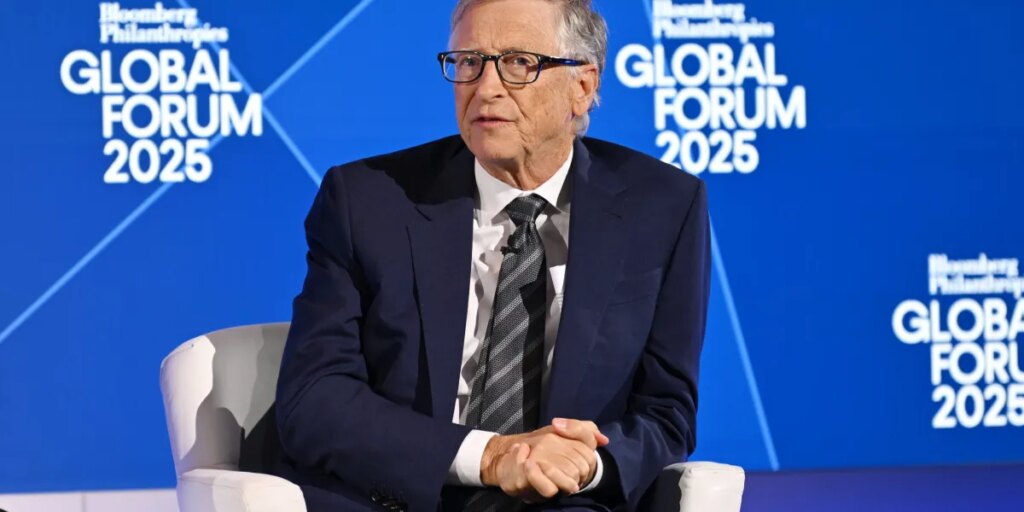
The wheel, the internet, the car, and electricity. All of these human creations pale in comparison to artificial intelligence, Microsoft co-founder Bill Gates believes. In his annual letter released today, the Microsoft co-founder wrote that, “Of all the things humans have ever created, AI will change society the most.” That change could be ultimately for the better, but it also poses considerable threats to the global population, he wrote. Gates has long been bullish on the opportunities that the revolutionary technology offers, particularly in industries like healthcare and education. However, he has also been mindful of the risks it poses, particularly if it falls into the hands of bad actors.
As such, there’s a flipside to the major healthcare transformations AI could bring. The 70-year-old philanthropist wrote: “In 2015, I gave a TED talk warning that the world was not ready to handle a pandemic. If we had prepared properly for the Covid pandemic, the amount of human suffering would have been dramatically less.”
“Today, an even greater risk than a naturally caused pandemic is that a non-government group will use open source AI tools to design a bioterrorism weapon.”
Gates was keen to highlight that society needs to do more to ready itself for an AI era, and that work so far hasn’t been adequate. There are two key issues arising because of the technology, he believes, the first being artificial intelligence being used by bad actors, and the second being disruption to the jobs market.
“Both are real risks that we need to do a better job managing,” Gates wrote, adding, “We’ll need to be deliberate about how this technology is developed, governed, and deployed.”
Companies and regulators are already grappling with the ramifications of AI being used for harmful outcomes. Only this week, Elon Musk’s xAI was told by Britain’s Technology Secretary Liz Kendall that it must “urgently” deal with a surge in sexualized images of women and children, generated without consent, by its artificial intelligence-powered tool Grok—which the company has now partially restricted.
Job market disruption
No one can quite agree on how significantly AI will upset the labor market. Fed chairman Jerome Powell, for example, said he is watching the data “very carefully” to monitor how deeply the hiring market will shift because of efficiencies offered by the tech.
Meanwhile, a note from Oxford Economics this week suggested that “firms don’t appear to be replacing workers with AI on a significant scale,” suggesting instead that companies may be using the headlines as a cover for routine headcount reductions. “We suspect some firms are trying to dress up layoffs as a good news story rather than bad news, such as past over-hiring,” the note explained.
Gates described a broader picture: One in which instead of laying off workers, their hours could be reduced or “even decide there are some areas we don’t want to use AI in.”
“In a mathematical sense, we should be able to allocate these new capabilities in ways that benefit everyone,” he wrote.
“We’re already starting to see the impact of AI on the job market, and I think this impact will grow over the next five years,” Gates continued. “Even if the transition takes longer than I expect, we should use 2026 to prepare ourselves for these changes—including which policies will best help spread the wealth and deal with the important role jobs play in our society. Different political parties will likely suggest different approaches.”
The post Bill Gates says AI could be used as a bioterrorism weapon akin to the COVID pandemic if it falls into the wrong hands appeared first on Fortune.