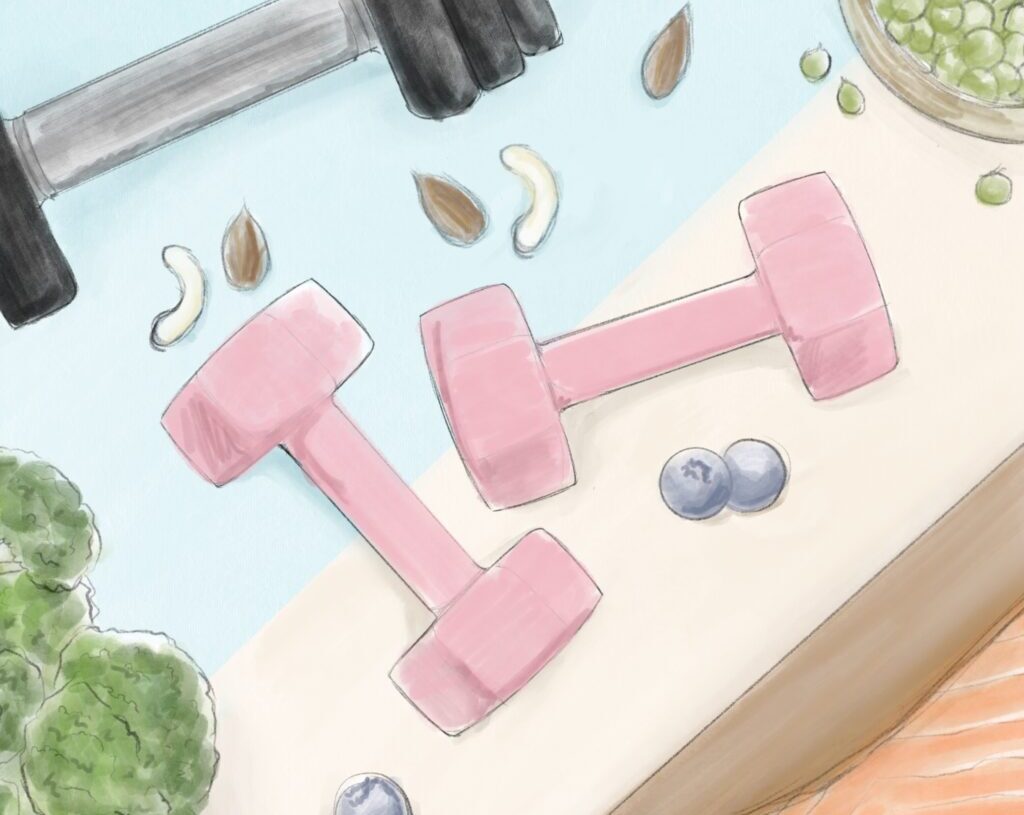
Every day, the Well+Being team at The Washington Post shares science-based advice on ways to promote good health. We talk to experts and read the latest research on topics such as nutrition, fitness, cognition, mental health and sleep.
But we don’t just write about the tips, we also try to put them into practice. Here are a few that we’ve decided to incorporate into our own lives to give our health a boost.
1. Start your day with this 5-minute breakfast
If you need a quick and easy breakfast, try this recipe from nutrition reporter Anahad O’Connor’s story on high-protein meals. Every dietitian Anahad interviewed suggested plain Greek yogurt for breakfast. For an extra boost of fiber, vitamins and healthy fats, they advised adding chia seeds, berries and sliced almonds. I’m always asking Anahad what he eats, so I found out he has a hack to save time and money: He uses frozen berries and zaps them in the microwave for a few seconds to soften them before mixing them into the yogurt. I’ve started doing that with organic frozen blueberries I buy in bulk. I mix them into nonfat Greek yogurt with almond or peanut butter, and a sprinkle of cinnamon and hemp, chia and ground flaxseeds. It takes five minutes and keeps me full all morning. — Emily Codik, assignment editor, Wellness
2. Do wall push-ups
I spent my life doing “girl” push-ups — a modified version of a full push-up where your knees touch the ground. I could never really do a good “normal” push-up and found the modified push-ups more manageable. Yet somehow, despite incorporating them fairly regularly into my workout routines over the years, I never progressed to the real deal. It wasn’t until I read this article, by my colleague fitness writer Gretchen Reynolds, that I got the wake-up call I never knew I needed.
It turns out I was making it harder on myself to train with modified push-ups. I learned that so many people who do these will never progress beyond them. So I took Gretchen’s advice and tried wall push-ups — an approach that better sets you up for success and strength than a “modified” push-up. After a few weeks, I found I could in fact do “regular” push-ups.
Women begin to lose muscle mass as early as their 30s, and it’s critical for all of us to incorporate regular resistance training into our workouts if we aim to age well. — Trisha Pasricha, Ask a Doctor columnist
3. Consider compressing your sleep
As someone who found it easy to stay asleep through the night, I was surprised when I started waking up at 2 or 3 a.m. and was unable to get back to sleep. For about a month, I tried many things, including managing my stress better, teas, breathing exercises and sleep medications, without much success. Then I began experimenting with compressing my sleep window. Instead of going to bed at 9 p.m., I pushed my bedtime later and later. Once I started going to bed at 10:30 p.m., I found myself sleeping through the night again. Lisa Strauss, a sleep psychologist, uses the analogy of a pizza dough to explain this technique: “Roll it out onto too large a surface, and it will be thin and holey. Roll it out over a small area, and it will be nice and deep.” — Anjuman Ali, deputy editor, Wellness
4. Eat more kiwis
Kiwis. I swear, I’ve rearranged my entire diet around kiwis this year, thanks to this column by Trisha, our Ask a Doctor columnist, about the furry little fruits. I’d already known I should pay more attention to my microbiome but hadn’t realized kiwis could help me start. Plus, they aid in controlling triglycerides and provide a healthy dose of actinidin, a digestive enzyme “so powerful that it’s used commercially as a meat tenderizer,” Trisha wrote. (I’d forgotten that line until rereading the column — since, regrettably, kiwis don’t improve memory — but it’ll stick with me now.) Thanks to Trisha, I eat at least one kiwi every day and have convinced my husband to join me. — Gretchen Reynolds, fitness columnist
5. Create a DIY sunrise
Like a lot of people, I find the shorter days of winter a bit of a challenge. Getting out of bed seems to require a herculean effort when the days get darker. Although I’ve tried sunrise alarm clocks to make it a little easier to get going and help my mood, I’ve had mixed success. This year, I’m taking a DIY approach. Given that I’m in a new space with fewer (and north-facing) windows, my plants require grow lights, which happen to be on a timer.
When daylight saving time ended in November, I decided to get a little strategic. Now, I’ve scheduled them to turn on, one after another, at 15-minute intervals, starting 30 to 60 minutes before I need to get up. When that fourth one turns on, I know I’m borderline late and really need to get moving. (And when I tell you it’s bright, it’s airport tarmac bright at that point.) I know it’s simple, but it seems to work! My body needs a big heads-up that the day is starting, so I’ve essentially mimicked the dawn, no pricey alarm clocks necessary. — Theresa Tamkins, Wellness editor
6. Eat more fermented foods
Fermented foods such as yogurt, sauerkraut, kefir, kimchi and kombucha are some of the best foods you can eat to nourish your gut. They contain beneficial microbes (also known as probiotics) that can improve your overall health by altering the makeup of your gut microbiome, the community of trillions of bacteria and other microorganisms that live in your digestive tract.
So I’ve started keeping a jar of sauerkraut or kimchi on the top shelf of my refrigerator in a place where I can see it easily. When I open my fridge to get something for lunch or dinner, I’ll take a quick bite so I can get an extra serving or two of fermented foods into my daily diet.
I also keep a bottle of plain kefir in my refrigerator. Sometimes, when I’m looking for a snack, I’ll see the bottle of kefir and grab it and take a swig. Having fermented foods in a visible spot in my fridge serves as a gentle reminder to get my daily dose of probiotics. — Anahad O’Connor, nutrition columnist
7. Consider psyllium husk
I started taking fiber supplementation pretty seriously a few years ago, and I was relying mostly on products that contain wheat dextrin, such as Benefiber. And they worked pretty well, but if I can be frank, I wasn’t achieving the kind of regularity I expected. But Trisha turned me on to psyllium husk. This is life-changing stuff. Unlike other fiber supplements, psyllium gels, which is what makes it so effective. It not only adds bulk to your stool, but it also acts like a sponge that may help lower cholesterol. Although that property is psyllium’s greatest asset, it makes consuming it a bit quirky. As soon as water comes in contact with psyllium, it starts to thicken, meaning you need to consume it pretty quickly to avoid the jellylike consistency. But after a year of using it, I’ve embraced the thickness, and I add it to my morning coffee (just like Trisha does). It’s a small sacrifice for me to be able to all but set a watch to how regular I’ve become on it. — Ryan Weber, producer/strategist
The post 7 science-based tips from the Well+Being team for a healthier year appeared first on Washington Post.