That shrill, high-pitched squeal you’ve been hearing lately? Don’t bother trying to adjust your TV or headphones, or calling your doctor for a tinnitis check. It’s just America’s beleaguered billionaires keening over a proposal in California to impose a one-time wealth tax of up to 5% on fortunes of more than $1 billion.
The billionaires lobby has been hitting social media in force to decry the proposed voter initiative, which has only started down the path toward an appearance on November’s state ballot. Supporters say it could raise $100 billion over five years, to be spent mostly on public education, food assistance and California’s medicaid program, which face severe cutbacks thanks to federal budget-cutting.
As my colleagues Seema Mehta and Caroline Petrow-Cohen report, the measure has the potential to become a political flash point.
Its well-heeled critics include Jessie Powell, co-founder of the Bay Area-based crypto exchange platform Kraken, who warned on X that billionaires would flee the state, taking with them “all of their spending, hobbies, philanthropy and jobs.”
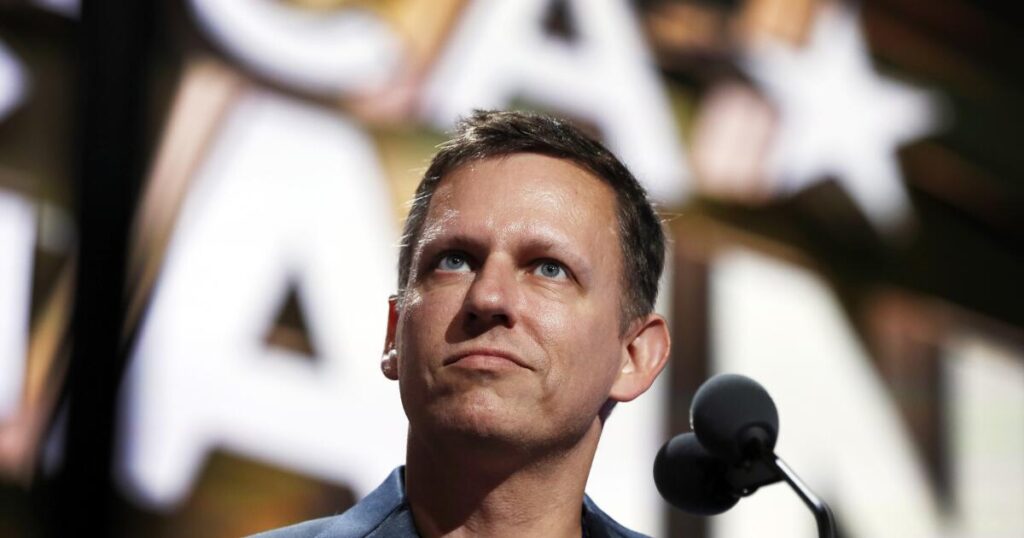
Venture investor Chamath Palihapitiya claimed on X that “$500 billion in wealth has already fled the state” but didn’t name names. San Francisco venture investor Ron Conway has seeded the opposition coffers with a $100,000 contribution. And billionaire Peter Thiel disclosed on Dec. 31 that he has opened a new office in Miami, in a state that not only has no wealth tax but no income tax.
Already Gov. Gavin Newsom, a likely candidate for the Democratic nomination for president, has warned against the tax, arguing that it’s impractical for one state to go it alone when the wealthy can pick up and move to any other state to evade it.
On the other hand. Rep. Ro Khanna (D-Fremont), usually an ally of Silicon Valley entrepreneurs, supports the measure: “It’s a matter of values,” he posted on X. “We believe billionaires can pay a modest wealth tax so working-class Californians have Medicaid.”
Not every billionaire has decried the wealth tax idea. Jensen Huang, the CEO of the soaring AI chip company Nvidia — and whose estimated net worth is more than $160 billion — expressed indifference about the California proposal during an interview with Bloomberg on Tuesday.
“We chose to live in Silicon Valley and whatever taxes, I guess, they would like to apply, so be it,” he said. “I’m perfectly fine with it. It never crossed my mind once.”
And in 2000, another plutocrat well known to Americans proposed a one-time tax of 14.25% on taxpayers with a net worth of $10 million or more. That was Donald Trump, in a book-length campaign manifesto titled “The America We Deserve.”
“The rich will scream,” Trump predicted. “The pundits and editorial-board writers will warn of dire consequences … a stock market crash, a depression, unemployment, and so on. Notice that the people making such objections would have something personal to lose.” (Thanks due to Tim Noah of the New Republic for unearthing this gem.)
Trump’s book appeared while he was contemplating his first presidential campaign, in which he presented himself as a defender of the ordinary American. His ghostwriter, Dave Shiflett, later confessed that he regarded the book as “my first published work of fiction.”
All that said, let’s take a closer look at the proposed initiative and its backers’ motivation. It’s gaining nationwide attention because California has more billionaires than any other state.
The California measure’s principal sponsor, the Service Employees International Union, and its allies will have to gather nearly 875,000 signatures of registered voters by June 24 to reach the ballot. The opposition is gearing up behind the catchphrase “Stop the Squeeze” — an odd choice for a rallying cry, since it’s hard to imagine the average voter getting all het up about multibillionaires getting squoze.
The measure would exempt directly held real estate, pensions and retirement accounts from the calculation of net worth. The tax can be paid over five years (with a fee charged for deferrals). It applies to billionaires residing in California as of Jan. 1, 2026; their net worth would be assessed as of Dec. 31 this year. The measure’s drafters estimate that about 200 of the wealthiest California households would be subject to the tax.
The initiative is explicitly designed to claw back some of the tax breaks that billionaires received from the recent budget bill passed by the Republican-dominated Congress and signed on July 4 by President Trump. The so-called One Big Beautiful Bill Act will funnel as much as $1 trillion in tax benefits to the wealthy over the next decade, while blowing a hole in state and local budgets for healthcare and other needs.
California will lose about $19 billion a year for Medi-Cal alone. According to the measure’s drafters, that could mean the loss of Medi-Cal coverage for as many as 1.6 million Californians. Even those who retain their eligibility will have to pay more out of pocket due to provisions in the budget bill.
The measure’s critics observe that wealth taxes have had something of a checkered history worldwide, although they often paint a more dire picture than the record reflects. Twelve European countries imposed broad-based wealth taxes as recently as 1995, but these have been repealed by eight of them.
According to the Tax Foundation Europe, that leaves wealth taxes in effect only in Colombia, Norway, Spain and Switzerland. But that’s not exactly correct. Wealth taxes still exist in France and Italy, where they’re applied there to real estate as property taxes, and in Belgium, where they’re levied on securities accounts valued at more than 1 million euros, or about $1.16 million.
Switzerland’s wealth tax is by far the oldest, having been enacted in 1840. It’s levied annually by individual cantons on all residents, at rates reaching up to about 1% of net worth, after deductions and exclusions for certain categories of assets.
The European countries that repealed their wealth taxes did so for varied reasons. Most were responding at least partially to special pleading by the wealthy, who threatened to relocate to friendlier jurisdictions in a continent-wide low-tax contest.
That’s the principal threat raised by opponents of the California proposal. But there are grounds to question whether the effect would be so stark. For one thing, notes UC Berkeley economist Gabriel Zucman, an advocate of wealth taxes generally, “it has become impossible to avoid the tax by leaving the state.” Billionaires who hadn’t already established residency elsewhere by Jan. 1 this year have missed a crucial deadline.
The initiative’s drafters question the assumption that millionaires invariably move from high- to low-tax jurisdictions, citing several studies, including one from 2016 based on IRS statistics showing that elites are generally unwilling to move to exploit tax advantages across state lines.
As for the argument that billionaires could avoid the tax by moving assets out of the state, “the location of the assets doesn’t matter,” Zucman told me by email. “Taxpayers would be liable for the tax on their worldwide assets.”
One issue raised by the burgeoning controversy over the California proposal is how to extract a fair share of public revenue from plutocrats, whose wealth has surged higher while their effective tax rates have declined to historically low levels.
There can be no doubt that in tax terms, America’s wealthiest families make out like bandits. The total effective tax rate of the 400 richest U.S. households, according to an analysis by Zucman, his UC Berkeley colleague Emmanuel Saez, and their co-authors, “averaged 24% in 2018-2020 compared with 30% for the full population and 45% for top labor income earners.” This is largely due to the preferences granted by the federal capital gains tax, which is levied only when a taxable asset is sold and even then at a lower rate than the rate on wage income.
The late tax expert at USC, Ed Kleinbard, used to describe the capital gains tax as our only voluntary tax, since wealthy families can avoid selling their stocks and bonds indefinitely but can borrow against them, tax-free, for funds to live on; if they die before selling, the imputed value of their holdings is “stepped up” to their value at their passing, extinguishing forever what could be decades of embedded tax liabilities. (The practice has been labeled “buy, borrow, die.”)
Californians have recently voted to redress the increasing inequality of our tax system. Voters approved what was dubbed a “millionaires tax” in 2012, imposing a surcharge of 1% to 3% on incomes over $263,000 (for joint filers, $526,000). In 2016, voters extended the surcharge to 2030 from the original phase-out date of 2016. That measure passed overwhelmingly, by a 2-to-1 majority, easily surpassing that of the original initiative.
But it may be that California’s ability to tax billionaires’ income has been pretty much tapped out. Some have argued that one way to obtain more revenue from wealthy households is to eliminate any preferential rate on capital gains and other investment income, but that’s not an option for California, since the state doesn’t offer a preferential tax rate on that income, unlike the federal government and many other states. The unearned income is taxed at the same rate as wages.
One virtue of the California proposal is that, even if it fails to get enacted or even to reach the ballot, it may trigger more discussion of options for taxing plutocratic fortunes. One suggestion came from hedge fund operator Bill Ackman, who reviled the California proposal on X as “an expropriation of private property” (though he’s not a California resident himself), but acknowledged that “one shouldn’t be able to live and spend like a billionaire and pay no tax.”
Ackman’s idea is to make loans backed by stock holdings taxable, “as if you sold the same dollar amount of stock as the loan amount.” That would eliminate the free ride that investors can enjoy by borrowing against their holdings.
The debate over the California wealth tax may well hinge on delving into plutocrat psychology. Will they just pay the bill, as Huang implies would be his choice? Or relocate from California out of pique?
California is still a magnet for the ambitious entrepreneur, and the drafters of the initiative have tried to preserve its allure. Those who come into the state after Jan. 1 to pursue their ambitious dreams of entrepreneurship would be exempt, as would residents whose billion-dollar fortunes came after that date. There may be better ways for California to capture more revenue from the state’s population of multibillionaires, but a one-time limited tax seems, at this moment, to be as good as any.
The post Yes, California should tax billionaires’ wealth. Here’s why appeared first on Los Angeles Times.