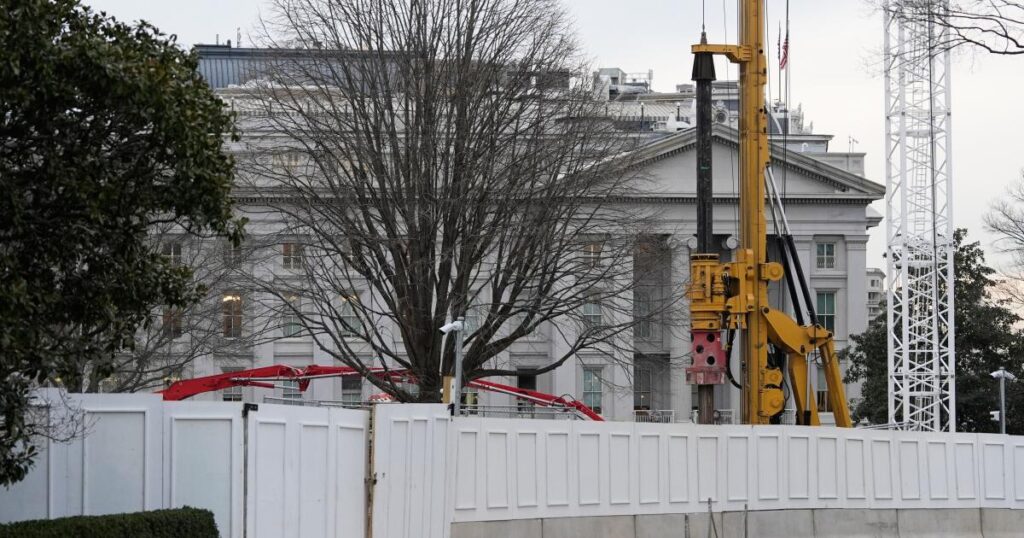
WASHINGTON — The White House said it was not feasible to save the East Wing because of structural and other concerns as officials shared details of President Trump’s planned ballroom at Thursday’s meeting of the National Capital Planning Commission.
Josh Fisher, director of the White House Office of Administration, ticked off issues including an unstable colonnade, water leakage and mold contamination in explaining why it was more economical to tear down the East Wing to make room for the $400-million ballroom than to renovate it.
“Because of this and other factors, the cost analysis proved that demolition and reconstruction provided the lowest total cost ownership and most effective long-term strategy,” Fisher said.
Will Scharf, a top White House aide whom Trump tapped to head the commission, opened the meeting by noting “passionate comments on both sides” of the ballroom project but adding that public comment wouldn’t be part of Thursday’s session.
“I view today’s presentation really as the start of a process as the ballroom moves through the overall NCPC process,” Scharf said, adding that his objective is for the commission to play a “productive role” as ballroom construction moves ahead.
In December, the White House submitted its ballroom plans to the commission, which is one of two federal panels that review construction on federal land — usually before ground is broken. The National Trust for Historic Preservation has sued to halt construction, accusing the Trump administration of violating federal laws by proceeding before submitting the project for the independent reviews, congressional approval and public comment.
The first step in the review process for the East Wing Modernization Project was Thursday’s information presentation, during which commissioners could ask questions and offer general feedback. A more formal review is expected in the spring — including public testimony and votes.
A summary on the commission’s website said the purpose of the project is to “establish a permanent, secure event space within the White House grounds” that provides increased capacity for official state functions, eliminates reliance on temporary tents and support facilities, and “protects the historic integrity and cultural landscape of the White House and its grounds.”
A comprehensive design plan for the White House prepared in 2000 identified the “need for expanded event space to address growing visitor demand and provide a venue suitable for significant events,” the summary said. It added that successive administrations had “recognized this need as an ongoing priority.”
The 12-member National Capital Planning Commission is led by Scharf. He said at the commission’s December meeting that the review process would be treated seriously and be conducted at a “normal and deliberative pace.”
Carol Quillen, president of the trust, told the Associated Press in a recent interview that she takes Scharf “at his word” that the commission will do its job.
Trump, a Republican serving his second term, has been talking about building a White House ballroom for years. In July, the White House announced a 90,000-square-foot space would be built on the east side of the complex to accommodate 650 seated guests at a then-estimated cost of $200 million. Trump has said it will be paid for with private donations, including from him.
He later upped the ballroom’s capacity to 999 people and, by October, had demolished the two-story East Wing. In December, he updated the price tag to $400 million.
The White House has announced few other details about the project but has said it would be completed before Trump’s term ends in January 2029. Trump has said the ballroom will be big enough for future presidential inaugurations to be held there. He also said it will have bulletproof glass and a drone-free roof.
While in Florida last week, the president bought marble and onyx for the ballroom “at his own expense,” the White House said. The cost was not disclosed.
Superville writes for the Associated Press.
The post White House says it wasn’t economical to save East Wing during ballroom construction appeared first on Los Angeles Times.