What is the UNFCCC treaty?
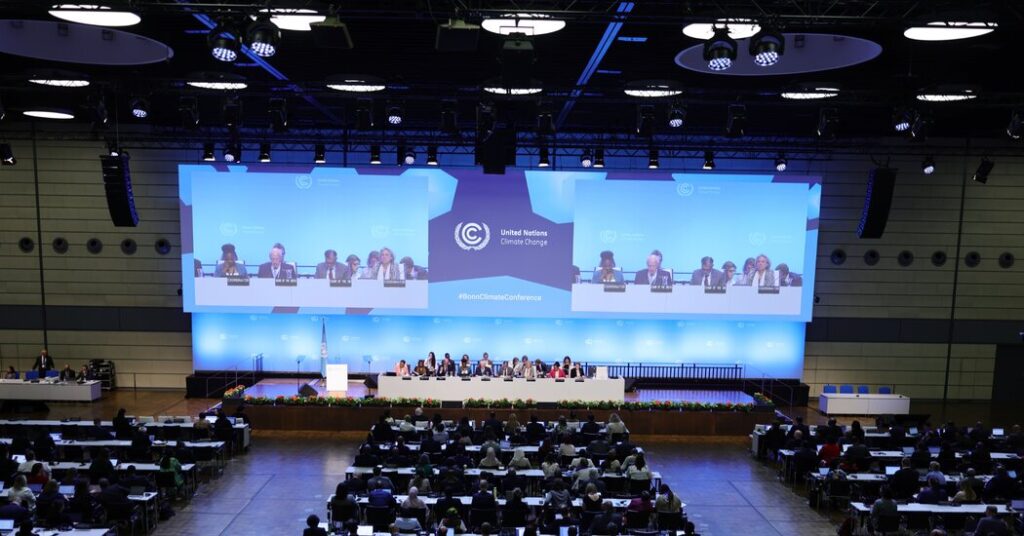
Established in 1992, the United Nations Framework Convention on Climate Change, or UNFCCC, is the treaty that sets a legal framework for international negotiations to address climate change. Under the treaty’s umbrella, nations gather every year to hammer out how they can collectively slow down the warming of the Earth’s atmosphere, which is caused principally by the burning of coal, oil and gas.
After years of negotiation, led in part by the United States and China, countries of the world agreed in 2015 to each set their own targets to reduce rising greenhouse gas emissions. That’s known widely as the Paris Agreement, because it was reached at a meeting in Paris under the auspices of the Convention on Climate Change.
The convention has an office in Bonn, Germany, and a staff of around 450. The United States customarily pays for around 20 percent of its core budget. Last year, when the Trump administration withdrew the U.S. contribution, the philanthropist and former Mayor Michael Bloomberg filled the gap.
Who else is a party?
Since 1992, 197 countries have ratified the convention. The United States was the first industrialized country to join, after ratification by the U.S. Senate.
Does a U.S. withdrawal matter?
It makes the United States an outlier. It matters with regard to America’s standing in the world, especially in the eyes of vulnerable countries that correctly point out that the United States is responsible for the largest share of the cumulative climate pollution heating up the Earth’s atmosphere.
Once the U.S. is out of a treaty, it’s hard for it to get back in. Ratifying a treaty requires a two-thirds majority in the U.S. Senate, an elusive task in today’s polarized politics.
The announcement said the withdrawal would take a year to go into effect.
Why now?
The administration instructed the State Department last February to review U.S. support for all global agreements and organizations. It imposed a 180-day deadline, which expired in August, 2025.
What are the implications?
The move takes the United States out of global discussions on renewable energy and measures to adapt to climate hazards. “It is not only self-defeating to let other countries write the global rules of the road for the inevitable transition to clean energy, but also to skip out on trillions of dollars in investment, jobs, lower energy costs, and new markets for American clean technologies,” said Manish Bapna, head of the Natural Resources Defense Council.
Somini Sengupta is the international climate reporter on the Times climate team.
The post What is the UNFCCC and Why Is the U.S. Pulling Out? appeared first on New York Times.