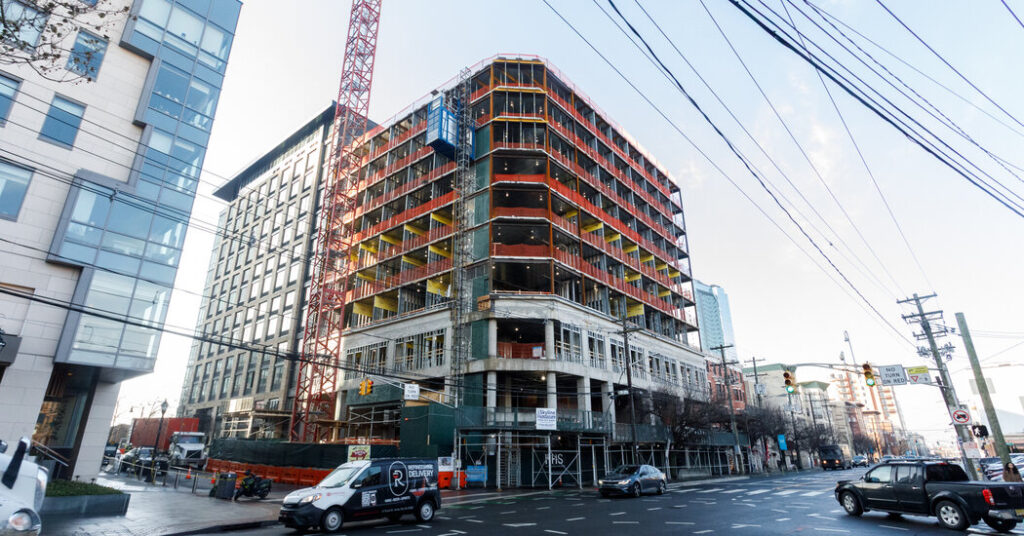
A few decades ago, Jersey City, N.J., was seen as a forlorn riverside strip of vacant warehouses, blighted streets, abandoned housing and decaying piers — a former manufacturing town hollowed out by 20th-century suburban flight.
Now it is a place of pro-housing dreams, where construction is constant and rezoning is realized, where a nearly century-old Art Deco hospital can be converted into an apartment complex and one of the city’s oldest churches can transform into a gleaming rental tower.
When Mayor Zohran Mamdani of New York looks across the Hudson River, he sees his city’s future, he says.
“One of the key lessons” of Jersey City, Mr. Mamdani said at a news conference last month, is that government officials should be making “the construction of additional housing a priority and working backwards from that.”
But for Jersey City residents, the housing boom is a more complicated story. Some have embraced the change, watching happily as apartment buildings rise over train stations, creating the sort of transit-oriented growth that urban planners praise as efficient and environmentally friendly. It has also been frustrating and painful for some longtime locals who have watched as their sense of community eroded, neighborhoods gentrified and some residents were displaced.
“Jersey City is a success story, an example of a city that has revitalized,” said Peter Kasabach, executive director of New Jersey Future, a nonprofit focused on sustainable growth.
But he also described shortcomings. His group recently conducted a study that found that about a third of the census tracts in Jersey City had experienced residential displacement or were at high risk of displacement.
At the heart of the evolution is Steven Fulop, a 48-year-old former Marine who worked in banking before becoming mayor of the city, New Jersey’s second-largest.
Set to leave office this month after a transformative 12-year tenure, Mr. Fulop, a Democrat, has spent much of his last year as mayor proselytizing about the merits of saying yes to development. (He is set to become the head of the Partnership for New York City, an influential business group.)
Jersey City is home to about 3 percent of the state’s population, but accounts for about 20 percent of new building permits in New Jersey, according to government data.
Rents, which have been rising for years despite the construction, finally began to flatten in 2023 and 2024, experts say. Now they may be falling.
The median asking rent in Jersey City was $2,650 in December, compared with $1,995 in 2017, according to Amanda Shur, a spokeswoman for StreetEasy/Zillow. By contrast, the median asking rent in New York City last month was $3,874, she said.
To get to this point, Mr. Fulop followed what he called a “clear and deliberate playbook.”
It has several planks: Rezone for denser building and taller towers, incentivize developments in lower-income areas through tax breaks, scrap parking requirements, accept imperfect projects, and get comfortable facing off with labor interests and community groups.
It has not been a path of ideological purity, nor has it pleased everyone.
“People say, ‘Hey, I’m going to build 20 percent affordable housing, and I’m going to get the developer to build schools and do 100 percent union labor,’” Mr. Fulop said. “Sometimes those economics don’t work, right? And so you need to make choices.”
At times, his city has not built with union labor. It has accepted developments with few affordable units, and has authorized construction that might not match a neighborhood’s character. “For me, the most important thing is building,” Mr. Fulop said, adding that it is important to work with the private sector.
Still, between 2010 and 2022, more than two-thirds of the housing growth in Jersey City came in the form of studios and one-bedroom units, according to the Regional Plan Association, a civic nonprofit. Smaller units can offer escape hatches for young, beleaguered Manhattan and Brooklyn renters, perhaps, but are of little use to local families worried about being priced out.
Bob Hurley, who built a boys’ basketball powerhouse at St. Anthony High School in Jersey City, wondered how middle- and working-class families could afford to make it there now. The median household income is about $95,000, according to the census.
Recreation centers and other affordable after-school destinations that long served as hubs for Jersey City youth have closed, said Mr. Hurley, 78, who is in the Basketball Hall of Fame. St. Anthony closed in 2017 after it ran out of money to keep tuition low.
“We don’t have the balance that we need,” Mr. Hurley said in his gravelly North Jersey timbre. “As we’re developing — buildings going up all over the place — I don’t see the infrastructure staying in line.”
He sees young transplants treating Jersey City as a “way station” to New York, he said. The families moving in can afford to send their children to expensive private schools, he added.
On a recent afternoon, Natasha McMullen, 30, a lifelong resident, gestured toward the skeleton of a half-built luxury apartment building on Grand Street in downtown Jersey City, near where a youth community center once stood. “This is ridiculous,” she said.
Ms. McMullen said most of her class at James J. Ferris High School, a local public school, had scattered across the state and country after graduation, driven away by the cost of living. She wants the city to slow down the development, she said, and she is concerned about the loss of green spaces, family-run stores and community gathering places.
Mr. Kasabach of New Jersey Future said the city had failed to plan for its own success and to build mechanisms to help keep longtime residents from being pushed out. Now the city is “playing catch-up” by requiring affordable units in some projects, he said.
The decline in available affordable housing has notably affected Black residents, who on average have less wealth than white families. Between 2013 and 2023, the city’s Black population fell by about 3,000, while its white population grew by about 15,000, according to a report from Rutgers University’s law school.
Mr. Fulop said he had no regrets about how the city had developed, but that he understood concerns about the decline in the Black population.
He noted that Jersey City remains one of America’s most ethnically diverse cities, and that the drop in Black residents mirrors a dynamic that is playing out across the New York City region. “It’s not unique,” he said.
Today, most low-income Jersey City households put more than 30 percent of their income toward rent or mortgage payments, the threshold for being cost-burdened, according to the Regional Plan Association.
But Jersey City residents spend less of their income on housing than the state average, the group found. Housing experts say that the building boom, whatever its flaws, has made Jersey City much cheaper than it otherwise would be.
Courtenay Mercer, a Jersey City resident and urban planner, said her city was offering a “release valve for the pent-up demand in New York City.”
Between 2010 and 2022, Jersey City produced housing at a rate more than triple that of the New York metro area overall, according to the Regional Plan Association. And no other U.S. city has mandated more affordable housing without state intervention, said Alex Armlovich, a senior fellow at the Niskanen Center, a nonprofit public policy group.
In May, Jersey City broke ground on the Bayfront Promenade, planned to be its largest mixed-income housing development. The city says about 80 percent of the units will be reserved for low- or middle-income households.
Mr. Mamdani says he speaks regularly with Mr. Fulop, and he has framed New York’s housing shortage as the core of the city’s affordability crisis, pledging to build 200,000 affordable housing units over the next decade.
New York made some strides under former Mayor Eric Adams, who embraced a program called “City of Yes” that included zoning changes as part of a plan to build 80,000 new homes. Mr. Mamdani selected Leila Bozorg, a pro-development official who worked in the Adams administration, as his deputy mayor for housing, and some of his first executive orders were aimed at accelerating housing construction.
“When most New Yorkers think about what causes them the most anxiety, what chips away most at their savings, what makes life in our city feel most impossible — housing is so often the answer,” Mr. Mamdani said at a news conference last month. “We don’t have enough of it.”
The post This City’s Housing Boom Is a Model for Mamdani appeared first on New York Times.