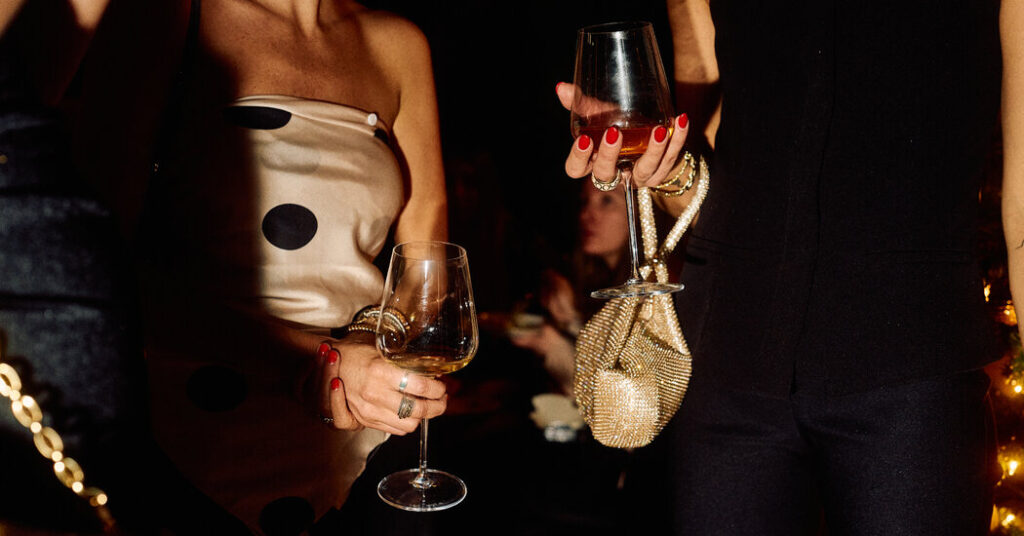
Neva Coleman was in high spirits on New Year’s Eve. It was just after 8 p.m., and the private club in the Flatiron district where she had gone to celebrate was already in full-bore party mode. It was a young, pulled-together crowd — lots of blowouts, velvet and at least one tux. Guests took spins around the main room, striking poses at the digital photo booth, assembling plates from the lavish appetizer buffet and procuring drinks at the smoky blue marble bar.
Ms. Coleman found a spot at the resolution station. She scribbled her intention for 2026 on a slip of paper, stuffed it in an envelope and affixed it to a bulletin board. “My resolution,” she yelled over the strains of disco to a couple of women who were also pinning down their hopes and dreams, “is that this year, I want to start a revolution of sober party girls.”
She spotted a quartet of fellow rising stars of sober TikTok, adjusted her silver tube top, darted across the room and announced her news. “I just came back from Florida where I recorded ‘Rise Above,’” said Ms. Coleman, best known on social media as @soberpartygirlll.
The group squealed in approval and raised their beverages in salute, a few of them eager to discuss their own recent podcast appearances. Rachel Hechtman, 36, who is known to her nearly 24,000 Instagram followers as @soberincentralpark, had just been a guest on “Dopey,” a comedic take on the recovery-podcast genre. Ms. Hechtman’s episode was titled “I Snorted Paris Hilton’s Coke, Dealt at Dartmouth, 4-Month Psychotic Hell, Secret Marriage.” It came out on Christmas Eve.
Ms. Coleman and her cohort were some of the 110 individuals who had opted to ring in the New Year at the Maze, the latest entrant to the city’s profusion of increasingly niche members-only clubs. Like other private spaces, the Maze features cozy club chairs and a restaurant that prepares Instagram-worthy dishes. But its bartenders don’t pour martinis or Malbec. The Maze may well be New York’s only dry members-only club.
“We don’t serve alcohol, and we expect members and guests to remain sober on site,” said Justin Gurland, the club’s founder and owner. But the club is catering to a generation that feels sobriety doesn’t have to be confined to Alcoholics Anonymous meetings in church basements. “We don’t impose rules on life outside the Maze,” Mr. Gurland added.
“I like to have several ways to maintain my sobriety,” said Bri Pecora, who was wearing a black strapless top and skinny capri pants and is known to her nearly 10,000 TikTok followers as @morefunwithoutit. “A.A. is great, but sometimes it can be God-centered.”
With annual membership dues of $3,300 (plus a one-time $1,500 initiation fee), the Maze is banking on the waning interest in drinking among young people with disposable income. A recent poll from the global research firm Gallup reported a pronounced decline in adults ages 18 to 34 who regularly drink alcohol compared with previous generations.
Mr. Gurland and his colleague in the venture, Dan Brody, are well versed in recovery. The longtime acquaintances became close five years ago, when Mr. Gurland, who is about to celebrate 18 years of being substance-free, guided Mr. Brody through his own early sobriety. They remained close while both building careers in the sober-house industry. After a few years of working in the so-called sobriety space, they decided to build one of their own in a former Japanese restaurant that was sitting empty on West 24th Street.
The place has the feel of a gentleman’s club from another era: rich wood floors, a hunter-green-and-claret color scheme and a preponderance of marble. But it’s decidedly modern. The club’s name, which appears in hand-drawn gold lettering on the exterior’s frosted glass, is also the title of one of Mr. Gurland’s favorite songs by the jam band Phish. (Once a self-identifying “regular Phish head,” Mr. Gurland now belongs to the Phellowship, a support group for sober Phish fans.)
Some of the 130 people who have become members of the Maze are in active recovery, Mr. Gurland said, and many of them regularly attend A. A. meetings. But many who have joined are simply sober-curious.
“Some people say, ‘I only drink at weddings,’ and other people say, ‘I just don’t want to be in an atmosphere that revolves around drinking,’” said Mr. Brody, who interviews applicants and estimated that half of the members are completely sober. Other members, like Bryan Linnell, a 32-year-old management consultant, fall somewhere else on the sobriety spectrum.
In September, Mr. Linnell learned that he had been accepted into the Tokyo Marathon, and right away, he and his fiancée, Christine Beaudet, took a hard-hat tour of the Maze. Even though the club wouldn’t be open for a month, they promptly joined. “A meeting place without the pressure of alcohol stood out to us,” Mr. Linnell said. He was inspired by his boss, a marathoner who lives in London and forswears his beloved Guinness when training for a race. “I’m not drinking, and I figured joining would help me focus on my goals,” Mr. Linnell said.
Before becoming a sobriety influencer, Ms. Hechtman had a fairly intense job at a nonprofit and was unhappy about her weight and her unhealthy relationship to alcohol. “I kept trying Weight Watchers, but it never worked because I was drinking all my points,” she said. Her mother suggested giving Dry January a try, and so she did. “I started walking around Central Park with my dog and posting videos on Instagram,” she said.
Five years later, Ms. Hechtman has lost 80 pounds and no longer works at her old job. She is focused on @soberincentralpark and its offshoot businesses. In addition to working as a consultant to nonalcoholic beverage brands, she is also a sober coach. Ms. Hechtman provides her clients a syllabus of journaling exercises, daily check-ins and weekly one-on-one sessions.
“Most of my clients don’t want to go to A.A. because they don’t like the word ‘alcoholic’ or they live in a small community and don’t want their neighbors to know what’s up,” she said.
Ms. Coleman (@soberpartygirlll) is even more determined to reinvent the public perception of sobriety. “I take my sobriety very seriously,” she said, “but not too seriously.”
Recent videos focus on her hair appointments or the designer outfits she wears to A.A. meetings. Her posts put an aspirational spin on the world of recovery, and she says her message is resonating. “I’ve heard from people in the U.S., the U.K., Denmark,” she rattled off. “I just got a D.M. from a woman in Australia.”
This attention is familiar for Holly Whitaker, whose provocative 2019 anti-alcohol manifesto, “Quit Like a Woman,” catapulted her to sober-influencer fame. “I wanted to be the poster child for sobriety,” Ms. Whitaker recently said, “because I just wanted to make the world sober.” But lately, she has been considering the consequences of building a personal brand around sobriety.
“There is a harm in holding it up as an aspirational life choice,” she said. “Because what happens is, you change. And then what happens if you drink again? Both in terms of what happens to you and the people who’ve been projecting themselves onto you? Healing work is dirty. It’s up and down. We’re not prepared to show that as influencers yet.”
But as midnight approached at the Maze, there was little evidence of the up and down or the dirty. At precisely 11:55 p.m., a flotilla of servers emerged from the shadows bearing trays of sparkling nonalcoholic rosé to toast the New Year. The clock struck 12, and hundreds of gold balloons rained down from the ceiling. Revelers helped themselves to a midnight snack of waffle fries and smash burgers. Ms. Coleman and a young woman with an icy blonde bob and a long white tube dress pressed their cheeks together to take a selfie, then toggled to their Uber apps.
“Mine’s a minute away,” Ms. Coleman said. “I already ordered it.”
The post The Sober Party Girl Revolution appeared first on New York Times.