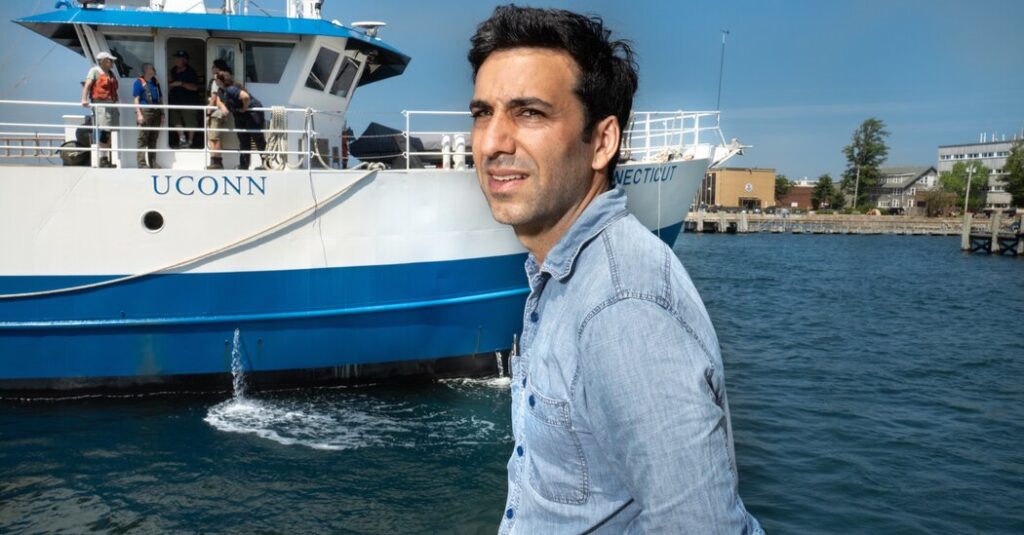
A few months ago, the oceanographer Adam Subhas and his colleagues turned the sea red. At first it looked as if the scientists had dumped a few barrels of beet juice into the Gulf of Maine. A narrow band of crimson water lingered in the wake of one of their chartered vessels, briefly tinging violet here or magenta there when tumbled by wind and waves. As the ship began to make a circle, the maroon trail elongated and expanded, soon filling a much larger part of the sea. Onlookers on a passing vessel might have mistaken the scene for the aftermath of a shark attack.
It was, in fact, something even more unusual — and, to some people, no less alarming. The scientists were deliberately pumping about 16,200 gallons of sodium hydroxide, more commonly known as lye, into the ocean, along with a red dye that made the solution easier to track. It was the final phase of a study on a promising yet controversial climate intervention, one that could simultaneously mitigate both global warming and another, equally terrifying consequence of carbon emissions: the rapid acidification of the world’s oceans.
Since the advent of the industrial age, the oceans have absorbed about one-third of humanity’s heat-trapping carbon emissions. Were it not for that immense buffer, the planet would be substantially warmer and more tempestuous than it is today. As carbon dioxide from the atmosphere dissolves into the ocean, however, it reacts with seawater to form carbonic acid, which disrupts the ocean’s chemical balance and reduces its capacity to absorb more carbon. Prolonged acidification will severely threaten marine ecosystems and fisheries on which more than one billion people depend.
To counteract these effects, scientists have proposed a type of geoengineering known as ocean alkalinity enhancement, which essentially involves concocting antacids for the sea. Modifying the planet’s chemistry in this way allows more carbon to flow from the atmosphere to the ocean, where it can be stored for thousands of years. Experts emphasize that such mediation would be entirely ineffectual without first slashing greenhouse-gas emissions. Yet they also agree that emissions reductions alone are no longer sufficient to prevent the planet from warming two degrees Celsius above the preindustrial base line, at which point extreme weather, sea-ice decline, species loss and crop failures would be anywhere from two to 10 times as bad as they are now and at which tens of millions more people would be subjected to severe heat, flooding and water scarcity. Given that the oceans cover more than 70 percent of the planet’s surface and are fundamental to climate regulation, it seems inevitable that they will be part of these supplemental efforts.
In mid-August, Subhas, who works for the Woods Hole Oceanographic Institution, and his colleagues convened several ships in a region of the Atlantic known as Wilkinson Basin, about 50 miles off the coast of Massachusetts. The main research vessel followed closely behind the dispersal ship, continually sampling and analyzing seawater. An entourage of autonomous underwater robots helped collect further data. At its largest, the red patch of alkalinity measured about six miles across; in some parts, it raised the water’s pH from a base line of 7.95 to 8.3. After five days of close observation, when the pH had returned to its pre-experiment level and the dye had faded, Subhas (pronounced suh-BOSH) and his colleagues began the journey back to Woods Hole, where they have since been analyzing their findings.
“What we can say so far is that we set up exactly the right conditions for the surface ocean to take up carbon dioxide from the atmosphere,” Subhas told me. “There’s no question that there was a flux. The big question now is, Can we quantify it?”
Developing reliable metrics is just one of the many hurdles to global carbon removal. Limiting warming to under two degrees Celsius requires the capture and sequestration of perhaps seven to nine billion tons of carbon dioxide each year, in addition to steep reductions in emissions. Experts estimate that ocean alkalinity enhancement alone could remove somewhere between one and 15 billion tons. But the investment and infrastructure needed to reach even a fraction of that potential is immense. The supplemental mining effort required to remove just one billion tons of carbon dioxide annually by adding alkaline minerals to the sea would most likely be equivalent to a second global cement industry, for example.
“If we’re serious about carbon dioxide removal, it’s going to be the largest thing humanity has ever done,” says David Ho, a professor of oceanography at the University of Hawaii at Manoa and an expert on the marine carbon cycle. “It really should be something that governments pour effort into, like the Manhattan Project.”
Planetary-scale carbon removal may prove both necessary and feasible, but that does not negate its fundamental audacity — or absurdity. Several centuries ago, humanity began to pilfer an immense power from the planet: hundreds of millions of years of sunlight, channeled through the pulsing greenery of life, swallowed by the earth, and compacted into outrageously energy-dense reservoirs of carbon we call fossil fuels. By setting those ancient repositories on fire, industrial nations initiated an eruption of carbon into the atmosphere at a rate that has no parallel in at least the past 66 million years. The consequences, more obvious by the day, have already been disastrous. Yet obstinate governments continue to feed the blaze, ignoring the available solutions. Forced to reckon with these compounding failures, but unwilling to forfeit the possibility of a better future, the world turns now to another ancient, earthly power. We look once more to the ocean.
“I don’t think it’s realistic to leave the oceans untouched,” says David Koweek, the chief scientist at Ocean Visions, a nonprofit conservation organization that focuses on marine approaches to countering climate change. “Our collective inaction has left us with little choice.”
As a graduate student in geochemistry at the California Institute of Technology in Pasadena, Subhas became fascinated by Earth’s long-term carbon cycle, which regulates climate and balances the pH of the ocean. Carbon continually cycles between air, sea and land. Throughout Earth’s history, huge injections of carbon into the atmosphere — from, say, increased volcanic activity — have resulted in a sweltering climate, a more acidic ocean and, in some cases, mass extinction of marine life.
As seawater becomes more acidic, it interferes with the physiology of ocean creatures in numerous ways, disrupting processes as diverse as metabolism, sensory perception, reproduction and communication. Extreme acidification is especially disastrous for a group of organisms known as calcifiers, which include corals, mollusks, crustaceans and many types of plankton. Calcifiers construct their shells and skeletons from alkaline minerals present in seawater, in particular calcium and carbonate. As pH drops, carbonate becomes less available and calcifiers struggle to build and maintain their armor. If the ocean becomes too acidic, they begin to dissolve.
Between the Industrial Revolution and 2024, the average pH of surface seawater decreased from about 8.2 to 8.04, corresponding to a 40 percent increase in acidity. The current rate of ocean acidification is greater than it was during any ecological crisis in at least the past 300 million years — so anomalous that it’s difficult to precisely predict how it will warp the modern ocean. Given that plankton form the foundation of ocean food webs, however, and that coral reefs alone support 25 percent of marine species, the implications are dire. Highly important fisheries, ranging from oysters, crabs and lobsters to herring, salmon and cod, could dwindle or collapse.
Earth as a whole is not helpless in the face of climatic and chemical volatility, however. It has powerful self-stabilizing processes. When carbon floods the atmosphere, making the planet hotter and stormier, its carbon-sequestering processes speed up. First, carbon dioxide in the atmosphere combines with rainwater, making it slightly acidic. As rain falls on land, it breaks down rocks, including ones like basalt and limestone, which contain alkaline minerals. Rivers carry the minerals liberated from these rocks to the ocean, where they nourish calcifiers and bind to dissolved carbon in seawater, reducing its acidity and allowing it to absorb more carbon from the atmosphere. In tandem, the remains of dead calcifiers sink into the depths, sequestering carbon in thick layers of seafloor sediments. Over hundreds of thousands to millions of years, these processes gradually pull carbon from the atmosphere, raise the pH of the ocean and cool the planet.
Although this innate resilience helps keep Earth stable on geologic time scales, it operates far too slowly to save extant life from the current rates of warming and acidification. Ocean alkalinity enhancement is an attempt to emulate and accelerate the planet’s stabilizing feedback loops so that they occur in a matter of decades. In 1995, Haroon Kheshgi, a chemical engineer at Exxon, published one of the first formal proposals for such an intervention, focusing on the feasibility of adding huge quantities of lime to the sea. Since then, scientists have published numerous simulations and modeling studies on many different alkaline treatments. But field studies in the ocean itself were hampered by a prevailing taboo against geoengineering.
Now an increasingly open-minded attitude toward geoengineering within the scientific community, combined with recent waves of funding, is allowing researchers to break out of the lab and study the effects of alkalinity-based interventions in the real world. The Gulf of Maine experiment — part of a project named LOC-NESS (Locking Ocean Carbon in the Northeast Shelf and Slope) — reflects this shift.
In parallel, numerous start-ups are already capitalizing on surging interest in alkalinity enhancement. Vesta, based in San Francisco, has focused on augmenting existing beach-nourishment projects, spreading close to 9,000 tons of sand made of the mineral olivine in nearshore waters around New York and North Carolina. Ebb Carbon, also headquartered in the Bay Area, has installed equipment at the Pacific Northwest National Laboratory in Sequim, Wash., that electrochemically separates seawater into acidic and alkaline streams and returns the alkaline stream to the ocean. Planetary Technologies, based in Nova Scotia, diffuses magnesium hydroxide through existing coastal outfalls at a power plant in Halifax. Last June, it became the first of these companies to deliver verified carbon-removal credits to its high-profile customers, which include British Airways, Stripe and Shopify.
While entrepreneurs in the private sector often justify this rapid development as a necessary response to a global emergency, many scientists and environmentalists argue that deployment must wait for the answers to a couple of key questions: Namely, is ocean alkalinity enhancement actually effective? And is it safe?
Concentrated sodium hydroxide is a highly caustic substance with a pH of 14, or what Subhas calls “pure alkalinity.” It’s used in detergents, drain cleaners and paper manufacturing; it’s also used to treat drinking water, produce anticoagulants and give traditional soft pretzels their glossy brown crust. Accidental spills of sodium hydroxide in rivers and creeks have killed thousands of fish. Although spills in the ocean have also harmed wildlife in the immediate vicinity, there is no evidence of long-lasting environmental repercussions, most likely owing to the alkalinity’s dilution in a vast body of water. Subhas and his collaborators designed their research apparatus to rapidly disperse lye in seawater, minimizing the risk of burning or killing nearby organisms. They calculated that their study might kill only nine more fish than would have died otherwise from natural causes. Every expert I interviewed agreed that the Woods Hole experiment did not present a significant danger to wildlife or the ocean ecosystem.
Orchestrating similar interventions on a global scale would be a much more complicated and risky endeavor. All viable forms of alkalinity require substantial energy and infrastructure to obtain and deliver, which entail their own emissions and environmental ramifications. Limestone, basalt and olivine must be mined, pulverized and in some cases chemically transformed before being transported to the coast. Potent alkaline solutions are produced through industrial processes and must be carefully handled. Electrochemical methods depend on dedicated, continuously operating facilities.
Adding too much alkalinity too quickly risks supersaturating seawater, which can result in spontaneous runaway accumulation of solid minerals — a process that releases carbon dioxide and lowers pH, greatly reducing or potentially negating the primary benefits of the enterprise. And even if alkaline materials are successfully mixed into the ocean, measuring and verifying the subsequent carbon removal is quite challenging. When the pH of the ocean increases, carbon gradually flows from air to sea over a period of weeks to years. In that time, as the introduced alkalinity diffuses across a large region of the ocean, the shift in carbon it’s presumably causing becomes increasingly difficult to distinguish from background fluctuations.
A prominent concern among the public and scientists alike is how planetary-scale alkalinity enhancement would affect life in the ocean. Research to date has largely concluded that moderate levels of alkalinity enhancement would have negligible or beneficial effects on many, though certainly not all, forms of ocean life. A recent review of 68 studies covering 84 species — including plankton, corals, mollusks and crustaceans — found that close to 40 percent of biological responses to increased alkalinity were neutral, 34 percent were positive and 26 percent were negative. But many questions remain understudied. The rocks that might be mined for such interventions, for example, sometimes contain certain nutrients and heavy metals that encourage algal blooms or have toxic effects that bioaccumulate. High concentrations of alkaline substances can also limit the availability of carbon dioxide and increase the murkiness of seawater, hindering the ability of phytoplankton to perform photosynthesis.
“What I am most concerned about are long-term, multigenerational effects on food webs and ecosystem structure and function that we cannot easily predict,” says Nina Bednarsek, a senior scientist at the Jozef Stefan Institute in Slovenia and a co-author of the recent review on how marine life responds to shifts in ocean chemistry. “Those sorts of changes can only be observed as alkalinity accumulates over long periods of time.”
Experts agree that beyond capturing carbon, a continuous, planet-wide implementation of ocean alkalinity enhancement would raise the average pH of the ocean’s surface — but only marginally, perhaps by half a percent or less. At this point, it’s simply not feasible for humans to return the ocean to its preindustrial chemical base line because the cost, effort and material resources required are too gargantuan. A global effort would, however, help prevent further acidification. As a marine antacid, alkalinity enhancement will probably be more effective in select regions of the coast that are home to especially vulnerable fisheries and ecosystems, like coral reefs.
Such defenses have a long history. The Indigenous peoples of western North America farmed clams in walled gardens along the shore to which they routinely added crushed shells. Research has since confirmed that doing so raises the pH of the water, improving the growth and survival rates of juvenile shellfish and, in combination with other benefits of the gardens, yielding two to four times as many adults. In the mid-2000s, oyster hatcheries in the Pacific Northwest began experiencing mysterious mass mortalities. They initially suspected a pathogenic bacterium, but in collaboration with Oregon State University scientists, they discovered that ocean acidification was the true culprit. Along the West Coast, strong upwelling frequently brings deeper, more acidic water to the surface. Some hatcheries now ameliorate the seawater they pump into their onshore facilities with sodium carbonate. “We can’t use the water as it is anymore,” says Sue Cudd, the owner of Whiskey Creek Shellfish Hatchery in Netarts, Ore. “We have to buffer.”
“I don’t think we can realistically talk about mitigating acidification on a global scale,” Bednarsek says. “You need to identify the most sensitive regions and fisheries, the ones you really want to preserve, and tackle those first, not just for the sake of the marine ecosystem but also for the human connections.”
The nascent field of ocean-based climate interventions is currently straddling a rift between scientific consensus and public perception. Many experts are finding that even if they secure the support of their colleagues and the necessary legal permissions, fostering trust and understanding among the public remains a challenge.
In recent years, miscommunication and secrecy on the part of scientists and start-ups have resulted in a string of failed geoengineering efforts and bad publicity. In early 2023, environmentalists in Cornwall, England, were outraged to learn that Planetary Technologies had already conducted an enhanced alkalinity trial in the area the previous fall, adding a milky slurry of magnesium hydroxide to an existing stream of treated wastewater flowing into St. Ives Bay. Intense protests, debates and scrutiny followed, continuing even after an independent report commissioned by the United Kingdom’s Environment Agency concluded that such trials pose very little risk to marine life. Last spring, Planetary Technologies officially canceled plans for further projects in the region, citing “commercial infeasibility.”
The Woods Hole team was determined to avoid similar mistakes. Over the course of a year, Subhas and his colleagues conducted more than 50 meetings and workshops with fishermen, tribal communities, policymakers and local businesses. They explained that their experiment was small, controlled and safe; that it was independent of commercial enterprises; and that the intervention they were investigating was intended to protect marine life and the livelihoods it sustains. Nevertheless, the study generated considerable controversy. Fishermen repeatedly raised concerns about disrupted operations and potential harm to crustaceans, fish and North Atlantic right whales. “This will be completely devastating to any and all wildlife in the area!” Ryan Sirois, a commercial lobsterman, posted on the Environmental Protection Agency’s website during a window for public feedback. “I hope you stop this outrageous pollution of our oceans as soon as possible, our planet depends on it.”
Some of the early in-person meetings were tense, says Sarah Schumann, a commercial fisherman who advocates fishery-friendly climate action. “Adam said two sentences, and the fishermen started blasting him with questions,” she recalls. “We’ve had so many experiences over the centuries where putting a chemical in water or air has come back to bite us, so it’s really hard now to be told that adding this chemical could reverse some of the damage.”
Much of the New England fishing community remains uneasy to this day. Several fishermen I interviewed said that they were not even aware of the initial E.P.A. review period until it was almost over and that most of their colleagues had never heard of marine carbon-dioxide removal. The window for public comment also coincided with an offshore wind-turbine accident near Martha’s Vineyard, in Massachusetts, which exacerbated opposition to perceived tampering with the ocean more generally.
The tensions reflect longstanding factions of resistance in the United States to expert-backed proposals for managing climate change. The Trump administration has repeatedly interfered with renewable-energy projects. Fossil-fuel interests have funded disinformation campaigns that portray wind turbines as environmental menaces. And some environmentalists have tried to stop the development of solar farms that impinge on endangered species’ habitats. Because so many people view the ocean as life-sustaining and inviolable, disagreements about marine-based climate interventions tend to be especially intense. Members of the same New England commercial-fishing communities that objected to the Woods Hole experiment have denounced offshore wind projects.
The repeated failure of world powers to sufficiently curb greenhouse-gas emissions has forced humanity into a bizarre pantomime. It feels like dancing around a wildfire with butterfly nets in hand, trying to catch every stray ember and flake of ash while halfheartedly throwing teacups of water onto the flames. Within the confines of this disorienting predicament, the necessary responses to climate change can appear to be — or can be made to look — as appalling as its repercussions.
Opponents of offshore wind have parroted the claim that the noise and infrastructure associated with wind farms disrupt cetacean communication and navigation, forcing whales to beach and die. Wind turbines “are causing whales to die in numbers never seen before,” President Trump has said. Although researchers plan to investigate the long-term effects of offshore wind farms on cetaceans, there is no scientific evidence that they are currently killing whales. A majority of recorded injuries and deaths among Atlantic right whales, the species of greatest concern, are related to entanglements with fishing gear and collisions with vessels. The most pressing threat to whales, plankton, life on Earth and civilization as we know it is not wind farms or preliminary studies on ocean alkalinity enhancement, but rather the very crisis both are intended to help resolve.
Ferris Jabr is a contributing writer for the magazine and the author of “Becoming Earth.” His work has been anthologized in four editions of the “Best American Science and Nature Writing” series.
The post The Scientists Making Antacids for the Sea to Help Counter Global Warming appeared first on New York Times.