President Trump was in complainer mode, reminding us that he felt he had not been treated respectfully by the news media, the Norwegian Nobel Committee, the mayor of New York City, Democratic officials and several Republicans.
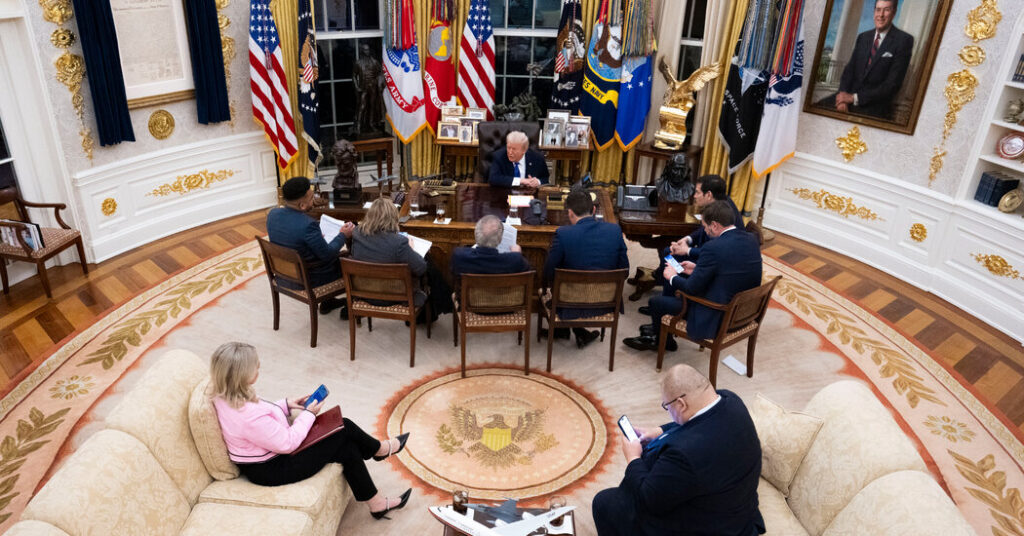
He played the part of the gracious host, pushing a button that summoned a valet bearing waters and Diet Coke, and guiding a laser pointer across several pieces of centuries-old American portraiture as he described the various updates of the Oval Office to his visitors.
He struck a father figure tone to aides and advisers in the room, referring to several of them — including Vice President JD Vance, 41, and Secretary of State Marco Rubio, 54 — in passing as “kids.” Both men were wearing shoes he had gifted them.
He put on his builder hat, a guy from Queens fixated on turning the White House into a top-of-the-line residence he can show off. Mr. Trump reminisced about that part of his biography — not coincidentally, the era of his life when he collected glowing headlines like precious gemstones — amid discussions about the chaos beyond the gates, much of it he had wrought.
“I was really good at real estate,” Mr. Trump said. “Maybe I was better at real estate than I am at politics,” he added at one point.
Most of all, Mr. Trump sought on Wednesday evening to present himself as indefatigable, projecting stamina and energy for a news organization he has accused of seditious behavior for reporting about his health and age. (The president turns 80 in June.)
During a nearly two-hour interview, followed by a tour of the White House and official residence, Mr. Trump tried on a full range of the personas he has used for decades in public life, and newer ones he has employed in his second term. The result: an encounter that took unpredictable turns throughout the evening. It’s a tactic he embraces as president, particularly on the world stage. If no one knows what you might do, they often do what you want them to do.
Throughout our conversation, Mr. Trump clearly relished the moments when he could showcase his plans for the new White House ballroom, the marble flooring he had installed in the Palm Room just off the Rose Garden — where the veins in the stone line up just right — and the highly politicized presidential portraits he has lined up along the colonnade that leads from the residence to the Oval Office.
Near the end of the interview, when asked about the possibility of elections in Venezuela, Mr. Trump hit pause on the question. A valet had just entered with a model of his White House ballroom project.
“I’m a big fan” of democracy, Mr. Trump said. “Let me show you this before I talk about democracy.” He turned his gaze to the miniature replica of the White House complex, complete with junior American flags and a tiny Marine One, the presidential helicopter.
Sometimes, though, duty calls.
When the interview began, Mr. Trump switched into the role he has been showcasing in public since the audacious capture of the Venezuelan president: the world leader with the might of the largest military behind him.
As he toggled back and forth, it was clear that he wanted us to witness it all, and every version of him.
The World Leader
For this scene, which occurred about four minutes after we arrived, Mr. Trump was stationed behind the Resolute Desk. In front of it was Mr. Rubio, who was perched just inches from a bust of Benjamin Franklin.
We were seated amid the gold-leafed carvings adorning the room, and the warm, camera-ready lighting that Mr. Trump has installed throughout the West Wing. On his desk were various news clippings and a file marked “TOP SECRET.” Behind his desk was a photo of his son Don Jr. crouched under the Resolute Desk — just as John F. Kennedy Jr., the toddler son of a young president, had done in a well-known photo published in 1963. Its golden frame was engraved: “FAVORITE CHILD.”
From stage left emerged Natalie Harp — an aide the president calls “A.I.” because she searches for things on the internet and delivers documents at his request. She assisted him in passing out a few visual aides. One document with the headline “Trump on Tiktok,” complete with a personal note from Shou Chew, the company’s chief executive, highlighted the president’s popularity on the platform.
Mr. Trump only had a few moments to boast about TikTok dominance and lament traditional press coverage before another aide materialized with a note featuring a more pressing direction: “Colombian President Gustavo Petro is calling for you.”
The president put a conspiratorial finger to his lips, signaling for everyone who had assembled to hush. We realized that the vice president had suddenly pulled a seat up next to Mr. Rubio. The call’s contents were off the record.
For days, Mr. Trump had made it known that he was toying with attacking the country, after accusing Mr. Petro of being “a sick man who likes making cocaine and selling it to the United States.”
After the call concluded and Mr. Rubio and Mr. Vance departed, Mr. Trump summed up the conversation by dictating a Truth Social post to Ms. Harp: “I appreciated his call and tone, and look forward to meeting him in the near future.”
Some time later, Mr. Trump circled back to that call with Mr. Petro, which had lasted the better part of an hour.
He wanted to know: “Do you think Biden could do that?”
The Full Battery
That last question, really, could have been the title of the whole production. Former President Joseph R. Biden Jr.’s name came up repeatedly during our encounter with him.
“Two hours,” Mr. Trump said of the interview length as it came to a close. “Katie, I could go nine hours.”
During the interview, we asked the president about the fact that he was eight years older than he was the first time he took office, and if anything had become harder for him.
“I think it’s easier for me,” Mr. Trump said. “I feel physically the same. I feel the way I did 40 years ago.” He said he had golfed recently with Gary Player, the 90-year-old retired professional. He praised Mr. Player and the other mentally sharp nonagenarians he has known.
Then, like a boomerang, Mr. Trump returned to his 83-year-old predecessor: “I think Joe Biden is the worst thing that ever happened to old people,” he said.
When pressed on additional questions about his health, Mr. Trump repeated an earlier comment he gave to The Wall Street Journal about the 325-milligram daily dose of aspirin he takes. Aspirin is not recommended as a preventive medication for people over 70, and taking it to prevent strokes or heart attacks could do more harm than good, according to the American Heart Association. The exception, some cardiologists say, is if someone has already had a heart attack.
In the interview, Mr. Trump said that he had never had a heart attack.
“I want nice, thin blood going through,” Mr. Trump said of his aspirin use.
Mr. Trump said that he was not taking any other blood thinners, “because everyone I know that took them is dead.” “They’re almost like trial and error,” he added.
Mr. Trump said he had never taken a GLP-1 medication for weight loss. “I probably should,” he said.
He calmly fielded questions about his health, showing no signs of his past eruptions about news coverage focused on his age, which he described in December as “seditious, perhaps even treasonous.” We asked him why.
“I’ve gone out of my way to take physical exams more than anybody,” Mr. Trump said. “I just feel it’s important because I think that people that are president ideally should be in good health, and they should be good cognitively.”
The Grudge Holder
Mr. Trump has a deep, long-running sense of grievance that he has not been the recipient of better treatment from people he believes should respect him.
A drive for positive recognition has shaped every part of Mr. Trump’s presidency, and it showed up at nearly every turn of the interview.
He showed he was irked by Zohran Mamdani, the mayor of New York City, who recently said that the U.S. capture of Nicolás Maduro, the leader of Venezuela, was in “pursuit of regime change” and “a violation of federal and international law.”
During Mr. Mamdani’s own Oval Office visit last November, Mr. Trump had seemed excited to encounter a young, charismatic political talent also from the borough of Queens. Now, weeks later, Mr. Trump appeared disappointed that Mr. Mamdani had rained on what had been an “incredible military, financial and psychological success.” (Another example of a short-lived buddy comedy.)
The world has heard about some of the slights Mr. Trump mentioned, including his long-running frustration that he has not been awarded the Nobel Peace Prize.
“I’ve ended eight wars and didn’t get the Nobel Peace Prize,” Mr. Trump said. “Pretty amazing. Obama got it. He was there for a few weeks, and he got it. He didn’t even know why he got it.”
But his desire to be praised — and his anger over not being praised adequately — poked through in less expected ways, including when he was asked about potential conflicts of interest in his family business.
Mr. Trump said that he was not concerned about overlap between his government work and his family business, because he did not feel that he was praised enough for keeping his sons from pursuing international business deals and for donating his presidential salary the first time around.
“I got no credit in the first term,” Mr. Trump said, adding: “
“I got nothing but criticized.”
By now, the sky outside the Oval Office had turned from gray to ink. Several floodlights visible from the Oval Office were positioned by workers using machines to churn away into the dirt outside, in service of constructing a White House ballroom where the East Wing used to be.
For all of his disappointment and eagerness to be appreciated, his ability to build an impressive edifice is the skill Mr. Trump believes he has mastered. He wanted to show us what would come after the demolition.
Will Scharf, the White House staff secretary, had entered the room and had been standing nearby with a set of personnel orders for the president to sign with his usual Sharpie flourish. But first, Mr. Scharf helped Mr. Trump correctly position a miniature United States Treasury building in its rightful place on the model set.
Mr. Trump was intent on showcasing his plans for a $400 million ballroom that he has said is being funded by donations and his own money. The building, he said, would be designed with four-to-five-inch-thick bulletproof glass, and would be large enough to host future presidential inaugurations.
“I upgrade everything. I’m an upgrader,” Mr. Trump said. “I am a great real estate guy.”
He peered down at the little world he was rebuilding.
“And that building being built right across the way, that beautiful building,” Mr. Trump said, referring to the ballroom. “They’ll be thanking me.”
Katie Rogers is a White House correspondent for The Times, reporting on President Trump.
The post The Many Faces of Trump: What We Saw When We Interviewed the President appeared first on New York Times.