Around 2018, Apple considered adding a tiny laser to its iPhones. The part would allow consumers to take better photos, more accurately map their surroundings and use new augmented reality features. But it would also cost Apple about $40 per device, cutting into the company’s profits.
John Ternus, Apple’s head of hardware engineering, suggested adding the component to only the more expensive Pro models of the iPhone, said two people familiar with the discussions who spoke on the condition of anonymity. Those devices, Mr. Ternus reasoned, tended to be purchased by Apple’s most loyal customers, who would be excited about new technology. Average consumers, on the other hand, probably wouldn’t care.
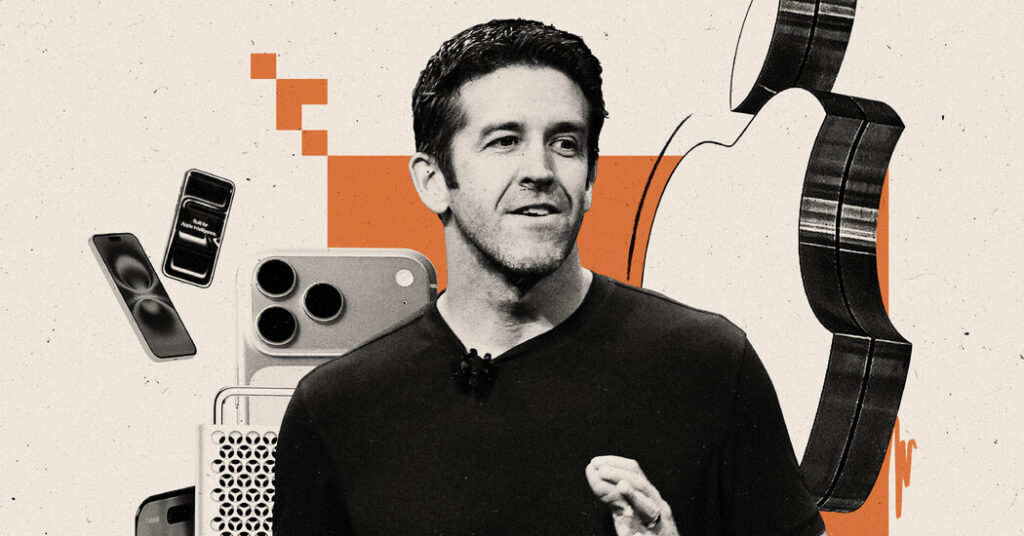
Threading the needle between adding new bells and whistles to Apple’s products while watching the bottom line has defined the careful, low-profile style of Mr. Ternus, who joined Apple in 2001. He is now considered by some company insiders to be the front-runner to replace Tim Cook, Apple’s longtime chief executive, if Mr. Cook decides to step aside.
Apple last year began accelerating its planning for Mr. Cook’s succession, according to three people close to the company who spoke on the condition of anonymity about Apple’s confidential deliberations. Mr. Cook, 65, has told senior leaders that he is tired and would like to reduce his workload, the people said. Should he step down, Mr. Cook is likely to become the chairman of Apple’s board, according to three people close to the company.
Despite his low profile, Mr. Ternus appears to have shot to the front of the pack to be Apple’s next C.E.O., according to four people close to the company. But Mr. Cook is also preparing several other internal candidates to be his potential successor, two of the people said. They could include Craig Federighi, Apple’s head of software; Eddy Cue, its head of services; Greg Joswiak, its head of worldwide marketing; and Deirdre O’Brien, its head of retail and human resources.
Mr. Ternus, 50, is the same age that Mr. Cook was when he took over for Steve Jobs in 2011. Like Mr. Cook, Mr. Ternus is known for his attention to detail and his knowledge of Apple’s vast supply network. Both men are also considered even-tempered collaborators, capable of navigating the bureaucracy of one of the world’s wealthiest companies without ruffling feathers.
Mr. Ternus’s rising profile has caused debate among Apple alumni and rank-and-file employees about whether he would lead like Mr. Cook, who succeeded by making the company more predictable and incremental, or Mr. Jobs, who laid the foundation for the company’s success with risky bets and visionary products.
“If you want to make an iPhone every year, Ternus is your guy,” said Cameron Rogers, who worked on product and software engineering management at Apple from 2005 to 2022.
The question for Apple is whether the company needs an innovator or another deft manager. While it has been years since the quick success of the iPhone and iPad, Apple has had many small hits under Mr. Cook and continues to be one of the most profitable companies in the world. Apple also faces tricky challenges, like navigating President Trump’s frequently changing tariff plans and its dependence on Chinese manufacturing.
Apple’s plans for artificial intelligence are also a big question. While other giant technology companies have spent tens of billions of dollars on developing A.I., Apple has largely been on the sidelines, and it has pushed off making major changes to its products with new A.I. technology.
It will be up to Apple’s board of directors to decide who will eventually replace Mr. Cook, who also sits on the board. The rest of the company’s eight board members did not respond to requests for comment, and Apple declined to comment and to make Mr. Ternus available for an interview. The Financial Times and Bloomberg previously reported on aspects of Apple’s succession planning.
Mr. Ternus, the youngest member of Apple’s executive leadership team, would be Apple’s first chief executive in three decades to have spent his career working on hardware. Unlike some of the other candidates to replace Mr. Cook, Mr. Ternus has worked on many of Apple’s devices as well as the global operations that manufacture those products.
But he would take over as a relative unknown outside Apple. Inside the company, he is known more for maintaining products than developing new ones, according to six former employees. And Mr. Ternus, who has been an engineer in Silicon Valley for all of his adult life, has limited exposure to the policy issues and political responsibilities associated with Apple’s corner office.
A California native, Mr. Ternus received a bachelor’s degree in mechanical engineering from the University of Pennsylvania, where he was on the varsity swim team. For his senior project, he designed a device that allowed quadriplegics to use head motions to control a mechanical feeding arm.
In the four years after his graduation from Penn in 1997, Mr. Ternus designed headsets and other products at a virtual reality start-up. He then joined Apple, first working on screens for Macs as the company transitioned away from the colorful iMacs of the late 1990s.
Within about three years, he became a manager, said Steve Siefert, Mr. Ternus’s first boss at Apple. During that time, their team moved office floors, switching from a closed office plan to mostly open seating with a few offices. When he was promoted, Mr. Ternus had the option to move into one of those offices but declined.
Mr. Ternus was “a man of the people,” Mr. Siefert said, adding that the decision to sit with his team likely helped Mr. Ternus manage and motivate his staff. When Mr. Siefert retired in 2011, freeing up his office, Mr. Ternus once again said he wanted to remain in the open space.
By 2005, Mr. Ternus had been promoted to lead Apple’s hardware engineering team for iMacs as it made the G5 series, said Michael D. Hillman, who helped hire Mr. Ternus and worked with him at Apple for more than a decade.
That team was working on using magnets to hold the computer’s glass screen in place, Mr. Siefert said. The technique was unusual for its time and faced skepticism, but Mr. Ternus still pushed for it.
“When presented with such an out-of-the-box idea, he would champion it,” Mr. Siefert added.
Mr. Ternus spent extended periods of time working with manufacturers in Asia, Mr. Hillman said. Mr. Ternus traveled between the continent and Silicon Valley and learned how difficult it could be to have a manufacturing supplier deliver on Apple’s design expectations. Apple also paired Mr. Ternus with an external consultant to advise him on leadership.
Mr. Ternus became a key lieutenant of Dan Riccio, his predecessor as Apple’s head of hardware. By 2013, Mr. Ternus’s role had expanded to include overseeing the Mac and iPad teams.
In recent years, Mr. Ternus has shouldered more responsibility for updates to Apple’s products. He spearheaded the iPhone Air, which was released last year with a new, slim design, and was a key leader in Apple’s transition from using Intel’s chips in Macs to using the company’s own chips in 2020. Mr. Ternus has also been involved in Apple’s experimentation with foldable phones, according to one of the people close to the company.
“He’s a nice guy,” Mr. Rogers said. “He’s someone you want to hang out with. Everyone loves him because he’s great. Has he made any hard decisions? No. Are there hard problems he’s solved in hardware? No.”
In a 2024 commencement speech at Penn’s engineering school, Mr. Ternus told graduating students that, in the future, they would be proudest not of specific projects but of the journey to make them all happen.
“Now, while you’re on that journey, there’s going to be many times in your career where you have to take on something new,” Mr. Ternus said. “And sometimes, you might wonder whether or not you can actually do it.”
Kirsten Noyes contributed research.
Kalley Huang is a Times reporter in San Francisco, covering Apple and the technology industry.
The post The Man Who Could Be Apple’s Next C.E.O. appeared first on New York Times.