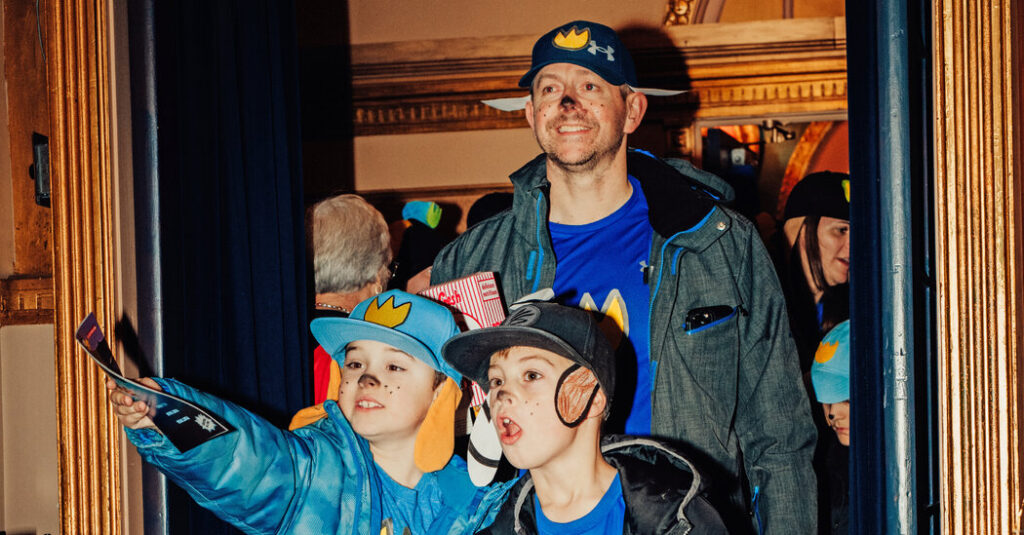
The costume check was no joke.
Before taking their seats at Dav Pilkey’s book event last month in South Bend, Ind., more than 1,600 attendees were scrutinized by clipboard toting staff who made sure that each guest was in compliance with a strict dress code. You had to wear a Dog Man mask or a hat with dog ears and a Dog Man badge. You had to have a Dog Man badge (yellow, tulip shaped) affixed to your shirt. And you had to have a Dog Man nose.
Only once your outfit was complete — there were extra noses and ears in the lobby — were you welcome to enter the century-old theater at the Morris Performing Arts Center.
This was the final stop of Pilkey’s monthlong, nine-city tour for “Dog Man: Big Jim Believes,” the latest installment in his best-selling series of graphic novels about a crime-fighting canine.
The free event, for which tickets were snapped up in minutes, featured a performance of “Dog Man: The Musical,” a chance to meet Pilkey himself and an attempt to break the Guinness World Records title for the largest gathering of people dressed as a character from a comic book or graphic novel. Hence, the inspection at the door.
But by the time a Guinness World Records official welcomed the crowd, the place rang with the sound of fidgety humans no longer in the mood to be dressed as dogs. A toddler slid off a booster seat, wailing. A father reprimanded his son for nibbling the end of his costume ear. A pair of girls belted alternative lyrics to the Black Eyed Peas song “Let’s Get It Started.” (Farts featured prominently.)
“Noses on, people,” warned a member of the costume police, red cape billowing as she patrolled the aisles.
Pilkey, 59, strode onstage, sans costume, arms waving. “Hello everyone!” he called, “Thank you for coming! You look wonderful!”
The crowd erupted in applause. Whatever frustrations arose from corralling kids to an event on a school night — the rushed homework, the early dinner, the parking logistics — suddenly evaporated.
Then Pilkey launched into his story of growing up with dyslexia and A.D.H.D, and dogs of all ages listened.
‘He introduced a new genre’
Dav (pronounced Dave) Pilkey’s books have sold more than 52 million copies in the U.S. since 2004, when Circana Bookscan started tracking sales. This makes him the fourth best-selling children’s author in that period, on the heels of Dr. Seuss, J.K. Rowling and Jeff Kinney. (By comparison, Stephen King’s books have sold 40.3 million copies in the same amount of time.)
If you’re not familiar with Pilkey’s work, here’s one reason: His graphic novels, published by Scholastic, are the kind that young readers enjoy on their own, no adult encouragement required. The books arrive home from the school library and migrate directly from backpack to bedroom, where Dog Man all but ensures that a student assigned 20 minutes of reading will not keep an eye on the clock.
Pilkey’s first book, “World War Won,” came out in 1987, before the parents of many of his current readers were born. “The Paperboy,” celebrating hard work and the beauty of routine, won a Caldecott Honor in 1997. Other picture books — including “God Bless the Gargoyles,” “The Hallow-Wiener” and “When Cats Dream” — show the range of Pilkey’s talent, featuring illustrations a New York Times reviewer once described as “Chagall-like.”
But Pilkey’s line drawings, purposeful misspellings and unplugged humor are what made him a mainstay on the best-seller list.
He launched his first graphic novel series in 1997 with “The Adventures of Captain Underpants,” which has now been translated into 37 languages. Dog Man, which started in 2016, has been translated into 50 languages. It spawned a spinoff, “Cat Kid Comic Club” (28 languages), and a movie, as did Captain Underpants. Dog Man and Cat Kid both have their own musicals.
“Dav introduced a new genre 20 years before the explosion of graphic novels,” said Deb Pettid, co-founder of The Rabbit Hole, a museum of children’s literature in North Kansas City, Mo., which features a Pilkey-inspired Turbo Toilet 2000 in its main restroom. “For a lot of kids, Dav’s books might be the first ones they read cover to cover, and that’s a huge accomplishment.”
Not everyone is a fan. Captain Underpants regularly appears on banned books lists thanks to its pooptastic humor and other knicker-twisting infractions. In 2021, Scholastic halted distribution of “The Adventures of Ook and Gluk: Kung-Fu Cavemen from the Future” because of tropes that perpetuate “passive racism.” Pilkey issued an apology, pledging to donate his advance and royalties from the book to charity.
Young readers have plenty of other books by Pilkey to choose from, and they can’t get enough of his blend of slapstick and gentle moralizing.
“He’s their favorite author in the world,” said Bryanna Bocardo, who traveled to South Bend from Florida to see Pilkey with her 8-year-old son, her sister, two nephews and a niece.
‘Words bounce all over the page’
On a drizzly Monday in November, three students sat at a round table at P.S. 161 in the Bronx, eating Little Caesars pizza with Pilkey. He was about to give a schoolwide presentation — his first event for the new book, on the eve of its publication — and these earnest girls were his welcome committee.
“I wrote a poem,” a girl named Hannah said, with prompting from an adult.
“Was that hard for you?” Pilkey asked, flashing his gap toothed grin.
“Not really,” Hannah said. “I like to use my imagination.”
Pilkey warmed up the room by chatting about his childhood. Suffice it to say, had a famous author visited his elementary school in suburban Cleveland, Pilkey wouldn’t have been on the shortlist for a celebratory lunch. He had trouble focusing and sitting still. He spent a lot of time in the hallway, exiled by teachers frustrated with his antics. That’s where he first drew Captain Underpants and Dog Man.
The students listened, wide-eyed. One asked Pilkey if he was ready for the assembly.
“I hope I’m ready,” Pilkey said. “I really hope I do a good job!” (He speaks in exclamation points, giving dorky uncle who’s trying hard, endearingly so.)
The same girl advised him to take five deep breaths to help him calm down.
When it was showtime, Pilkey bounded into the spotlight in the school’s dimly lit auditorium, bellowing, “Let’s make some nooooise!” The students obliged, waving Dog Man fans and making a commotion worthy of a Taylor Swift concert. Someone at the back of the room yelled, “I love you!”
The mood shifted when Pilkey launched into a well practiced talk about his struggle to learn to read. Even now, he said, “words bounce all over the page.”
He recalled how his second book, “’Twas the Night Before Thanksgiving,” was rejected by 23 publishers. How the four P’s he learned from his mom — positivity, practice, persistence, purpose — paid off. “It doesn’t matter how small we are, we can make a big difference,” he reminded the students.
Then he drew pictures of his characters on an easel, passing out prizes to students who correctly identified each one.
Pilkey appeared at ease, with or without breathing exercises. But even during a second wave of hysteria when teachers rolled in carts piled with free hardcovers, Pilkey concentrated on pleasing others. Having spent the first decade of his life absorbing negative feedback, he doesn’t take success for granted.
“I’m writing for the kid I used to be,” Pilkey said in an interview. “I had such a tough time; I was so ashamed. It was a different era.”
‘I just had to work harder’
Pilkey’s personal story begins, in part, at a Pizza Hut in northeast Ohio. It was there, while working during his senior year of high school, that David Pilkey Jr., son of a reverend and a piano teacher, became “Dav” thanks to a name tag made with a faulty label maker. The spelling stuck.
At Kent State University, Pilkey had a professor who encouraged him to write books for children. When “World War Won” landed with relatively little fanfare, Pilkey crisscrossed Ohio, Georgia and Indiana, selling copies out of his Toyota Camry.
“I met so many inspiring people who were in love with the idea of getting kids excited about books,” Pilkey said during an interview at Scholastic’s Manhattan headquarters. “It was a good time. Until the flood.”
Pilkey was living in Kent, Ohio when water damage ruined boxes and boxes of his books.
“My phone had been turned off by that point,” he said, “I was running out of dough.” He went to a pay phone to make a collect call to his then-publisher, asking if he could get more copies to be paid for at a later date. The publisher declined.
“He told me he didn’t think I had what it took to make it in the world of children’s books,” Pilkey said. “I just had to work harder.”
“’Twas the Night Before Thanksgiving” came out from Scholastic in 1990. A year later, “A Friend for Dragon” landed on shelves, illustrated with a watercolor set purchased at a grocery store.
Pilkey said, “When those books got accepted I thought, ‘Maybe this is a real job.’”
He choked up when explaining how he always had the support of his parents, and got teary again when talking about his wife, Sayuri, whom he married in 2005 when he was 39.
They met on Bainbridge Island, outside of Seattle, and now live in Tokyo, not far from Sayuri Pilkey’s mother (to whom Dav Pilkey dedicated “Cat Kid Comic Club: Perspectives,” along with his own mom). They don’t have children but plan to get “a couple of chihuahuas and kitties” when their travels are over: “That’s the dream.”
Even now, dyslexia “helps me choose my words very carefully,” Pilkey said. A.D.H.D, which he calls “Attention Deficit Hyperactivity Delightfulness,” helps him keep a story moving; he gets bored easily.
His readers can relate.
William Brotherson, 9, met Pilkey in South Bend along with his mother, his brother and a classmate who built her own Dog Man head with cardboard, construction paper and foam. “Me and Dav have something in common,” he said. “We both have A.D.H.D.”
This makes him proud, Brotherson added. “Very proud.”
‘We are all winners!’
Imagine the collective groan of a thousand kids learning that there won’t be a snow day after all.
This was the sound that filled the South Bend theater when the crowd learned that it had not, in fact, broken the record for the largest gathering of people dressed as a character from a comic book or graphic novel. The final count came to 1,627 — 158 Dog Men short of the current record of 1,784 comic book characters in one place, set at Comic-Con in Salt Lake City in 2015.
Nevertheless, a cast member from “Dog Man: The Musical” declared, “We are all winners!”
Pilkey had already been spirited away to a ballroom, where he waited to meet his fans — all 1,600 of them, if they were so inclined. By the time he reached South Bend, his new book had sold more than 500,000 copies, according to Circana Bookscan. (He ended 2025 as the year’s biggest-selling children’s book author.) He’d spoken about the importance of literacy and creativity to more than 20 student groups, the majority of them in underserved communities. He’d shared his story in packed arenas and concert halls, always emphasizing the four P’s. He’d given away nearly 6,000 books.
Now confetti rained down as a massive pack of South Bend pooches headed upstairs for the highlight of the evening.
For two hours, Pilkey warmly greeted every child, parent, grandparent, teacher, librarian and bookseller who filed through the ballroom. Each time someone praised his work, he appeared genuinely grateful, even a bit surprised. His eyes never strayed to assess the line, which was long, crowded and circuitous.
Many readers handed Pilkey their own comics, and he promised to read them when he was back home in Tokyo. (He finds them inspiring. He saves them all.) To the surprise of his publicist, Pilkey revealed the title of his next Dog Man book — “A Sprinkle in Time” — to one group. His tireless wife stood nearby, passing out a limited edition Dog Man comic.
Julie Wable was there with several family members, including her 9-year-old grandson Eli, who created a comic called Mint Man in honor of his late father, who loved mint chip ice cream and Captain Underpants.
“This was a fun thing for us to do, to help us get through the holidays,” Wable said, describing how she drove to the theater to secure tickets and her husband ironed badges onto shirts. It was the family’s second attempt to break a Guinness world record. The first, at a nearby high school, involved a gathering of people waving foam hands simultaneously.
“We have failed again,” Wable laughed. “But everybody was happy to be here.”
“Like Dav said,” she added, “we don’t always succeed the first time.”
Audio produced by Tally Abecassis.
Elisabeth Egan is a writer and editor at the Times Book Review. She has worked in the world of publishing for 30 years.
The post The Man Behind ‘Dog Man’ Is a Pack Leader for Young Readers appeared first on New York Times.