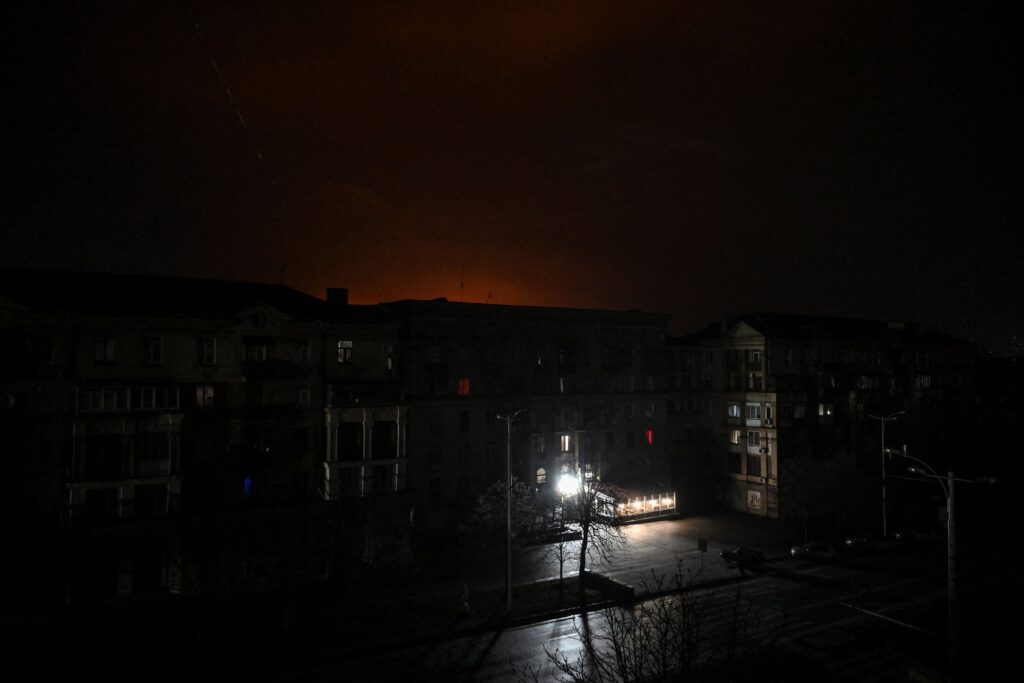
KYIV — Swarms of Russian attack drones pounded the eastern Ukrainian regions of Zaporizhzhia and Dnipropetrovsk overnight Thursday, plunging almost the entire area into darkness — one of the widest blackouts there since the start of Russia’s full-scale invasion in 2022, local officials said.
“This is the first such situation for the Zaporizhzhia region in the last four years — a total blackout in our region,” the head of the regional administration, Ivan Fedorov, said on Ukrainian television on Thursday.
Fedorov also wrote on social media late Wednesday that because of the power outage, “air raid sirens could not be heard,” but “in the event of an air threat, residents will be informed via loudspeakers by the Zaporizhzhia region’s patrol police.”
Russia’s latest assault on Ukrainian infrastructure occurred as the U.S. operation in Venezuela ousting President Nicolás Maduro, along with comments in Washington about potential military action in Greenland, risk distracting attention from the war in Ukraine.
On Tuesday, high-ranking officials from Europe, Ukraine and the United States met in Paris to continue crafting a proposal to halt Russia’s war, including potential security guarantees for Ukraine to deter another Russian attack. Those guarantees could introduce European peacekeeping forces on Ukrainian soil.
However, Russia has not agreed to the peace plan and has said it would not accept the presence of foreign troops in Ukraine.
Ukrainian President Volodymyr Zelensky and other Ukrainian officials have pointed to Russia’s longtime support of Maduro, and Russia’s effort to protect oil tankers that are part of a shadow fleet serving Venezuela, as further evidence that Moscow is not aligned with President Donald Trump’s goals.
By Thursday afternoon, power had resumed in Zaporizhzhia and was “operating on schedule,” Zelensky said in a social media post. However, electricity in Dnipropetrovsk was only partially restored and “work continued” in the cities of “Dnipro, Kamianske, Kryvyi Rih, Nikopol, Pavlohrad and other cities and communities,” the president said.
Zelensky appealed to Ukraine’s “partners around the world” to “respond to this deliberate torment of our people.”
“Diplomatic discussions cannot be a pretext for slowing down the supply of air defense systems and equipment that helps protect lives,” Zelensky said, adding that there is “absolutely no military rationale in such strikes on the energy sector and infrastructure that leave people without electricity and heating in wintertime.”
Ukraine’s air force said in a social media post on Thursday that 27 Russian attack drones struck 13 locations in Ukraine, while Ukrainian air defenses shot down 70 drones.
In a social media post on Thursday, Ukraine’s deputy prime minister for reconstruction, Oleksiy Kuleba, said that repair work was underway to restore heat and water “for over a million subscribers.”
In Dnipro, the capital of Dnipropetrovsk, Mayor Borys Filatov wrote on the Telegram messaging platform that “all city hospitals have been fully switched to generators. There are necessary water reserves. The treatment process is not being interrupted.”
Ukraine’s state railway company wrote on Telegram on Wednesday as the attack in Dnipropetrovsk and Zaporizhzhia was ongoing that “all trains in the region are switching to backup thermal power” and signaling and communication systems were operating on backup power, and train stations were being powered by generators.
The post Russian strikes cause wide-scale blackout in two Ukrainian regions appeared first on Washington Post.