Two years ago, Internal Revenue Service officials announced an ambitious plan to fix a gaping hole in federal tax law enforcement.
For decades, the agency had not conducted significant audits of private equity, venture capital or real estate investment firms, industries equal in size to the economies of Germany, Japan and India combined.
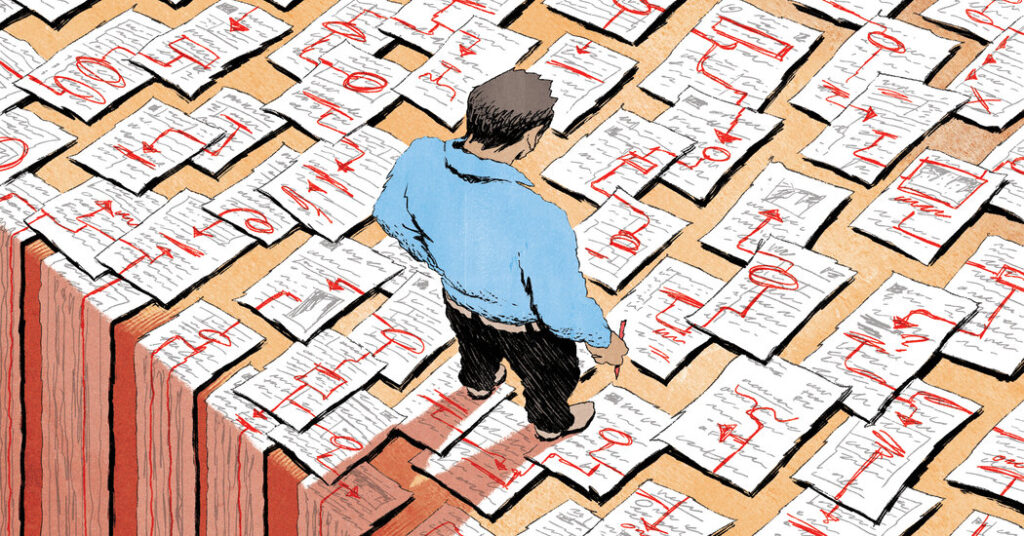
These companies were typically structured as partnerships, governed by a subspecialty of the tax law that few in the I.R.S. knew how to examine. The agency quickly hired and trained hundreds of examiners to dig into such vehicles. They helped uncover a whole new family of aggressive tax shelters, used by companies including Occidental Petroleum, that the Treasury estimated was costing the public at least $100 billion over a decade.
Now the effort is falling apart. Since President Trump returned to office, nearly all the senior leaders of the operation have left the I.R.S. — taking the newly acquired partnership tax expertise with them. Audits have been abandoned, they have decreased in number and the initiative is foundering.
Progress on complex audits has slowed to a trickle, tax lawyers who specialize in these cases said. The new initiative’s emphasis on large partnership exams has not gone “completely to zero, but it has certainly dropped 80 or 90 percent,” said Gary Huffman, a tax lawyer at Vinson & Elkins who represents partnerships that are being audited. A lawyer who handled roughly 15 such audits in 2024 reported only three in 2025. Another who advised clients on four such audits in 2024 saw zero new audits in 2025.
The turn away from audits of big partnerships is part of the I.R.S.’s broader chaos, which has been accompanied by a slew of tax giveaways to industry in Mr. Trump’s new term. Big companies are benefiting from the gutting of regulations, and the agency is pulling back from a crackdown on various shelters. The agency is likely to be even more compromised because it has fewer officials to handle the current filing season after significant changes to tax law.
From the early days of the second Trump administration, right-wing anti-tax groups have been attacking I.R.S. officials overseeing partnership audits. Holly Paz, a top I.R.S. official, is suing the agency, alleging that administration officials illegally leaked her employment information to Fox News. Now, nearly all the I.R.S. officials overseeing the effort — about 15, including recent hires from the private sector — have quit, according to people familiar with the activity. The I.R.S. official in charge of the audits abruptly left the agency early last year.
The cost-cutting Department of Government Efficiency project encouraged the exodus: The I.R.S. laid off thousands of probationary employees, disproportionately hitting the partnership audit team because so many technical experts on the team were recent hires.
“We were having good success bringing into the I.R.S. seasoned tax and legal expertise to help with complex audits, including for large partnerships,” said Danny Werfel, who served as I.R.S. commissioner for the final two years of the Biden administration. “Because these folks were relatively recent hires, they were probationary employees. When all probationary employees were let go, lots of talent walked out the door.”
An I.R.S. spokesman declined comment.
Unlike corporations, partnerships do not pay income taxes themselves. Instead, the tax obligation flows through to the partners. Each partner’s share of the tax obligation is based on his or her share of the partnership’s profits or losses. Those allocations are made according to complex rules that dizzy even veteran tax lawyers, and allow tax planners to engineer elaborate tax avoidance structures.
Trump Administration: Live Updates
Updated
- Trump withdraws the U.S. from more international organizations.
- Trump proposes a huge increase in military spending.
- Trump pulls out of the global climate treaty.
The tax rules for partnerships were created in the 1950s, when such vehicles were used to operate, say, family grocery stores — not multibillion-dollar investment vehicles with partners across the globe. Business activity has moved increasingly from traditional corporations to partnerships — or “pass-throughs.”
Profits reported by partnerships exploded to $2.6 trillion by 2022, from $267 billion in 2000, the most recent I.R.S. data shows. Profits reported by traditional corporations grew at about half that pace.
But the I.R.S. failed to keep up. The New York Times revealed in a 2021 investigation that a lack of expertise meant the I.R.S. virtually never audited private equity firms like Blackstone and Apollo. Michael Desmond, the I.R.S. chief counsel during the first Trump administration, acknowledged that such audits were “almost nonexistent,” because the agency “just doesn’t have the resources and expertise.”
By late 2023, the agency had expanded the program and set plans to audit 75 of the largest partnerships in the United States, including hedge funds and real estate investment partnerships. Their assets, on average, exceeded more than $10 billion. The I.R.S. said the effort was meant to “shift attention to wealthy from working-class taxpayers” and to “identify sophisticated schemes to avoid taxes.”
Since Mr. Trump returned to office, business and right-wing groups have lobbied the I.R.S. and Treasury to eliminate the partnership audit group. The National Association of Manufacturers accused the team of “contributing to the overreaching and unduly burdensome administrative state that the current administration is seeking to curtail.” And a new anti-tax group, the Alliance for IRS Accountability, urged the administration and Congress to eliminate the unit, calling it a “prime example of government weaponization” targeting political opponents. The group offered no evidence for this claim.
With no one left to look for the dodges, tax experts warn that abusive shelters are likely to proliferate.
A recent study by a team of business and law school professors at schools including Stanford, the University of Georgia, New York University and the University of Chicago found that audits of complex partnerships had a “high return on investment,” generating $20 in collected taxes for each $1 spent by the I.R.S. That return is over eight times what the I.R.S. generates from auditing corporations, the researchers found.
Jesse Drucker is an investigative reporter for the Business section and has written extensively on the world of high end tax avoidance.
The post Push to Audit Private Equity and Venture Capital Falters Under Trump appeared first on New York Times.