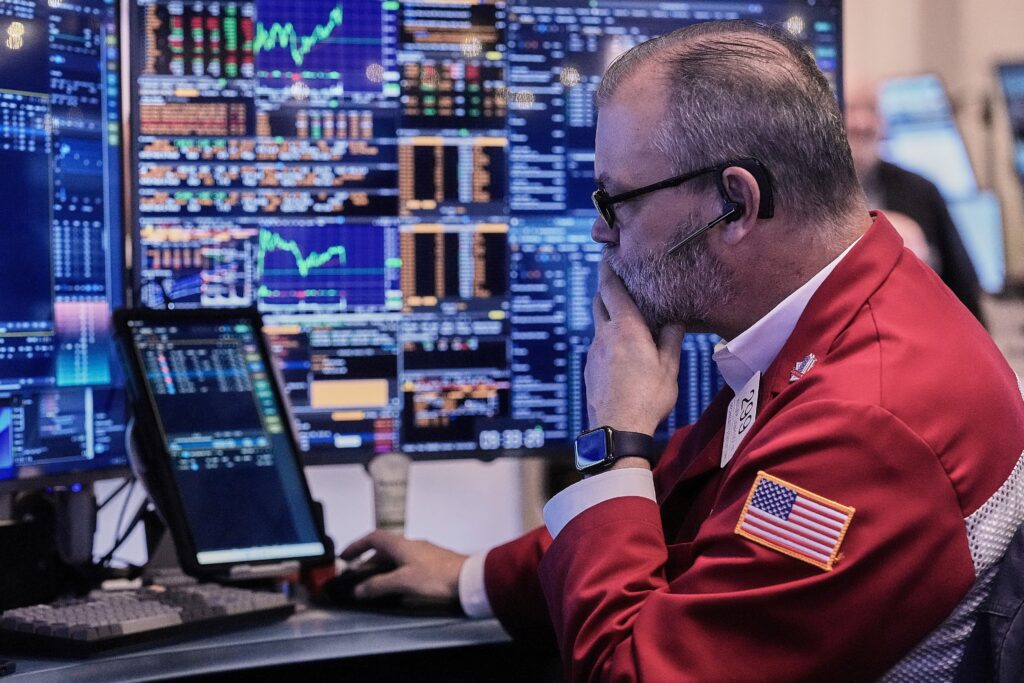
The U.S. attack on Venezuela and President Donald Trump’s public musings about military strikes against other nations may yet rattle the global economy, but Wall Street is taking the president’s bellicose behavior in stride.
Investors drove stock prices to a new all-time high on Tuesday even as a crisis atmosphere billowed around the president’s demands that the United States take control of Greenland, an island that belongs to Denmark, a U.S. ally.
The extraordinary episode, which European officials say threatens to destroy the NATO alliance — along with Trump’s public consideration this week of further U.S. military action in Colombia, Cuba, Mexico and Iran — marked his sharpest break yet with the global system that helped make the U.S. wealthy. In its place, an unsettling era of might-makes-right is dawning.
“It is quite remarkable that financial markets seem to be brushing off the breakdown of the rules-based order and the geopolitical risks that come with it. We’re really in completely uncharted waters,” said Eswar Prasad, author of “The Doom Loop: Why the World Economic Order Is Spiraling Into Disorder.”
In the days after the Saturday U.S. raid that captured Venezuelan President Nicolás Maduro, the S&P 500 index rose, the yield on the 10-year Treasury treaded water, and oil prices barely budged. Even as the president and his team publicly debated future military targets, Wall Street’s so-called “fear index,” the VIX, showed little sign of stress.
The subdued market response reflected the limits of the past week’s action and the difficulty investors face in pricing unpredictable contingencies such as a potential U.S. military strike on drug labs in Mexico or Colombia.
After a quarter-century of socialist rule, Venezuela’s output equals 0.1 percent of the global economy and its oil wells produce just 1 percent of global supply, according to Capital Economics in London.
Investor enthusiasm for U.S. stocks remains intact, with belief in the promise of artificial intelligence overshadowing vague notions of potential global risks. U.S. economic growth also remains steady, offering additional support for asset prices.
“The end of the rules-based global system is a manifestly bad thing. But do I think that’s going to meaningfully reduce global GDP growth? No, I do not,” said Neil Shearing, chief economist for Capital Economics.
Late Wednesday, the White House announced that Trump has withdrawn the U.S. from 66 international organizations, including more than two dozen U.N. bodies and others dealing with climate change and gender.
The crumbling of the U.S.-led global system began before Trump’s presidency, said Ian Bremmer, president of Eurasia Group. Under multiple presidents, the U.S. complained about the cost of collective security and lost interest in “free trade.” China joined the global economy but insisted on preserving its authoritarian political system and nonmarket economic practices. Russia remained a largely unhappy outsider.
The financial ramifications of these developments will take time to materialize.
“Geopolitics moves in cycles, but they’re long cycles,” said Bremmer. “These are tectonic shifts. They aren’t short-term equity movements.”
Trump’s global aggressiveness threatens the system of rules and institutions that American policymakers helped construct at the end of World War II, aiming to prevent a repeat of global depression and war. The charter of the United Nations, created under U.S. auspices in 1945, for example, prohibits “the threat or use of force against the territorial integrity or political independence of any state.”
Where the architects of the postwar world sought to constrain the powerful and protect the weak, Trump enthusiastically wields every tool of statecraft — from bombs and missiles to tariffs and sanctions — with little regard for traditional restraints.
This week’s market calm provides a striking contrast to the changes that roiled the international landscape as the U.S. president proclaimed a muscular new “Donroe Doctrine,” a play on the 19th-century Monroe Doctrine, which governed U.S. policy toward its neighbors.
At the United Nations, U.S. allies and adversaries alike said the attack on Caracas violated the U.N. Charter and international law, criticism that administration officials dismissed as empty verbiage.
“We live in a world, in the real world, that is governed by strength, that is governed by force, that is governed by power,” Stephen Miller, White House deputy chief of staff, told CNN. “These are the iron laws of the world that have existed since the beginning of time.”
The White House insists the president has not made a final break with the traditional global system. Greenland and the U.S. remain bound by the NATO treaty, while administration officials have characterized the attack in Venezuela and those threatened against Colombia and Mexico as acts of self-defense against drug-trafficking nations that are undermining U.S. prosperity by killing or disabling untold numbers of Americans.
“The rules-based international order was always predicated on countries maintaining mutual respect for each other and the right to uphold their national security. Narco-terrorist regimes who flood American communities with illicit drugs and criminal illegal aliens clearly show no respect for the laws and citizens of the United States,” said Kush Desai, a White House spokesman.
To be sure, U.S. foreign policy has often been interventionist, including during military occupations of Nicaragua, Haiti and the Dominican Republic in the early 20th century. The Reagan administration went to war in Grenada in 1983; six years later, President George H.W. Bush sent troops into Panama. Elsewhere, the 2003 U.S. invasion of Iraq sparked global protests.
Such actions, however, often were accompanied by soaring rhetoric about democratic values, language that was absent from Trump’s public comments about the Venezuela operation or potential moves against other nations.
“The U.S. could have framed this as ‘freedom’ versus ‘authoritarianism,’” said Shearing. “The fact that they didn’t was striking.”
Indeed, Trump’s foreign engagements are laser-focused on short-term U.S. goals without regard to their potential long-term consequences, analysts said. With the traditional system governing global relations breaking down, there is a growing risk of “fragmentation of the rules of the game,” according to Prasad, a former International Monetary Fund official and now an economics professor at Cornell University.
Trump’s unpredictable global forays distinguish this period from what has come before. For nearly three decades following the end of the Cold War, U.S. policymakers promoted increased global economic integration during a period known as “hyper-globalization.” Companies were able to divide their operations across multiple countries, confident that a period of relative global stability would endure.
Russia’s unprovoked 2022 invasion of Ukraine marked a clear end to that period. Now, the United States — once the principal arbiter of international norms and behavior — has emerged as another engine of instability. Global corporations must consider the risk of unexpected U.S. actions that complicate their supply chains and financial linkages.
“They have to build in significantly more geopolitical risk to every business and investment decision that they make. This just makes them more conservative. Is the world going to come to a screeching halt? No. But with all this uncertainty about the international rules, we’ll have less growth and innovation than we otherwise would have,” said Michael Smart, who worked on international economic issues for President George W. Bush and is now managing director at Rock Creek Global Advisors in Washington.
Trump’s rejection of the postwar system has only deepened since his first term, when he challenged the World Trade Organization’s quasi-judicial system for settling disputes and scorned negotiations involving 100-plus nations in favor of one-on-one bargaining where the world’s largest economy enjoyed greater leverage.
Since returning to the White House, he has upended the global trading system by imposing the highest tariffs since the 1930s and withdrawn the U.S. from multilateral gatherings such as the Group of 20 leaders summit and the annual U.S. climate change conference.
The president seems determined to ignore the limits on state action that are an essential part of the rules-based system. But the U.S. grew wealthy over the 80 years those rules have been in place, said Henry Farrell, a political scientist at Johns Hopkins School of Advanced International Studies.
“This is disastrous in the long term for the U.S. economy,” Farrell said. “The result is that the United States is going to be a weaker, poorer and meaner country than it has been in the past.”
The post On Wall Street, investors ignore Trump’s talk of war appeared first on Washington Post.