(4 stars)
“I’d kill for that job,” you say, but would you really? Maybe in this economy, and maybe if you lived in a society where what you did for a living defined everything about you: social status, wife and children, the respect of your peers, your existence as a man. I’m not talking about the United States — no, no, of course I’m not — but South Korea, the setting for Park Chan-wook’s wicked comedy of capitalism and homicide, “No Other Choice.”
Park is a master of dark delights, with a string of classics that include “Oldboy” (2003), “The Handmaiden” (2016) and “Decision to Leave” (2022); he’s a little like a South Korean Hitchcock with a more evil sense of fun and a buried undercurrent of social outrage. Here, he takes a 1997 Donald E. Westlake novel, “The Ax,” and applies it to his home country with malice aforethought. The result is an entertainment that draws blood.
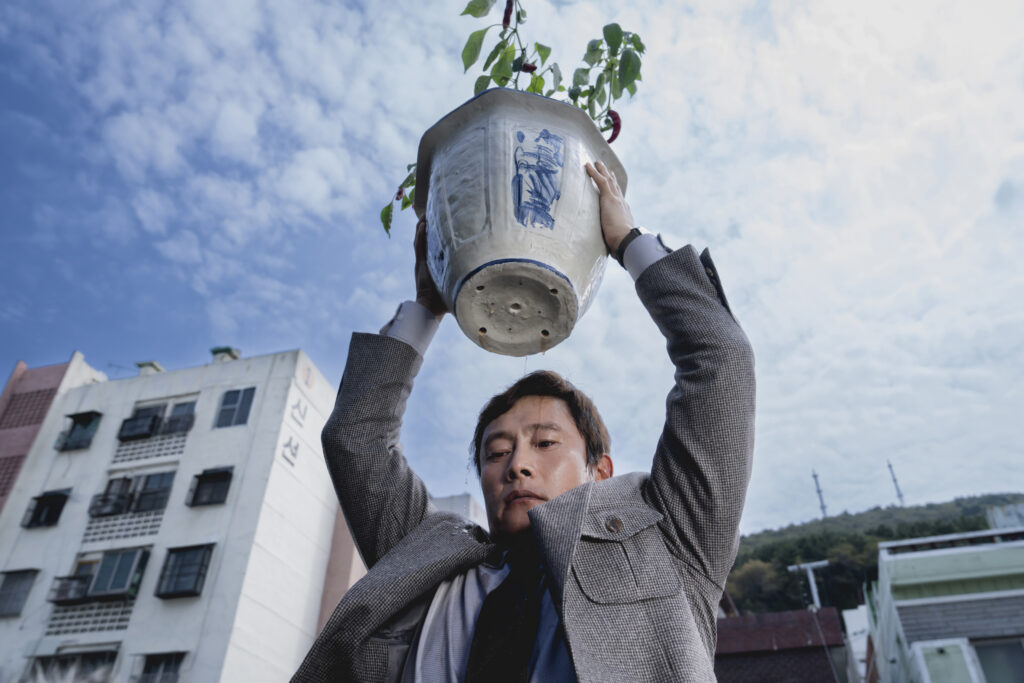
Our hero is Man-su (Lee Byung-hun), who has worked his way up over the years to a supervisory position at a paper factory, allowing him to buy his childhood home and live in bourgeois luxury with wife Min-ri (Son Ye-jin), teen stepson Si-one (Kim Woo Seung) and their young cello-prodigy daughter Ri-one (Choi So Yul). All is well until the plant is bought by Americans and Man-su is let go along with other employees, leading to a hilariously awful human-resources retreat where the laid-off men learn useless mantras to shore up their shattered self-confidence.
Man-su vows to find work but instead suffers through a Kafkaesque round of interviews that seem specifically designed to humiliate job seekers. He works retail, sees his wife take a position as a hygienist for a handsome dentist, frets about music lessons for his gifted daughter and ignores a not-at-all symbolic toothache before deciding with cold, desperate logic to seek out the men standing between him and gainful employment. We are in “Kind Hearts and Coronets” territory now, with a frisson of Patricia Highsmith’s murderous view of human relations.
And, as in Highsmith, murder is anything but easy. The men Man-su sets his sights on are even sadder specimens than he: a drunken buffoon (Lee Sung-min) with a cheating spouse (Yeom Hye-ran), a beaten-down family man (Cha Seung-won) working in a shoe store, a pompously insecure macho man (Park Hee-soon). “No Other Choice” plays Man-su’s misadventures as pitch-black comedy that every so often erupts into slapstick, as in a riotous three-way brawl between the buffoon, his wife and Man-su. The laughs get more grimly perverse the longer the movie goes on, and the fury at a system that pits these men against one another is a given, even if they’re too busy eating each other alive to see it.
The Westlake novel has been adapted before, as a 2005 Costa-Gavras movie called “The Ax” that saw only a European release; the new film is dedicated to the 92-year-old director, who assisted Park in the long gestation of “No Other Choice.” With a screenplay credited to Park, his frequent collaborators Lee Kyoung-mi and Lee Ja-hye, and Canadian actor-director Don McKellar, the film paints a caustic picture of South Korean society that could extend to many other countries and cultures, including our own.
Of course, in an English-language version, the hero might not possess a talent for shaping miniature bonsai trees that comes in handy when it comes to body disposal. (The production design of Man-su’s house, an explosion of greenery in a sterile Seoul, is one of the movie’s many pleasures.) But he might have a spouse who suspects the worst and weighs that against her suburban creature comforts. In a heroically funny lead performance, Lee Byung-hun conveys the existential agony of a man holding it together on the outside while inside he’s coming apart, and he’s matched step for step by Son as the wife, whose pragmatism goes much further than her husband thinks.
They’re all villains and victims of a societal structure that, in the words of more than one character here, gives them “no other choice.” But every waking moment obeying that structure is a choice, and Man-su taking his culture’s Darwinian imperative to its bloody logical conclusion is a choice. Such choices have consequences, even if they’re not the ones you expect. There are winners in “No Other Choice,” but as Park makes clear in the film’s quietly devastating final images, they’ve won at a cost that hollows the soul. No translation necessary.
R. At area theaters. Contains violence, language and some sexual content. In Korean, with English subtitles. 139 minutes.
Ty Burr is the author of the movie recommendation newsletter Ty Burr’s Watch List at tyburrswatchlist.com.
The post ‘No Other Choice’: Four stars and a full body count appeared first on Washington Post.