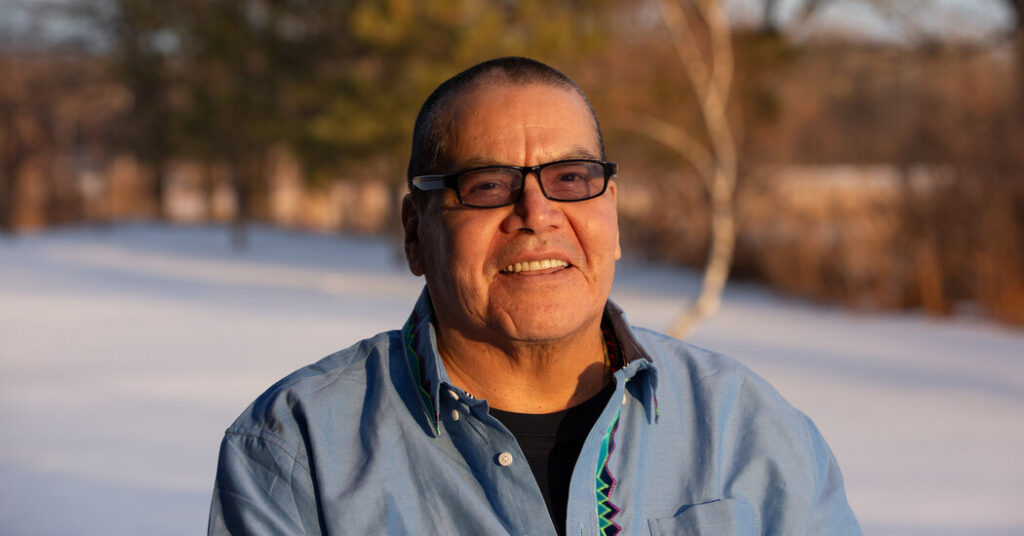
More than 25 years after he was found guilty of first-degree murder in the killing of a woman who ran a small country store, Brian Pippitt walked out of Minnesota’s largest prison a free man on Wednesday.
Mr. Pippitt, 63, was convicted in 2001 and sentenced to life in prison for the 1998 murder of Evelyn Malin, 84, who had owned a convenience store in a rural area north of Mille Lacs Lake for more than half a century. Her body was found in her living quarters, which were attached to the Dollar Lake Store in Aitkin County, Minn.
His conviction was upheld on appeal, and his post-conviction petition was denied.
For the last decade, lawyers at Centurion Ministries, a national nonprofit group that works to free the wrongly convicted, and the Great North Innocence Project, based in Minneapolis, have maintained that there was no forensic or physical evidence connecting him to the crime.
In 2024, concluding a two-year investigation of Mr. Pippitt’s case, the conviction review unit of the Minnesota Attorney General’s Office agreed. After reviewing thousands of pages of materials and interviewing more than 25 fact and expert witnesses, it concluded that Mr. Pippitt was neither at the scene of the murder, nor was he involved in the crime.
The unit detailed in a 119-page report that Mr. Pippitt’s conviction was based on unreliable testimony from two witnesses that should have never been presented to the jury. Both witnesses have since recanted their testimony.
Then it made a rare recommendation that Mr. Pippitt’s conviction be vacated. The unit has received more than 1,200 applications since it began accepting them in August 2021. Mr. Pippitt’s is only the third in which it has recommended relief, and the first in which it recommended a full exoneration of an incarcerated person.
More than a year later, the Minnesota Board of Pardons — made up of the governor, the attorney general and the chief justice of the state Supreme Court — voted 2-1 in September 2025 to commute Mr. Pippitt’s life sentence, three years before he was to become eligible for parole.
“The shame, the hate of people thinking I am responsible for not only the death of an elderly woman, but the rumors associated with a crime such as this — the fact the truth would surface has kept me going throughout the years,” Mr. Pippitt told the pardons board by videoconference from a state prison in Faribault, Minn., that month.
“I hope to find work and live the rest of the time I have left on this earth in peace,” he said, according to The Minnesota Star Tribune.
Ms. Malin was found dead on the morning of Feb. 25, 1998, in McGregor, a town of about 400 residents. Sheriff’s deputies discovered her on the floor of her bedroom with her mattress on top of her. Her face had been beaten, with marks that suggested strangulation.
Detectives pursued more than 100 leads and interviewed many witnesses. Ms. Malin’s family publicly chastised the Aitkin County sheriff after a year passed with no arrest.
Around that time, investigators went back to Mr. Pippitt, who had given investigators an alibi in the days after the killing.
Before Mr. Pippitt’s trial, a judge offered him a seven-year sentence as part of a plea deal, The Star Tribune reported. Mr. Pippitt rejected that offer, later saying, “I didn’t want to admit to something I didn’t do.”
The conviction review unit said in its report that the lawyer who represented Mr. Pippitt during his 2001 trial, who was trying his first homicide case, was “unprepared, under-experienced and overburdened.”
The unit’s investigators noted that the lead prosecutor “presented a case theory that conflicted with objective evidence,” and that he was disbarred in Minnesota in 2007.
They wrote that Ms. Malin’s death “was unquestionably tragic,” leaving “a void in the community that could not be filled, even with the proper identification of the true murderer.”
“And yet, despite the desire for someone to atone for the crime, the atonement cannot be placed on just anybody. Otherwise, it is not justice that is served, it is convenience.”
Mr. Pippitt’s lawyers said they would continue to push for his full exoneration to clear his record — he is in a supervised release program — and make him eligible for compensation funds for wrongfully imprisoned people.
The Aitkin County Attorney’s Office, which prosecuted Mr. Pippitt, did not respond to a request for comment on Thursday.
Mr. Pippitt, a member of the Mille Lacs Band of Ojibwe, thanked Centurion Ministries and the Great North Innocence Project for taking up his case in a joint statement that the groups issued on Wednesday.
In September, in his video testimony to the Board of Pardons, Mr. Pippitt was asked about what he would do if his sentence were to be commuted.
“I intend to take care of my father and take care of my family,” he said. “I have had to hear about the problems with no way of helping them, and I have felt helpless.”
Adeel Hassan, a New York-based reporter for The Times, covers breaking news and other topics.
The post Minnesota Man Is Freed After Serving 25 Years for Murder He Did Not Commit appeared first on New York Times.