Multiple legal and practical obstacles stand in the way of Minnesota officials who could file criminal charges against the immigration agent who shot and killed a motorist in Minneapolis, legal experts said on Thursday.
A state investigative agency said that federal agencies denied it access to evidence in the shooting and that it was withdrawing from the investigation. That leaves the Hennepin County attorney, Mary Moriarty, without crucial information about the shooting that would help her determine whether to pursue charges against the agent from Immigration and Customs Enforcement.
There is also legal precedent, in previous cases in Michigan and Idaho, that suggests federal law enforcement officers are shielded from state charges by the Supremacy Clause of the U.S. Constitution. That means any case that brings charges against the agent is likely to face scrutiny from a judge.
And on the state level, despite the successful prosecution of Derek Chauvin, the police officer who was convicted in 2021 of murdering George Floyd in Minneapolis, prosecutors across the country are often reluctant to charge law enforcement officers with serious crimes because juries are historically unwilling to convict.
“Prosecuting a police officer for the use of deadly force is among the most, if not the most, challenging type of case that prosecutors ever work on,” said Amy Sweasy, a former assistant Hennepin County attorney. “They are difficult even when there are full investigations with no other barriers.”
In 2019, Ms. Sweasy won a rare conviction in the case of a police officer who fatally shot a Minneapolis woman, making the officer the first in Minnesota to be convicted of murder in an on-duty killing.
Prosecuting the ICE officer who shot and killed the woman, identified as Renee Nicole Good, “is a very challenging scenario,” Ms. Sweasy said.
In tense phone calls on Thursday, state officials discussed the fallout from their exclusion from the investigation. They are under considerable pressure from many residents of Minnesota who are outraged over the killing and called for state prosecution of the agent on social media. Two law enforcement officers with knowledge of the matter, who were not authorized to speak publicly, identified the agent as Jonathan Ross.
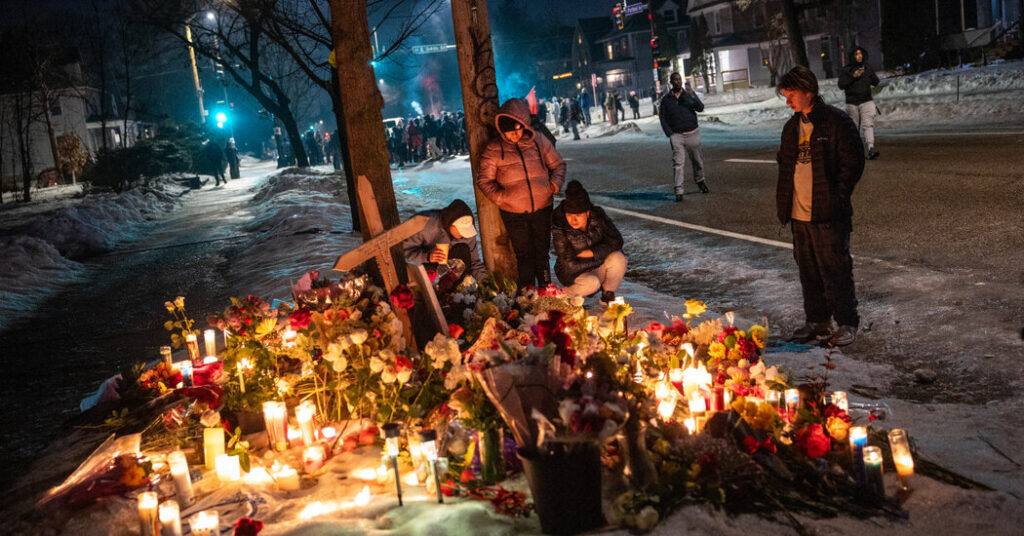
At a vigil on Wednesday evening, local clergy members called for the arrest and prosecution of the agent, and members of the crowd repeatedly chanted “murder” in response.
If state officials decide to file criminal charges against Mr. Ross, there would almost certainly be an effort to remove the case from state court to federal court, legal experts said, and extensive pretrial motions to have the case dismissed.
Gov. Tim Walz of Minnesota, a Democrat, said he wanted the state to do a full investigation of the actions of Mr. Ross.
“By not allowing Minnesota to participate, and the prejudgment that’s already been made by leadership, creates a very, very dangerous situation,” Mr. Walz said on Thursday in response to the announcement that state investigators had withdrawn. “And that’s why once again I’m going to reiterate to our federal partners, ‘Simply let us be part of this.’”
Kristi Noem, the homeland security secretary, said that the state does not have jurisdiction in the matter.
Ms. Moriarty, the Hennepin County attorney, said that her office is “exploring all options to ensure a state-level investigation can continue.”
“If the F.B.I. is the sole investigative agency, the state will not receive the investigative findings, and our community may never learn about its contents,” she said in a statement. “We are speaking to our local partners on paths forward that will allow us to review the investigation and be transparent in our decision making.”
State Representative Samantha Sencer-Mura, a Democrat from Minneapolis, said her constituents were outraged to learn that the state Bureau of Criminal Apprehension, a nonpartisan agency, was no longer part of the investigation.
Asked whether she favored state charges in the case, she said, “I think we need a thorough and independent investigation to be able to answer that question.”
There is nothing in Minnesota law that would prevent a person from being charged simply because they are an actor of the federal government, legal experts said, but they also pointed to previous cases where state prosecutors tried and failed to convict federal officers.
In 2025, a judge in Michigan dismissed state charges brought by the attorney general, Dana Nessel, who filed murder and manslaughter charges against a Michigan state trooper who struck and killed a fleeing man with an S.U.V.
The judge said the trooper was acting as a federal law enforcement officer and was entitled to immunity under the Supremacy Clause, which shields federal agents from state prosecution in many instances.
In a separate case in Idaho, an F.B.I. agent who fatally shot a woman during a raid was charged by the state for involuntary manslaughter, but a court dismissed the charges, saying he was acting within his duties.
The state attorney general in Minnesota, Keith Ellison, successfully led the prosecution of Mr. Chauvin, but operated in close collaboration with the Hennepin County attorney’s office.
Mitch Smith and Campbell Robertson contributed reporting.
Julie Bosman is the Chicago bureau chief for The Times, writing and reporting stories from around the Midwest.
The post Legal Hurdles Likely to Stymie State Charges in Minnesota ICE Shooting Case appeared first on New York Times.