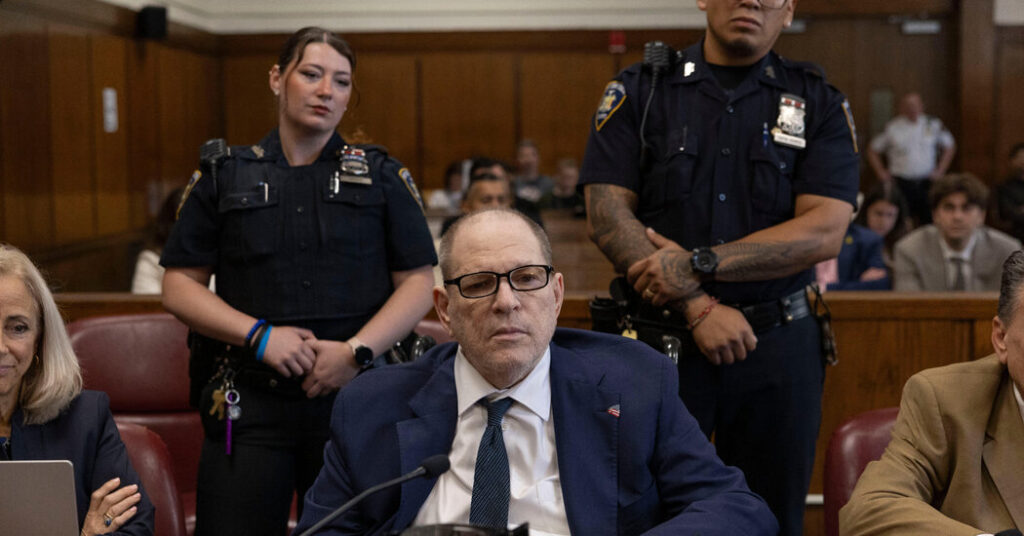
Harvey Weinstein, the disgraced former Hollywood mogul, will on March 3 face a third trial in New York for a charge that he raped an aspiring actress in a Manhattan hotel room more than a decade ago, a judge said on Thursday.
At the first trial, in 2020, Mr. Weinstein was convicted of the rape, but the verdict was overturned in 2024. At the second trial, which concluded in June, the jury was deadlocked on whether prosecutors had proved that he raped the woman, Jessica Mann.
As Mr. Weinstein awaited a new trial date, his lawyers asked the judge in the case, Justice Curtis Farber of State Supreme Court in Manhattan, to throw out his conviction. Some of the jurors, they argued, felt threatened and coerced into their vote.
On Thursday, Justice Farber denied their motion, set a trial date for March and directed Mr. Weinstein’s lawyers to tell prosecutors within two weeks if their client will plead guilty. Prosecutors with the Manhattan district attorney’s office, led by Alvin L. Bragg, asked the judge to move the trial date to April 14, but he did not budge.
“I think we’re going to be in a position to tell you we’re not ready to go to trial in March,” the lead prosecutor, Nicole Blumberg, told the judge.
On Thursday, Mr. Weinstein, 73, was wheeled into the courtroom wearing a blue suit, white shirt and a pin on his right lapel. He has been held at the Rikers Island complex since 2024, and his lawyers have said that his health has deteriorated while he has been there. They have argued against prolonging his detention during his case.
Mr. Weinstein told the court that he was “disappointed” in the outcome of the hearing on Thursday and said that his situation “feels like a slow march to my death.” Dysfunction among the jurors in June, the repeated trials and “outside pressures,” have “turned the process into something that feels predetermined,” he said.
“I know I acted wrongly,” he told the judge. “But I never assaulted anyone.”
His trials have become a high-profile example of how New York criminal cases can drag on for years. They also highlight a new focus from law enforcement on pursuing sex-crimes cases, which can often be difficult prosecute.
Mr. Weinstein’s legal drama first captivated the country nearly a decade ago, when he was accused of using his power and influence to harass and sexually assault women. Many of the women were young and trying to make it in the entertainment industry, according to dozens who came forward.
In 2017, investigations by The New York Times and The New Yorker revealed accusations of Mr. Weinstein’s mistreatment and that his company covered it up. Mr. Weinstein was arrested the next year and charged by Manhattan prosecutors. His first trial in New York was held in 2020, when a jury convicted him of felony rape and criminal sexual act. The New York Court of Appeals overturned the conviction in 2024.
At the second trial in June, the jury found him guilty of one criminal sexual act, acquitted him of another and reached no decision on the rape charge.
After the mixed verdict, Mr. Bragg, who created the office’s first Special Victims Division to elevate such cases, said moving forward with another trial was part of his office’s commitment to prosecuting sex-crimes cases.
In 2015, the then Manhattan district attorney, Cyrus R. Vance Jr., declined to charge Mr. Weinstein after a model said he had groped her breast and slid his hand up her skirt during a business meeting at his Manhattan office.
This latest trial in New York would be the third time Ms. Mann, the aspiring actress, testifies against Mr. Weinstein. She has said that she entered a complicated relationship with Mr. Weinstein that was at times consensual, but he raped her in a hotel room in March 2013.
“I have told the district attorney I am ready, willing and able to endure this as many times as it takes for justice and accountability to be served,” she said after the mistrial.
On Thursday, Mr. Weinstein’s lawyer Arthur L. Aidala argued that it was Mr. Weinstein’s notoriety that was leading to a third trial. “If his name was not Harvey Weinstein, his case would be disposed of,” Mr. Aidala said, adding, “I obviously have fatigue of this case.”
Ms. Blumberg, the prosecutor, responded by saying that Mr. Weinstein’s name did not factor into the decision to retry him. If he “wants to accept responsibility and plead guilty to raping Jessica Mann,” she told the judge, her office would be willing to discuss a plea.
Mr. Weinstein is also facing prison time in California. He was convicted of sexual assault in a separate case in Los Angeles in 2022 and sentenced to 16 years there. He is appealing that verdict.
Hurubie Meko is a Times reporter covering criminal justice in New York, with a focus on the Manhattan district attorney’s office and state courts.
The post Judge Sets Date for Weinstein’s Third Trial for Same Rape Charge appeared first on New York Times.