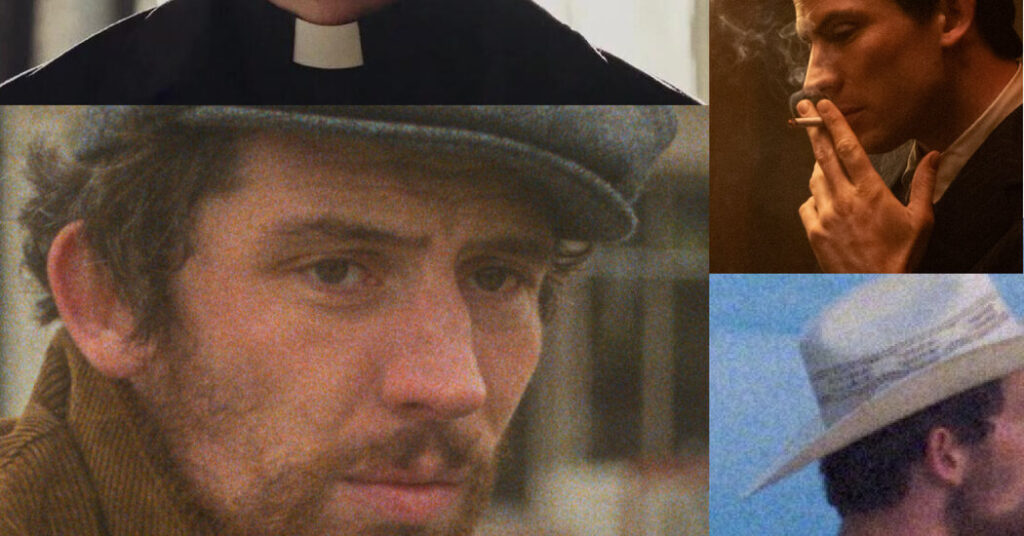
Last fall, during what I now think of as our Season of Josh O’Connor Content, the British actor steamed up a gay romance in one movie, went on the lam in another, rode a horse across the scorched earth in a third and slipped on a priest’s collar to find deliverance in the fourth. O’Connor was ubiquitous, and indispensable. Other actors could have played these roles, and maybe even convincingly made them their own. Yet the specificity both of O’Connor’s screen presence and of his strikingly different performances — their nuance and slow-gathering emotional power — makes it tough to imagine anyone else in them.
It isn’t unusual for hot commodities to appear in more than one movie a year, either by design or coincidence. That scorcher Pedro Pascal showed up in three movies in 2025, while other in-demand attractions like Paul Mescal and Elle Fanning made do with two. No one, though, seemed as agreeably omnipresent as O’Connor, who between September and November starred in “The History of Sound,” “The Mastermind,” “Rebuilding” and “Wake Up Dead Man: A Knives Out Mystery” amid innumerable public-relations meet-and-greets. Taken together, these four dissimilar movies announced, well, whispered O’Connor’s arrival.
If you are wondering who?, you aren’t alone. O’Connor has been making movies for more than a decade, mostly in his home country. His public profile has steadily increased in recent years, partly because of the dominating influence of Netflix, home to two of his wider-seen vehicles — “Wake Up Dead Man” and the royal soap “The Crown.” O’Connor acknowledged the relative novelty of his celebrity last month when he hosted “Saturday Night Live.” During his monologue, he warmed up the room with affable self-deprecation. “For those of you who know my face but maybe can’t quite place me, no, I am not the mouse from ‘Flushed Away.’” The show briefly cut to an image of the rodent hero from that 2006 animation.
Calling attention to the delightful elephant ears in the room was a shrewd, ingratiating move, and drew the kind of friendly laughs that close the gap between performer and audience. The monologue didn’t zing but did its job because it made O’Connor — with his smiles, gentle self-mockery, unplasticky good looks and pitcher ears, which almost invite you to grab hold of them — seem like a real person, not some entertainment bot. There’s much to be said about his talent, which was honed by study (the Bristol Old Vic Theater School in England) and has deepened with his choices. There’s also something to be said about his natural charisma.
PRAISE FOR O’CONNOR’S BIG YEAR started last January at the Sundance Film Festival following the premiere of Max Walker-Silverman’s “Rebuilding.” Set in contemporary Colorado in the aftermath of a devastating wildfire, it is a thoughtful reconsideration of the West and the western genre, their romance and corrosive myths. O’Connor plays Dusty, a loner who’s struggling after the loss of his small ranch. At one point, he reluctantly moves into a FEMA trailer in an isolated makeshift camp, and insistently tells another disaster victim who’s living there: “Listen, I’m not like these folks.” O’Connor delivers the line as if he were sharing a confidence; the words already sting so he doesn’t need to embellish them.
Dusty is so self-contained that you need to discover the character from the outside in — an O’Connor specialty — less from the words he says than how he says them. Dusty’s silences, his isolation and his surroundings speak for him, and their weight grows heavier incrementally. The character’s cowboy laconism allows O’Connor draw you in with his now-muted charisma and the mysteries of Dusty’s inner being, which emerge from how he moves through life and takes up space, how his eyes cloud and head bows. Even in his talkier movies, O’Connor can retreat inwardly so persuasively (and bring you along with him) that it seems like you can see thoughts forming in his head. Dusty also strikes totemic poses, cutting a solitary figure against a landscape that evokes other lonesome travelers, men in particular.
Like some other notable O’Connor movies, “Rebuilding” is also about men and masculinity. Few actors have made men seem as intriguingly complex and contemporary as he has recently. At this point, though, in this serious appreciation of his serious talents, I need to acknowledge a truism that is conspicuous from his loyal admirers, from high-fashion influencers and social-media habitués, and which was grasped by “S.N.L.”: O’Connor is one of pop culture’s feverishly loved boyfriends. He’s prodigiously talented, yes, with a depth and breadth that may not have fully emerged. Yet part of his appeal is that, similarly to how both Pascal and Benedict Cumberbatch signify, O’Connor’s acting abilities dovetail with a singular charm and air of unforced authenticity that feel as welcoming offscreen as on.
O’Connor’s offbeat heartthrob image makes his casting as a priest in Rian Johnson’s “Wake Up Dead Man” one of its slyer jokes. As a boxer turned pastor who’s swept up in a murder mystery that tests him with material hurdles and spiritual tribulations, the actor shows obvious comic flair. More crucial to the movie’s meaning, however, is the sincerity that O’Connor brings to this pugilist priest and his struggles. He’s far more tamped-down in “The Mastermind,” a low-key, politically resonant 1970s drama from Kelly Reichardt. Here, the mystery is the actual character, a comfortably middle-class malcontent turned thief who’s blinkered and finally consumed by self-interest. O’Connor’s precision fits Reichardt’s termitelike approach to narrative, as does their shared uninterest in making you love them.
As distinct as O’Connor’s performances are in “Wake Up Dead Man” and “The Mastermind,” they are also of a piece with his diverse, expansive body of work. The choices that he’s made, those he has received or pursued — including Alice Rohrwacher’s “La Chimera,” a dreamy Italian art film in which he plays an Orpheus figure — have demonstrated his expressive range, and only made him more appealing. He can go nice or nasty as well as both at the same time, and he doesn’t mind testing your sympathies. He’s at once wincingly recognizable and admirably off-putting in “The Crown,” in which his Prince Charles makes his princess bride’s life a misery. With nasally droning hauteur and seething resentment, O’Connor brings to life a man raging in the shadow of yet another woman who’s far more loved than he is.
O’Connor was showered with awards for his performance as Prince Charles, but by the time he appeared on “S.N.L.” that role had been eclipsed by some of his later juicier turns. Chief among these came in Luca Guadagnino’s irresistible tennis romance “Challengers” (2024), in which O’Connor plays a roguish player involved in a sexy, lightly fraught romantic triangle with another, more successful male player and a female player turned coach. The men just share an eager, open-mouth kiss, but Guadagnino teases the possibility that they could get it on, if only when their female love interest is watching them. Guadagnino is a connoisseur of beauty, and one of the other gifts he bestows in “Challengers” is the understanding that O’Connor is at ease as an object of desire, and he showcases the actor accordingly.
I HAVE TO WONDER if this part of O’Connor’s acting portfolio and his persona made some at “S.N.L.” uncomfortable. The skits showcasing him were lackluster overall, including the two in which he kissed another man. The funnier sketch hinged on how a group of women at a bachelorette party respond to two hyperbolically sensitive male strippers in cozy cardigans: It turns the women on. Whatever the context, there is still power and real stakes involved when men hungrily lock lips in public, especially given the re-emergence of aggressively and, at times, violently reactionary gender norms. That it matters who kisses whom was only affirmed by the fact that “S.N.L.” even tried to squeeze laughter from something so human.
The show fell flat despite O’Connor, and it’s hard not to wonder if he was too elusive a figure and too complicated. “I know I have a reputation for being what the internet calls a soft boy,” he said in his monologue, as he opened his arms and his eyebrows jumped. After ticking off some hobbies (embroidery, gardening), he added: “I’m just your average, everyday 65-year-old woman.” That line earned some laughs, but it was more revealing than funny. Intentionally or not, it also expressed an unease about gender that isn’t evident in O’Connor’s performances, including in his breakout movie, “God’s Own Country” (2017), a small, poignant drama in which he plays a farmer who falls in lust, then in love, with another man.
O’Connor inhabits that movie with naked feeling and the same is true of his tonally dissimilar performance in Oliver Hermanus’s “The History of Sound,” which finds the actor in the arms of Mescal’s besotted lover. They play conservatory music students who, after being separated by World War I, reunite for a wistful trip in Maine. The ostensible reason for their journey is a project that O’Connor’s character is coordinating to record old folk songs before they vanish, and that sends the men trekking through the backcountry. Their idyll is filled with soulful music and passion, and while the movie can slip into preciousness, the actors are superb. O’Connor is quietly shattering as a man who can’t be saved, even by love.
In June, O’Connor will take a great leap into the stratosphere with his starring role in Steven Spielberg’s latest, “Disclosure Day.” He’s also in the next Joel Coen movie, which was shooting in Scotland last year and is shrouded in secrecy. Both filmmakers have substantially larger profiles than any of the directors O’Connor has worked with. Yet while his casting in them cements his It Guy status, they are no guarantee of a thriving, wide-open future for O’Connor, and they also can’t serve as a bulwark against the industry’s turbulence, the audience’s fickleness and all the other uncertainties every performer faces. I don’t know if O’Connor will get to kiss another guy in either movie or be able to demonstrate his soft-boy appeal in all its depth. I imagine that his talent will be undeniable; I hope his softness is, too.
Manohla Dargis is the chief film critic for The Times.
The post Josh O’Connor x 4 appeared first on New York Times.