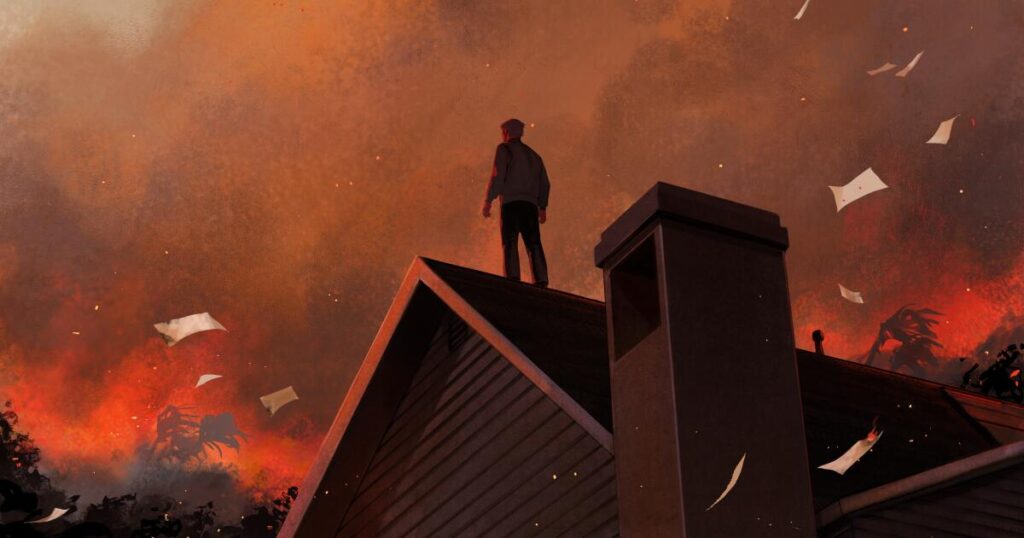

I climbed out my daughter’s bedroom window and scrambled up to the ridge of the house. I felt it before I saw it, and then, I saw it. It was just around the corner, a block away, and it had traveled five miles between my home and where it started in less time than it took to binge a half season of “The White Lotus.” Red-orange and fierce in color, high and wide in girth, the flames surged forward, consuming every house, school, church, business, vehicle, bush and bicycle in its path, animated by hundred mile an hour winds and dragged by the swirling clouds of smoke that flushed ahead and settled over our home.
I’m a writer, I make my living with my imagination. It was my imagination, after all, that carried me, at 25, to Hollywood with a spec script in one hand and my bible in the other — a much pored-over paperback copy of John Irving’s “The World According to Garp.” Irving is the writer who made me want to be a writer, and I have read and cherished his books since first reading this masterpiece as a young man. He is one of life’s mysteries, having published this monumental novel at just 36, by which age I was barely flirting with adulthood. I am to this day faithfully obsessed with his methods and writing style, but as I arrived in Los Angeles, I was just hoping to write one sentence one day as good as any one sentence in “Garp,” and by so doing, make something of myself.
Forty-seven years later, I’m still not sure I’ve written that sentence, but I used my imagination to create a career in the television business. I’ve written hundreds of scripts, survived multiple strikes, the pandemic, periods of unemployment and done well enough to purchase the house in Pacific Palisades on whose roof I was now standing, watching the conflagration that was coming.
We raised our children in that house, and they, to our delight, were now bringing their children over most weekends. Going to the beach, cooking, playing Uno and Slapjack, visiting the park and letting me measure their heights on the wall just inside the toy closet near where I’d done the same for their mothers years ago.
Even as I stood on my roof, seeing that hell-red blaze running toward me, I refused to imagine that that fire would actually barge into our home, come in through the upstairs windows, the eaves, front and back doors, up through the floorboards, and incinerate my family’s safe place and everything in it, in just a matter of hours.
As I dropped the car in gear and drove away ahead of the flames that Tuesday, I was convinced we would soon step back into our bubble, air out our home and resume the beautiful life we’d been living all those years. The last thing I looked at was the sign above the front door that read: “Gigi and Ump’s House: Established April 25, 2018” — the day our first grandchild was born.
I’m painfully aware that our home was not the first, nor only house ever consumed by fire. That is one incalculable, messy club I have no doubt. After all, our world was made with fire and likely engulfed in flames more times than we know. And yet somehow … it comes back. It always comes back. Now, at night, I lie awake worrying about how we’ll come back. We’ve been knocked down. We’re wrecked. We’ve lost every single physical thing we carried into our home for safekeeping. Still, I have faith we’ll get up and start over. I mean, we’re built that way. My wife is a survivor, and I travel with her.
The week after the fire, we took our two grown daughters out to the house to see what was left. The four of us sobbed as we entered the Palisades village, trying to make sense of the ravaged town. It looked desolate and black — destroyed businesses, block after block of homes burned to the ground, the mountains behind denuded and black as coal. These were houses we knew well, that we’d spent time in. Friends’ homes. I parked across the street from where our house had stood in one form or another for 80 years. We got out and stared slack-jawed at the deep pile of gray ash, and the painted number on the curb, 1160, all that was left.
It gutted me seeing my children bent over, racked with sobs from the sledgehammer blow of disbelief and heartbreak at the sight of their home lying before them in ashes. It wasn’t just my home that had vanished, I realized. My kids’ home had vanished too. And something inside them went with it as they stood there looking at the small spot on Earth where they had harbored their bodies most of their lives, where they kept their things, grew their love and their memories. All of it, gone.
Scrambling to get out ahead of the flames that Tuesday, my wife wisely bagged up the albums of family photographs while I ran up the outdoor staircase to “The Dog House” — my office over the garage. I could feel and smell and hear the fire one street away. Inside, I looked around the space I had built for myself and spent so many hours in. A product of a blended family, one of 10 children, I never had a room of my own until I realized one day that my garage could have a second story, and if I built a room up there, it could be mine.
Into that room, I’d stuffed all the stuff that had stuck to me over the years. I’d spent thousands of hours there, put many thousands of words on paper, invented characters and scenarios, edited hours of film, played music, listened to music, read, dreamt, drank and, of late, introduced my grandsons to Ump’s world.
With the fire literally outside my door, I looked around at my computers, stacks of music, guitars, the antique Deco furniture I found in a worn out L.A. furniture store 50 years ago, the Chinese rug we bought in New York City, family photos, collectibles, a Henry Diltz picture of the Doors posing beneath the Santa Monica Pier, the “Dark Winds” silver belt buckle Jim, my line producer, gave me at the end of last season, and the carpenter’s ruler my grandfather gave me when I was 4, the last time I saw him.
On my bookshelves lived my beloved book collection — hundreds of signed, first edition novels which had taken me years to collect. Every book had a story on top of the story within of how I’d hunted it down in antiquarian bookstores big and small across the world, and later online. I cherished those books — not only loved to read them, loved to think about them, loved to see them, loved to be in the room with them.
Spread out on the floor were greeting cards from my wife, kids, grandkids and friends I’d saved over the years. The day before the fire, for no apparent reason, I’d decided I needed to go through that cabinet. I’m glad I did because it gave me a chance I didn’t know I needed to lay eyes one last time on the sentiments carried in those cards.
A “Three Days of the Condor” poster signed to me by Robert Redford occupied a prominent place on the wall across the room. Copies of my scripts (many signed by the actors who had lifted my words off the page) were stacked along the shelves. My notebooks, every bad poem I’d ever written, my will and my TV show memorabilia were tucked away in an antique trunk beneath the table upon which sat the books I was currently reading.
With the fire at my door, and my eyes taking in every physical thing that now defined me, I froze. What the hell do I take out of here? I needed a moving van. I needed time. To think. To prioritize. I needed to understand the very real fact that the next time I came back here, none of these things would exist anymore. I needed to understand why I hadn’t been ready for this.
As I turned to flee, my eyes scanned across the signed John Irving novels I had fastidiously collected since I fell in love with his writing as a young man, starting with “Garp.” I built upon that sole copy until I had every one of his books except for his most recent, “The Last Chairlift.” I’d been looking for that one since its publication, but had not been able to find a single signed copy in the wild. I ran down into the garage, grabbed up a couple of cloth shopping bags, ran back upstairs, loaded up the books and drove away from the house with the clothes I was wearing, my wife, our dogs and my Irving books.
There are nights I wake up crying about what it must’ve looked like when the fire decided to take that room. I wonder, did it come in through the windows I’d cavalierly left open or drop down from the roof? I imagine the flames melting the stained glass, licking at the cabinets before incinerating my beloved books above.
Three weeks later, after moving in with my daughter, her husband and children, we found a rental in Studio City. We’d been there only a couple days when we decided to venture out with the dogs for a walk. We soon came upon one of those Little Free Libraries book lovers like me build out in front of their homes. I’m always pulled to these little structures, curious to see what treasures lie within.
To my astonishment, standing on its end, facing out, was an unsigned first edition hardback of John Irving’s 15th novel, “The Last Chairlift.” I don’t understand how or why this book was there in the same way I don’t understand why I’ve had such a productive and rewarding writing career, why my marriage worked or why my house burned to the ground, but there it was — instant balm for the recent burn scars that mottled my mind and body. This book had made its way into my hands now with otherworldly timing, and into the room in the rental house where I work. Until recently, lined up with its 14 siblings, it represented the entirety of my book collection.
As I slid “The Last Chairlift” onto the shelf with the others, I remembered that many years ago a dear friend of mine had studied with John Irving at the Iowa Writers’ Workshop. I wondered … would she feel comfortable reaching out to Mr. Irving, or his agent? I wanted to ask him if he’d sign this book, which had now begun to write its own mythology as it sat sentinel over his other signed books on the shelf behind me.
So, I wrote my friend an email and told her my story. It’s not lost on me that had I not lost everything, I would not have found myself asking a friend to reach out to the greatest living American writer in my lifetime. The cost had been immense. I had paid it, and there was no going back. I was going to see this unforeseen opportunity through. Because Irving had been there with me when it was all just a dream. And he was here now after the dream had burned down.
As it turned out, my friend was no longer in touch with Mr. Irving, but she had an email address, though she was not sure if it was still good. The next day, after considerable consternation and multiple false starts, I wrote John Irving an email conveying my story. The pressure of sending a missive to the one writer you had lived your entire professional life wishing you could ever be as good as nearly derailed the whole enterprise. But I pressed on, kept it short and off it went.
Two weeks passed. I was hoping I’d had a bum address, that he hadn’t received it, but I feared the truth was, sympathy for my situation aside, he’d thought I had no business invading his privacy, and I should’ve known better than to think I could drop in on him via email. I felt desperate, which I was, and rude, which I hadn’t wanted to be.
And then, Sunday. A sunny afternoon, sitting outside with my grandsons when — ping! An email. From John Irving. Because even his emails are literary, this one was erudite and friendly. He not only sympathized with our loss but also shared our heartbreak as he described his own very personal connection to the Palisades fire.
A week later I mailed off the book. Two weeks after that, he sent it back to me with this inscription: “For John Wirth, with my appreciation, John Irving.” “The Last Chairlift” now sits on the shelf behind me as I type these words, right next to “The World According to Garp.” When I look back, my eyes go right to these two books, the beginning and end of something, and maybe, a new beginning.
I recognize these books are not a stand-in for the house we lost, they don’t make up for the house we lost, but the words inside them, when combined with the words I use to tell the story of how they came to be mine, feel like home.
The rooms in Irving’s stories are there on the shelf, inviting me to walk through them whenever I want. Just like the rooms in our beloved, lost home, that call to me night after night, about 3 in the morning, when I wake up and imagine myself standing at the open front door, looking out over the porch at the world, as if it were still there.
John Wirth is the showrunner of AMC’s hit series “Dark Winds.” He’s written and produced hundreds of hours of television, and conceived the WGA’s Television Writers Handbook, which begat the WGA’s Showrunner Training Program. For most of the last 15 years, he has made his professional home at AMC.
The post John Wirth: After the fire took my home, John Irving’s books became one appeared first on Los Angeles Times.