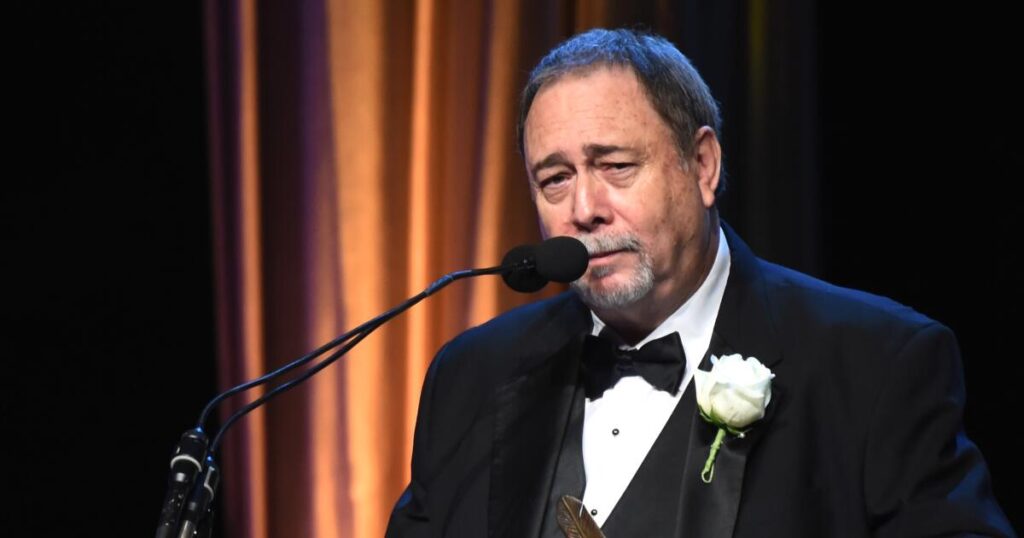
Jim McBride, the Grammy-nominated country songwriter who partnered with singer Alan Jackson on songs including “Chattahoochee” and “Chasin’ That Neon Rainbow,” died Tuesday. He was 78.
“Jim was a good man and a great and genuine songwriter,” Jackson wrote on Thursday in an Instagram story. “He understood country music and touched many with his songs. Jim and I wrote some of my favorite songs together and I don’t know if my career would have ended up quite the same without his help, inspiration, and encouragement in my early years. Thank you Jim, rest in peace.”
Jackson’s photo showed him and McBride as younger men, smiling and holding ASCAP certificates. In 1994, “Chattahoochee” won the Country Music Assn.’s award for song of the year and they were nominated for the Grammy for country song of the year as well.
“I am in shock. I am devastatingly sad. My phone has been ringing and dinging all day, so I hope my friends will understand I’m just not able to talk right now,” songwriter and close friend Jerry Salley wrote Wednesday on Facebook, noting that McBride died after a fall on Monday. McBride had texted Salley just hours before falling, the latter said.
“I’ll never know why he took a chance to write with me” when they met in Nashville in the early 1980s, Salley wrote, “but man, we hit it off, became instant friends, and loved being in the writing room together. He always brought out the very best in me.”
Though best remembered for his Jackson collaborations, McBride’s songs were also recorded by artists including Conway Twitty, Johnny Lee, Johnny Cash, George Jones, Reba McEntire, Alabama, Willie Nelson, Charley Pride, Kris Kristofferson, Randy Travis, Toby Keith and Dwight Yoakam.
“We will greatly miss Mr. McBride — may his legacy live on forever,” the Alabama Music Hall of Fame said Wednesday on Instagram. The hall remembered the songwriter as a “beloved Alabamian, songwriter, friend, mentor, and so much more.”
Born Jimmy Ray McBride in Huntsville, Ala., on April 28, 1947, he began writing songs a child, but didn’t get one recorded until much later.
“The songs just started coming in my head and after a while I decided to try it,” he said in an interview published by American Songwriter at the end of 1997. “I just thought I’d write some songs and bring them to Nashville and see what happened.”
He said he was always drawn to anything about music and learned early on that “that little bitty name beneath the song was the person who wrote the song.”
McBride’s first bid sending songs to Nashville didn’t result in instant success. He knew only one guy in town, songwriter Curly Putman, who served as a mentor.
“Curly gave me good advice and he was always very honest. He told me, ‘Unless I’m honest I can’t help you,’” McBride told American Songwriter. “I’d play him a song and he’d tell me what was wrong with it and he was always right. But if there was something there, he would be sure and let me know that I had done something right. And he always encouraged me to get another opinion, but I never did; his opinion was always good enough for me.”
He saw several of his songs performed in the early 1970s on the show “Hee Haw,” but in the mid-’70s he wound up tucking his dreams away and staying at his job with the U.S. Postal Service. Even then, he kept writing songs with Roger Murrah, who would be a Grammy nominee in the early 1990s for “Don’t Rock the Jukebox,” recorded by Jackson.
He promised Murrah and others that he would return to Nashville if he got “that big lick.” Then came Conway Twitty, who wanted the song “A Bridge That Just Won’t Burn.”
“Roger called me one night and said, ‘I guess you need to pack your bags, we’ve got Conway’s next single,’” McBride told American Songwriter. “I quit the post office the day after Christmas, 1980, and then started work the first of January with Bill Rice and Jerry Foster. The only other writer they had was Roger Murrah.”
Events at that time were bittersweet for McBride, whose mother — his biggest musical influence growing up — died of cancer in 1981. She was buried the same day he was supposed to get his first music award, for “A Bridge That Just Won’t Burn.”
That September he had his first No. 1 hit, “Bet Your Heart On Me,” with singer Johnny Lee. And he fine-tuned his songwriting.
“I don’t think I’d ever had a bridge in a song until I moved here,” he told American Songwriter. “Another thing I had to unlearn was that I wasn’t Kristofferson. I cut back on the poetic stuff. I was writing a lot of stuff where every line had to be brilliant. Through the years, I learned to write conversational lines.”
McBride didn’t have a hit single again for six years, until Waylon Jennings recorded “Rose in Paradise,” his last No. 1 track, in 1987.
“I had songs on 14 albums and couldn’t get a single,” McBride told Huntsville’s News19 in 2023. “Randy Travis kinda kicked the door open and Waylon.” After that, McBride said, “Things started picking up.”
That’s when he met Alan Jackson, with whom he would have four No. 1 hits, “Chattahoochee” being the biggest of them.
“He said, ‘Will you write with me?’ And I said, ‘Yeah, let’s get together,’” McBride told News19. “So, we got together and hit it off just like that. It was like writing with myself, really.”
McBride was inducted into both the Nashville Songwriters Hall of Fame and the Alabama Music Hall of Fame in 2017 and was a past president of the Nashville Songwriters Assn. International.
But for more than 30 years, that hit song “Chattahoochee” was a part of his life — especially the one line at the beginning where it talks about it getting “hotter than a hoochie coochie” down on the Chattahoochee River, which borders Alabama and Georgia. Everyone wanted to know what that meant, apparently.
“Alan got tired of everyone asking him,” McBride told News19. “He told everybody to call me, and they did. When the county fair would come to town, there was always a side show with the hoochie coochie girls. So that’s what I was thinking. And the deal was if you were a young man, you’d try to get in there before you were 18.”
And why, pray tell?
“They’ll show you a little bit,” he said, “but you’re going to have to pay if you see any more.”
McBride is survived by his second wife, Jeanne Ivey, and sons Brent and Wes from a previous marriage.
The post Jim McBride, ‘Chattahoochee’ songwriter and Alan Jackson collaborator, dies at 78 appeared first on Los Angeles Times.