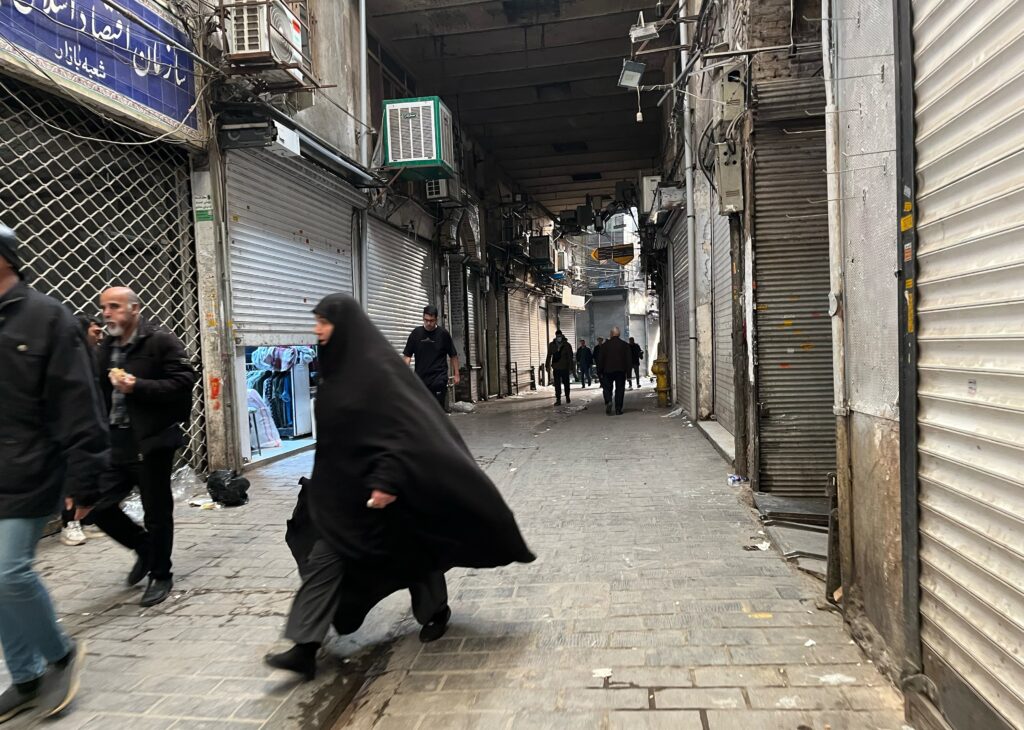
ISTANBUL — The Iranian government is struggling to contain protests that began late last month with merchants in Tehran that have now exploded into mass demonstrations and extended strikes in cities and towns across the country.
In the modest city of Abdanan, a large crowd went on the march Tuesday night, shouting for the death of Iran’s supreme leader, Ayatollah Ali Khamenei. In the major city of Mashhad on Wednesday night, people tore down an enormous flag bearing the Islamic Republic’s emblem and ripped it into shreds. And in a new and potentially portentous turn, many businesses have shut down their storefronts, bringing much of the country’s already ailing economy to a standstill.
Security forces have responded with violence in many instances, including killing protesters, raiding hospitals and arresting thousands, according to human rights groups. Estimates of the death toll range from at least 27 to 36 people, according to tallies by human rights groups. The Center for Human Rights in Iran said Tuesday that six children have been killed by security forces.
Some videos shared online have shown the security forces at times overwhelmed by the size of the gatherings. And despite the repression and official announcements of modest economic changes, including monthly payments worth $7 to households for purchasing basic food items, the protests appear to be gaining momentum.
“They haven’t accepted the legitimacy of even the most basic demands of this people, so now people are at the edge,” said Omid, 55, a carpet store owner in the capital, Tehran, in an interview on Wednesday. That day, security forces had countered protesters in the Tehran bazaar with tear gas, videos showed. As Omid spoke, he said four or five teenage girls were hiding in his store from security forces. Like other Iranians interviewed for this article, he spoke on the condition that he not be fully named for fear of government reprisal.
In Abdanan, a largely Kurdish city, videos showed security forces standing on a roof and looking down at the crowd, which chanted for their support. Some of the officers waved at the protesters, sparking cheers.
Sohrab, 50, a resident of the northern city of Rasht, said that there were protests at the city’s Shahrdari Square on Wednesday morning. Most shops were closed, and the scene was tense and chaotic, he said.
“A few minutes ago a plainclothes agent was beating a guy in his head and face in front of me,” he said Wednesday. “And then on another corner a group of them started running behind two young guys, but it was impossible to say what they were escaping from and what the forces were after. It is like random bits and pieces of violence here and there.”
Nazanin, 35, lives in Semnan, a city in north central Iran that has seen little unrest in the past, even during the widespread demonstrations in 2022. But this week, there was a small protest there, she said, with people chanting “Javid Shah,” or “Long live the King,” an expression of support for Iran’s deposed monarchy.
Iran’s exiled former crown prince, Reza Pahlavi, this week issued what he described as his first-ever call for Iranians to take to the streets, calling for them to protest by chanting either from their homes or on the streets, on Thursday and Friday evening. Nazanin said she was planning to heed Pahlavi’s call.
On Thursday, Nazanin said, at least a third of the businesses in Semnan were closed. And they were not alone. In western parts of the country, where the country’s Kurdish population is concentrated, businesses appeared to largely abide by a call by Kurdish political parties to shutter their businesses.
And people in Tehran, Rasht, and Mashhad — major Iranian cities in different parts of the country — said in interviews that the vast majority of shops in their areas were closed. Shops that were open included supermarkets, where Iranians were having trouble finding basic goods, especially cooking oil.
Some businesses posted winking, satirical statements announcing they were closed. “Since the weather is really good, we thought we should close up and go walk in the streets,” a jeweler in Mashhad said on Instagram. “We’ve stopped our sales until further notice.”
If the suspension of economic activity continues, it could prove significant. Large-scale closures of businesses have been largely absent from past rounds of protest in Iran in recent decades.
“Everyone is on a strike now,” said Amir, a food vendor in Karaj, near Tehran, on Wednesday. “The economy has collapsed. The bazaar has collapsed. One of my acquaintances in the bazaar said, ‘If they want to shoot and kill us, let them! We have had enough.’”
Iran’s government has repeatedly faced street protests, especially since 2017 — an average of one mass protest movement every two years. Each time, the authorities have managed to suppress the demonstrations through force, including mass arrests and killings.
Several Iranians interviewed by The Washington Post pointed to President Donald Trump’s public support for the protesters as adding to people’s motivation to resist. Trump has said the United States would intervene if Iranian authorities kill protesters, though it’s unclear what that intervention would look like.
Some Iranians on Thursday were reporting internet service disruptions, though there did not appear to be a mass shutdown. The government has throttled the internet in past rounds of unrest, trying to block information about developments from circulating.
In text messages, the government told some Iranians that according to “observation,” they had been in the vicinity of “an illegal gathering” and warned them not to do so again, according to screenshots of the messages shared with The Post.
Authorities have also been calling and threatening people who post messages in support of the protests on the social media accounts. One woman, a book blogger in her 30s with about 35,000 Instagram followers, said she received such a call last week after praising the bravery of Iranian protesters and urging solidarity. The caller identified himself as an intelligence officer and told her she had 30 minutes to remove her posts or she would face a criminal case.
“This time, all of those injustices that have been done to us have accumulated, and people are out on the street because of those injustices,” she said. “There is a lot more anger this time, and people are much more hopeful. The more it goes on, the more people are coming out.”
Other Iranians posted that they too had been threatened by the government over their statements.
“Don’t you all say ‘peaceful protest’? Don’t you all say ‘freedom of speech’?” another woman said on her public Instagram account this week, addressing authorities she said had threatened to open a case against her.
Ali Sharifi-Zarchi, a widely respected computer engineering professor at Iran’s elite Sharif University of Technology in Tehran, posted a simple, five-word message in Persian on his X account on Jan. 5: “Ali Khamenei’s not my leader.”
It was a startling statement in a country where criticizing Khamenei so directly has long been considered to be crossing a red line, even as Iranian presidents and other officials are often harshly attacked by their rivals and the media. Employment at a public university like Sharif, and indeed any prominent institution in Iran, is impossible for those considered to be firmly and openly opposed to the government. Sharifi-Zarchi did not immediately respond to an email requesting comment.
Outside Sharifi-Zarchi’s office door, the Basij, the state militia that often cracks down on protests, pasted images of his post, social media posts by Trump and a sign that read, “Speaking in the same voice as the enemy.” The group posted a picture of what they had done on its X account.
Sharifi-Zarchi, in turn, shared a screenshot of the Basij’s X post and wrote: “The enemies of the Iranian people are those who attack hospitals, deploy tear gas in the metro, and respond to unarmed protesters with live ammunition.”
On Thursday, he had a simpler message: “The victory of the Iranian people is near.”
The post Iranian protests and strikes escalate as state struggles to contain them appeared first on Washington Post.