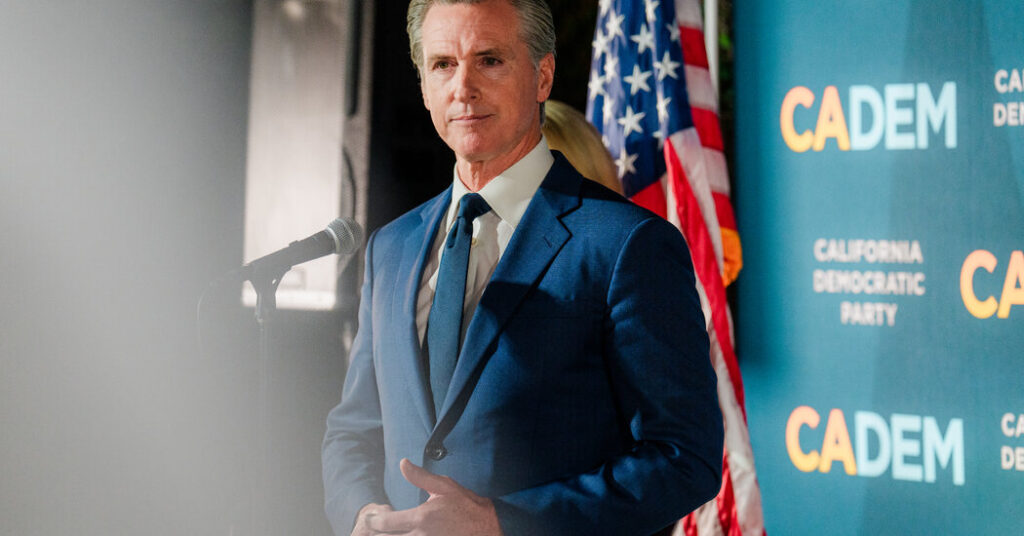
Gov. Gavin Newsom plans to use his final formal address to the California Legislature on Thursday to pitch his state — and his own leadership — as the true standard for democracy in America in sharp contrast with President Trump.
Mr. Newsom, who is entering his final year as governor, intends to deliver a speech with national implications in a California setting that closely resembles the State of the Union given at the U.S. Capitol each year, based on early excerpts provided by his office.
Officially, the State of the State address is Mr. Newsom’s platform for laying out his agenda for the year, a formal way of communicating his legislative and budget priorities to the lawmakers he must work with to achieve his goals. Unofficially, it is an opportunity for him to portray himself as a national leader for the Democratic Party and to define his legacy governing the nation’s most populous state in advance of an expected run for president in 2028.
In his address, the governor will describe his state as “a beacon” for the nation and the world and argue that Mr. Trump has abandoned democratic norms and sowed chaos.
In his two terms as governor, Mr. Newsom has generally tried to avoid giving formal speeches like the one he will deliver on Thursday to a joint session of the California Legislature. He does not like using teleprompters because he has dyslexia, and he has insisted in the past that he would rather speak to Californians around the state rather than in a legislative chamber.
But because of term limits, this is Mr. Newsom’s last opportunity to give the annual address to legislators, and there has never been more national interest in his agenda than there is now. The speech on Thursday will be his first State of the State address in the chamber of the Assembly, California’s equivalent to the House of Representatives, since 2020.
According to his office, Mr. Newsom will use his speech to directly attack Mr. Trump and “convey that California is a stable democracy, an economic engine with conscience and a functioning alternative to Donald Trump’s federal dysfunction.”
“In California, we are not silent,” he planned to say, according to an excerpt. “We are not hunkering down. We are not retreating. We are a beacon. This state is providing a different narrative. An operational model, a policy blueprint for others to follow.”
Convincing the nation that California is an example worth following will be a difficult sell. The state has the nation’s highest unemployment rate outside the District of Columbia, and costs for housing, electricity and gas in California are among the highest in the country. Communities in Los Angeles are still in the early stages of rebuilding after last year’s deadly fires that destroyed thousands of homes.
While Mr. Newsom is suggesting California is a state to be emulated, Republicans have routinely portrayed the state as the opposite, as an example of liberal values gone too far. And this week, President Trump told California and several other Democratic-led states that he would freeze funding for child care and cash assistance programs because he believed the states have allowed too much fraud.
Trump Administration: Live Updates
Updated
- Congress challenges Trump on vetoes, health, war and spending.
- U.S. trade deficit fell to lowest level since 2009, as tariffs reshape global trade.
- Trump withdraws the U.S. from more international organizations.
The states have disputed that characterization and vowed to respond with litigation, though Mr. Newsom also told MS Now on Monday that he “can’t stand fraud” and would work with Trump officials to stop it if they identify it.
On Thursday, Mr. Newsom plans to stand on his record to outline his vision for California — and, by extension, America: raising wages for the working class; combating climate change by advancing clean energy; lowering the cost of housing, health care and energy.
“Affordability,” he plans to say, is “not a word we just discovered. And it’s certainly not a hoax.”
Homelessness is still pervasive in California, but Mr. Newsom plans to embrace his efforts addressing it by saying the number of unsheltered people in the state is on the decline, while suggesting that some local officials are dragging their feet.
Mr. Trump’s two terms have served as bookends on Mr. Newsom’s eight years as governor, providing a convenient foil at key points in the governor’s political career. In 2018, Mr. Newsom ran for office as a leader of the Democratic resistance, with ads depicting a cartoon President Trump, with bushy eyebrows and tiny hands, scampering across the country to try to stop the “bold, progressive future” that Mr. Newsom promised for California. On Thursday, the governor expanded the map, casting himself as a defender of American values.
The speech signals a return to tradition for a governor who has largely eschewed it. California governors since the mid-20th century have delivered a State of the State speech to lawmakers in the State Capitol as a way to set the agenda at the start of every year.
Instead, Mr. Newsom has mostly released addresses on video, announced policy proposals while visiting cities around the state, and once spoke via livestream video at an empty Dodgers Stadium during the Covid-19 pandemic.
And last year, the State of the State was such an afterthought that the governor sent it to lawmakers as a letter — in the final week of the legislative session.
Should Mr. Newsom run for president, he would be better off focusing on a message about the future of the country, not his record leading California, said Matt Bennett, a Democratic strategist who worked on presidential campaigns for two former governors.
He recalled working with former Gov. Michael Dukakis of Massachusetts on the 1988 campaign that highlighted his state accomplishments to win the Democratic presidential primary. But Mr. Dukakis then lost the general election to George H.W. Bush.
Four years later, Bill Clinton defeated Mr. Bush afterdrawing very little on his experience as the governor of Arkansas, said Mr. Bennett, who also worked on that 1992 campaign. Instead, Mr. Clinton focused on a centrist vision for the Democratic Party.
A presidential campaign may test whether Mr. Newsom can be authentic about his deep roots in California while honing a message that goes beyond his work in the state.
“Nobody cares about his legacy,” he said. “When it comes to voters in South Carolina, that is not what concerns them. What they’re going to be wondering is, does he have a vision of the future that seems realistic, and am I a part of it?”
Laurel Rosenhall is a Sacramento-based reporter covering California politics and government for The Times.
The post In Address, Newsom to Highlight His Leadership and Contrast Himself to Trump appeared first on New York Times.