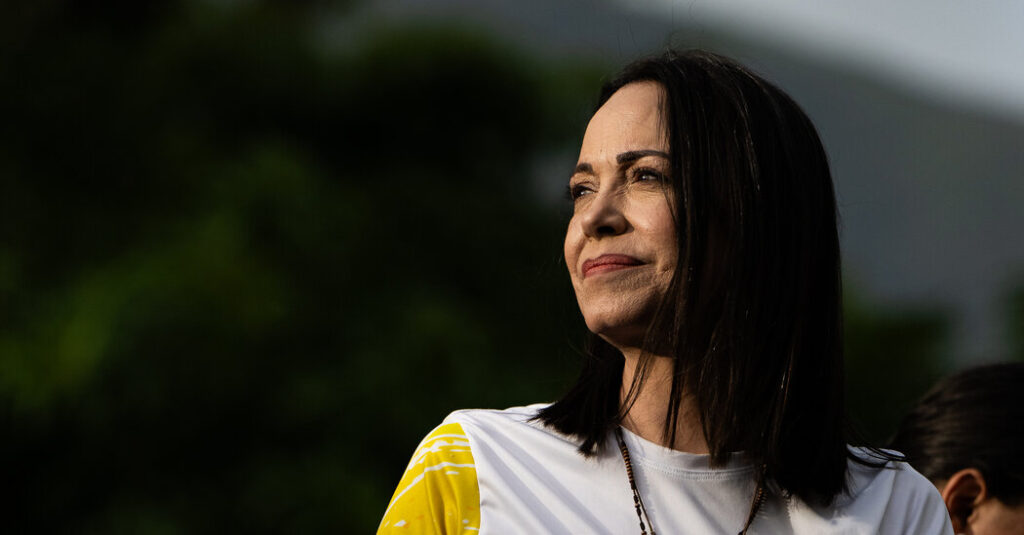
For more than a year, most Venezuela observers assumed that if Nicolás Maduro lost power, the country’s charismatic opposition leader, María Corina Machado, would lead a transition to democracy.
That expectation all but disappeared on Saturday with a few words from the American president. Just hours after announcing that Mr. Maduro had been captured in an extraordinary military raid by U.S. forces, President Trump stunned many by declaring that Washington would instead work with Mr. Maduro’s vice president, Delcy Rodríguez, saying that Ms. Machado lacked “support within or the respect within” Venezuela to lead.
At one level, Mr. Trump’s statement is simply wrong. Ms. Machado, who was awarded the Nobel Peace Prize in 2025 for her fight to restore democracy, is, by far, the country’s most popular politician. In 2024 she led an electrifying campaign against Mr. Maduro. (She was barred from running.) When electoral authorities declared Mr. Maduro the winner, she announced that tally sheets collected by opposition activists from more than 83 percent of polling stations showed that her candidate, Edmundo González, had won decisively.
If Venezuela were a democracy, then Ms. Machado’s party would be in power. But Venezuela is not a democracy, nor will it become one overnight simply because Mr. Maduro is no longer around. When the Trump administration made the decision to carry out a surgical operation to extract Mr. Maduro instead of occupying the country, it also chose, at least in the short term, to work with a state structure designed and run by supporters of Mr. Maduro and his predecessor Hugo Chávez. Ms. Machado, who describes that structure as a mafia, is simply not a figure who can coexist with those institutions.
Over the past year, Ms. Machado has gone out of her way to court Mr. Trump, going as far as dedicating her Nobel Prize to him and echoing debunked claims that Venezuela played a role in the outcome of the 2020 U.S. presidential election. Her failure to condemn the deportations of Venezuelans and what many consider extrajudicial executions in the Caribbean was seen by many as an uncomfortable yet necessary compromise to bring about change in her country. Yet such Faustian bargains rarely end well, and this was no exception.
Shortly before Mr. Trump’s declaration about working with Ms. Rodriguez, Ms. Machado issued a statement calling on the armed forces to recognize the presidency of Mr. González. Though the Biden administration initially recognized him as the country’s president-elect, the U.S. secretary of state, Marco Rubio, this week deflected questions about whether Mr. González was the country’s legitimate leader, and Ms. Rodríguez was sworn in as interim president.
There may, of course, be other reasons Mr. Trump has not warmed to Ms. Machado, including the fact that she was awarded the Nobel Prize that he thought should have been given to him. (He has said that was unrelated to his decision to back Ms. Rodríguez.) That would not be unexpected from a president who often puts personal relationships and rivalries ahead of policy. Yet even if any of those reasons helped explain his decision, they do not alter a basic fact: Once Washington chose to work with the institutions of Chavismo rather than to dismantle them, Ms. Machado ceased to be a viable choice to run the country.
For years, Ms. Machado has cultivated the image of a hard-liner who was unwilling to reach deals with Venezuela’s governing elite. Presenting the country’s political divide between the Chavistas and their opponents as a moral battle has been her central message throughout her remarkable political rise. “This is a spiritual fight between good and evil,” she told supporters after the 2024 election, “and God is on our side.”
Rejecting dialogue and compromise became a defining characteristic of Ms. Machado’s political identity. Whenever the opposition entered talks with Mr. Maduro, she denounced the initiatives as attempts to help the regime by allowing it to gain time and undermine opponents. She promoted election boycotts, claiming that elections organized by him were designed only to legitimize his dictatorial rule. After several dozen countries recognized the opposition legislator Juan Guaidó as interim president in 2019, she condemned him for not using his constitutional authority to formally request foreign military intervention to restore law and order.
As Venezuelans grew increasingly disenchanted with every political leader who had promised — and failed — to remove Mr. Maduro from office, many gravitated toward Ms. Machado, who claimed that he remained in power because of the lack of resolve and determination of opposition leaders. His brazen electoral fraud and the ensuing crackdown on dissent only vindicated her claim that the regime would never relinquish power through negotiation alone.
Even if Mr. Trump had tried to overhaul Venezuela’s governing system and allowed her party to take power, Ms. Machado still might not have been the right leader. Her rejection of compromise with moderate members of the opposition would be a particular obstacle because that group tends to play a crucial role in transitions to democracy.
A page from Venezuela’s history illustrates the danger of believing that a democratic transition can be built solely on popular support. In 1945 the Democratic Action Party was able to seize power from a military dictatorship, with the backing of pro-democracy military commanders. It convened elections, which it won with more than 70 percent of the vote, but proved unable to forge a stable coalition capable of offering guarantees to the military establishment. That government was overthrown in 1948, ushering in a decade of military rule.
Ms. Machado often talks about Venezuela as having lived under authoritarian rule for the past quarter-century. That is not entirely correct. Although Mr. Chávez was rightfully criticized for undermining democratic institutions, he was also highly popular during his time in office and built a lasting political movement that still has significant support. Ms. Machado’s own history isn’t one of steadfast defense of democratic principles. She has been accused of backing a 2002 coup attempt against Mr. Chávez, who was elected in a free and fair election. She denies backing the coup.
In choosing to work with existing power structures rather than embark on an open-ended state-building project, the Trump administration has acknowledged a basic reality: Chavismo cannot simply be wished away. Where Mr. Trump has gone wrong is in ignoring the idea that Venezuela needs meaningful democratic reforms to move forward.
Mr. Trump’s decision to partly justify intervention on the claim that Venezuela stole U.S. oil assets has only deepened mistrust of Washington among many Venezuelans. If the United States is to play a role in helping Venezuelans build their future, it must begin by showing basic respect for their fundamental rights, including not only their political and human rights but also their ownership of their nation’s natural resources.
While popular support is a crucial determinant of who should have a seat at the table, it cannot be the only one. Centrist political forces, civil society, business and labor also need to be there. Their support will be essential to stabilizing Venezuela.
The sidelining of Ms. Machado by the Trump administration should prompt deep reflection among Venezuela’s opposition forces. It is one thing to mobilize voters; it is quite another to enable meaningful and peaceful transformation. Her message gained traction precisely because it promised drastic change in a country ravaged by a deep economic and social crisis. But while that brand of politics may be effective in gaining popular support, it is far more dangerous when it comes to creating a durable governing coalition.
More than a quarter-century ago, a majority of Venezuelans became enamored with a young, charismatic leader who promised radical change and drew a stark line between the corruption of the past and a bright future. Yet in defining politics as moral absolutism, that leader, Mr. Chávez, created a trap from which the country has not been able to escape. The way is not to try to replace one moral absolutism with another.
Francisco Rodríguez is a senior research fellow at the Center for Economic and Policy Research and a professor of international and public affairs at the University of Denver’s Josef Korbel School of International Studies.
The Times is committed to publishing a diversity of letters to the editor. We’d like to hear what you think about this or any of our articles. Here are some tips. And here’s our email: [email protected].
Follow the New York Times Opinion section on Facebook, Instagram, TikTok, Bluesky, WhatsApp and Threads.
The post How Machado Lost Her Chance to Lead Venezuela appeared first on New York Times.