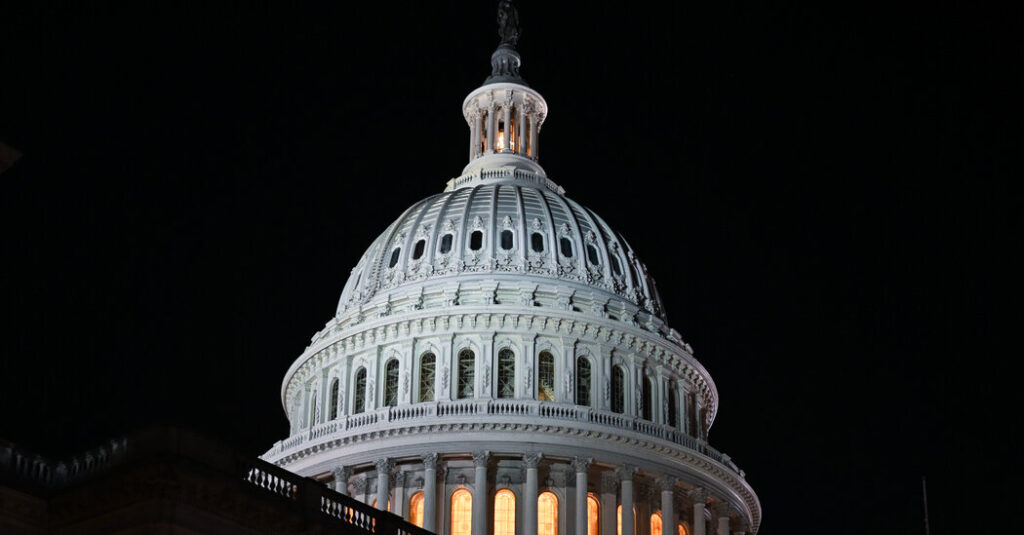
The House on Thursday overwhelmingly passed legislation to reject steep cuts requested by President Trump and fund parts of the government including the Justice and Commerce Departments, in a bipartisan breakthrough before a Jan. 30 spending deadline.
Action on the roughly $180 billion package signaled progress toward a broader agreement that could avoid the kind of bitter spending fight last fall that prompted the longest government shutdown in the nation’s history.
The vote was 397 to 28, with 22 Republicans and 6 Democrats opposed.
The package still must pass the Senate before it can be sent to Mr. Trump, but it appeared to be on track for enactment. White House officials said in a statement of administration policy on Wednesday that he would sign the legislation.
At the same time, lawmakers are racing to finalize six additional spending bills to ensure the government does not shut down at the end of January. Those remaining measures — which include funding the Homeland Security and Health and Human Services Departments — are considered some of the most difficult to reach bipartisan consensus on.
In the legislative package that lawmakers unveiled this week, appropriators rejected the steep cuts that Mr. Trump’s budget had put forward earlier this year, and instead proposed slight trims or spending freezes to the budgets of several agencies, and slight increases in others. Rather than acquiescing to Mr. Trump’s request to cut funding for the National Science Foundation by 57 percent, for example, lawmakers held its budget flat.
“The Appropriations Committee has long sought to operate in a bipartisan and collaborative manner, and with today’s package, we fulfill that longstanding commitment,” said Representative Tom Cole, Republican of Oklahoma and the chairman of the Appropriations Committee. “The end result is a reminder for us all that consensus — not partisan obstruction — is not only possible, it is preferable.”
Conservatives who would have preferred steeper spending cuts said they were appeased by the fact that the bills represented a return to regular order: the practice of writing and passing individual spending bills, rather than lumping all 12 funding bills together into a behemoth package, or enacting a stopgap, emergency funding measure to keep funding flat.
Trump Administration: Live Updates
Updated
- Democratic lawmakers ask for an investigation of the Middle East envoy Steve Witkoff.
- Prosecutors said to pursue new investigation of Letitia James.
- Congress challenges Trump on vetoes, health, war and spending.
The legislative package contains a slew of earmarks requested by both Democrats and Republicans for projects in their communities. That drew objections from some conservative House Republicans, who have long opposed the practice of lawmakers’ inserting funding for individual projects into spending bills, deeming it an inappropriate use of federal funds.
“Earmarks are the currency of corruption, and they’re coming back in full force in these products,” Representative Chip Roy, Republican of Texas, said.
He successfully killed an earmark requested by Representative Ilhan Omar, Democrat of Minnesota, that would have provided $1 million in funding to a Somali-led nonprofit organization that described itself as “dedicated to creating a better, safer and more connected community for individuals experiencing drug addiction” in the East African community in the Twin Cities.
Democrats said the compromise bills, which did not include any partisan policy dictates offered by Republicans, would create stricter spending guardrails for the Trump administration to follow than if they had adopted a stopgap funding bill.
“I understand there may be some of my Democratic colleagues who are apprehensive about providing any funding for this administration — an administration that has abused its authority time and time again, while thumbing its nose at Congress and the rule of law,” said Representative Rosa DeLauro of Connecticut, the top Democrat on the Appropriations Committee. “But abandoning the regular order appropriations process does nothing to rein in this administration. All it does is forfeit our ability to fight for the priorities that are important to us, to our constituents and to the American people.”
The bill also includes language written by senators that would require a number of agencies that were decimated by the Department of Government Efficiency, such as the National Park Service and the National Weather Service, to “maintain staffing levels” in order to “fulfill the mission” of the agencies.
Some Democrats had pressed Republicans to include narrower language, but Republicans argued that mandating a certain head count of employees was overly prescriptive.
“The reason that we had tougher language was because we don’t want to give this discretion to the Office of Management and Budget, which clearly has made the judgment that the National Weather Service has too many human beings working at the National Weather Service,” Senator Brian Schatz, Democrat of Hawaii and an appropriator, said at a hearing considering his chamber’s version of the legislation last year.
Catie Edmondson covers Congress for The Times.
The post House Passes Spending Package Before Another Shutdown Deadline appeared first on New York Times.